Supply and Operations Essentials
Introduction to Supply Chain Management
What Is a Supply Chain?
Think about your favorite t-shirt. It didn't just appear in the store. It started as cotton in a field, was spun into thread, woven into fabric, cut and sewn, and then shipped across roads and seas to reach you. That entire journey, from raw material to finished product in your hands, is a supply chain.
A supply chain is the network of all the individuals, organizations, resources, activities, and technology involved in the creation and sale of a product. Supply Chain Management (SCM) is the art and science of managing this flow. The goal is to coordinate all the different parts of the chain to work together seamlessly.
Supply Chain Management spans all movement and storage of raw materials, work-in-process inventory, and finished goods from point of origin to point of consumption.
The Core Components
Every supply chain, whether simple or complex, involves a few key functions working in harmony. Think of them as different players on the same team, each with a specific role.
Procurement: This is the starting point. Procurement involves finding and sourcing the raw materials and components needed to make a product. For our t-shirt, this means a company buying raw cotton from farmers.
Production: Also known as manufacturing, this is the process of transforming raw materials into a finished product. It’s where the cotton is turned into fabric, which is then cut and stitched into a t-shirt.
Distribution and Logistics: Once the t-shirt is made, it needs to get to the customer. This involves warehousing (storing the product), inventory management (keeping track of how many shirts are available), and transportation (moving the shirts from the factory to a warehouse, then to a store).
logistics
noun
The detailed coordination of a complex operation involving many people, facilities, or supplies. In SCM, it specifically refers to the movement and storage of goods.
These components come together to form a supply chain network. Simple networks might connect a few local businesses, while complex ones can span the entire globe, like the one for a modern laptop.
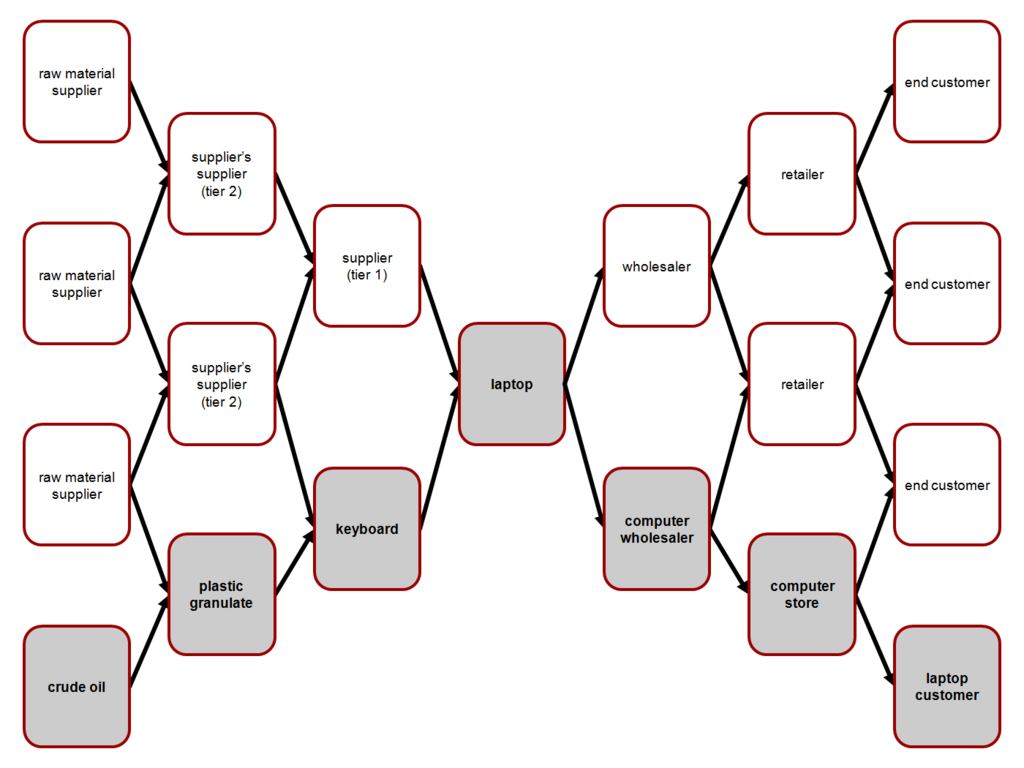
Why Integration Matters
Imagine if the t-shirt factory produced 10,000 shirts, but the logistics team only had trucks to ship 5,000. Or what if the procurement team bought scratchy, low-quality cotton? The final product would suffer, costs would rise, and customers would be unhappy.
This is why integration is the most important concept in SCM. It’s the practice of ensuring all components and partners in the supply chain are in constant communication, sharing information and coordinating their efforts.
When a supply chain is well-integrated, inventory is minimized, waste is reduced, and products get to customers faster. It creates a system that is efficient, responsive, and profitable.
The structure of these networks can vary widely. Some are straightforward, while others are incredibly intricate.
| Simple Supply Chain (Local Bakery) | Complex Supply Chain (Smartphone) | |
|---|---|---|
| Suppliers | Local farm for flour and eggs | Dozens of global suppliers for chips, screens, batteries |
| Production | One baker in one kitchen | Multiple factories in different countries |
| Distribution | Customers buy directly from the store | Global network of warehouses, cargo ships, and delivery services |
| Coordination | Simple and direct | Requires advanced technology and constant communication |
Now that you have a handle on the basics, let's test your knowledge.
What is the best definition of a supply chain?
A smartphone company contracts with a factory to assemble its new model. This assembly process is part of which key supply chain function?
Understanding these foundational ideas—the flow of goods, the core components, and the need for integration—is the first step to seeing how modern business works. Every product you use is the result of a supply chain working behind the scenes.