Supervised Machine Learning Deep Dive
Introduction to Machine Learning
What is Machine Learning?
Machine learning teaches computers to learn from data. Instead of writing a long list of explicit rules for every possible situation, we let the machine figure out the rules for itself by looking at examples. It's a bit like how we learn. A child learns to recognize a dog not by memorizing a definition, but by seeing many different dogs and being told, "That's a dog."
Machine learning is the process of teaching a computer to make predictions or decisions based on patterns in data, rather than being explicitly programmed for the task.
This ability is more than just a neat trick. It's the engine behind many tools we use every day. When a streaming service recommends a movie you might like, or your email client filters out junk mail, that's machine learning at work. It excels at tasks that are too complex or change too often to be solved with traditional programming.
Three Ways Machines Learn
Just as people have different learning styles, machines can learn in a few different ways. The method we choose depends on the problem we're trying to solve and the kind of data we have. The three main types are supervised, unsupervised, and reinforcement learning.
Supervised Learning
noun
A type of machine learning where the model learns from data that is labeled with the correct answers.
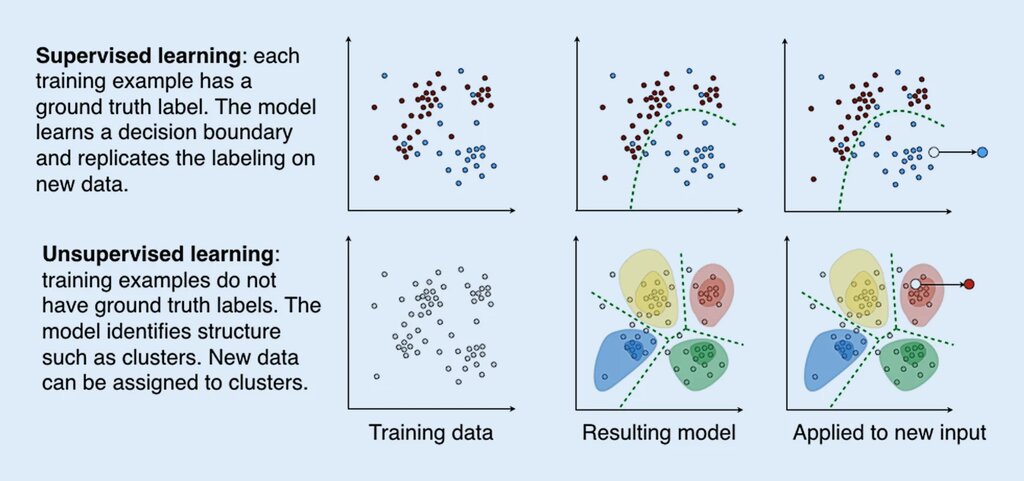
Supervised learning is like studying with a set of flashcards. Each card has a question (the input) and the correct answer (the output). The goal is to learn the relationship between them so well that you can answer new questions you've never seen before.
In machine learning, this means we feed the computer a dataset where each example is "labeled" with the right answer. For instance, to build a spam filter, we would provide thousands of emails, each labeled as either "spam" or "not spam." The model learns the patterns associated with each label.
Unsupervised Learning
noun
A type of machine learning where the model works on its own to discover patterns and information in unlabeled data.
Unsupervised learning is the opposite. Here, the machine is given a dataset with no labels or correct answers. Its job is to explore the data and find any hidden structures or patterns on its own. It’s like being given a box of mixed Lego bricks and asked to sort them into piles without any instructions.
This approach is useful for tasks like grouping customers into different segments based on their purchasing habits, or identifying unusual activity in a computer network that might signal a security threat.
Reinforcement Learning
noun
A type of machine learning where an agent learns to make decisions by taking actions in an environment to maximize a cumulative reward.
Reinforcement learning works like training a pet with treats. A software "agent" learns by performing actions and getting feedback in the form of rewards or penalties. The goal is to learn the best series of actions—a strategy—that earns the most rewards over time.
This method is powerful for teaching machines to master complex games like chess or Go, where the optimal move isn't always obvious. It's also used in robotics, where a robot can learn to walk or manipulate objects through trial and error.
How Models Are Trained
No matter which learning style we use, the core process involves training and evaluation. First, we need data. Lots of it.
During training, the machine learning model processes this data and tries to find patterns. It's essentially making a guess, checking how wrong it is, and then adjusting its internal logic to make a better guess next time. This process is repeated thousands or even millions of times, with the model gradually getting more accurate.
The training process is an iterative cycle: predict, measure error, and adjust.
Once training is done, we need to know how well the model actually learned. This is the evaluation phase. We test the model on a separate set of data it has never seen before. This is crucial. A model that simply memorized the training data won't be useful for making predictions on new, real-world information.
If the model performs well on this new data, it's ready to be used. If not, we might need to adjust our approach, provide more data, or try a different kind of model. This cycle of training and evaluation is fundamental to building effective machine learning systems.
What is the primary difference between machine learning and traditional programming?
An e-commerce company wants to group its customers into different segments based on their purchase history, without any pre-existing labels for these groups. Which type of machine learning is best suited for this task?