Supervised Learning for Business Leaders
Supervised Learning Overview
Learning with an Answer Key
Think of supervised learning as training an AI with flashcards. Each card has a question on one side and the correct answer on the back. You show the AI the question (the input data), it makes a guess, and then you show it the answer (the label). After going through thousands of these flashcards, the AI starts to learn the patterns and can eventually answer new questions it has never seen before.
In business terms, supervised learning uses historical data where you already know the outcomes to make predictions about the future.
For example, you could feed a model thousands of past loan applications. Each application is labeled as either "defaulted" or "paid in full." The model learns the characteristics associated with each outcome. When a new application comes in, the model can predict the likelihood of that person defaulting on their loan. The "supervision" comes from the fact that we are teaching the model with labeled, correct answers from the past.
The Three Flavors of Machine Learning
Supervised learning is the most common type of machine learning, but it's not the only one. It's helpful to understand how it differs from its counterparts: unsupervised and reinforcement learning.
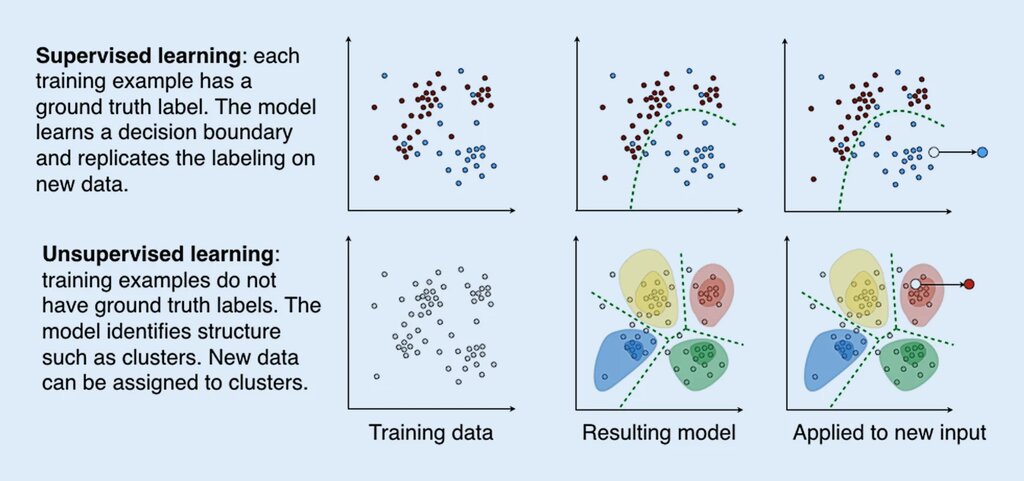
Each approach learns differently and is suited for different kinds of problems.
| Type | How it Learns | Business Example |
|---|---|---|
| Supervised | From labeled data (like flashcards with answers) | Predicting if an email is spam or not. |
| Unsupervised | By finding patterns in unlabeled data | Grouping customers into different segments based on purchasing behavior. |
| Reinforcement | Through trial and error (rewards and punishments) | Training an AI to optimize stock trading strategies. |
Putting Supervised Learning to Work
The core value of supervised learning in business is its predictive power. It excels at answering specific, outcome-oriented questions by learning from the past. This makes it a powerful tool for data-driven decision-making.
Common applications include:
- Sales Forecasting: Predicting future sales volume based on past sales data, marketing spend, and economic indicators.
- Customer Churn: Identifying customers who are likely to cancel their subscriptions based on their usage patterns and support history.
- Credit Scoring: Assessing the risk of lending to a potential borrower.
- Image Classification: Identifying objects in images, such as flagging defective products on an assembly line.
In each case, the model is trained on a dataset where the correct answer is already known. This historical data becomes the foundation for making accurate predictions about new, unseen data, allowing businesses to anticipate trends, mitigate risks, and seize opportunities.
Now, let's test your understanding of these core concepts.
What is the key characteristic that defines supervised machine learning?
In the analogy of training an AI with flashcards, what does the 'answer on the back of the card' represent?
By understanding the fundamentals of supervised learning, you can begin to see how historical data can be transformed into a strategic asset for your business.