Supervised Learning for Business
Introduction to Supervised Learning
Learning with a Teacher
Imagine teaching a toddler to recognize different fruits. You show them an apple and say, "This is an apple." You show them a banana and say, "This is a banana." After seeing many examples with clear labels, the child learns to identify a fruit they've never seen before.
This is the core idea behind supervised learning. It's a type of machine learning where we act as the teacher for a computer model. We feed it a dataset full of examples where the correct answer is already known. The model's job is to learn the underlying patterns that connect the examples to their answers.
In supervised learning, the algorithm learns from a dataset that has been “labeled” with the right answers.
The quality of these labels is everything. If you tell the toddler that a banana is an apple, they'll learn incorrectly. Similarly, a supervised learning model is only as good as the labeled data it's trained on. This data acts as the ground truth, guiding the model as it learns to make accurate predictions.
Supervised vs. Unsupervised
The main difference between supervised learning and its counterpart, unsupervised learning, comes down to one thing: labels.
As we've seen, supervised learning uses labeled data. It has a clear goal, like predicting a price or classifying an email. The 'supervisor' provides the correct answers for the model to learn from.
Unsupervised learning is different. It works with unlabeled data. There's no teacher providing the right answers. Instead, the model's task is to find hidden structures and patterns on its own. Think of it like giving someone a box of mixed fruits and asking them to sort them into groups based on similarity. They might group by color, size, or shape, discovering the categories for themselves.
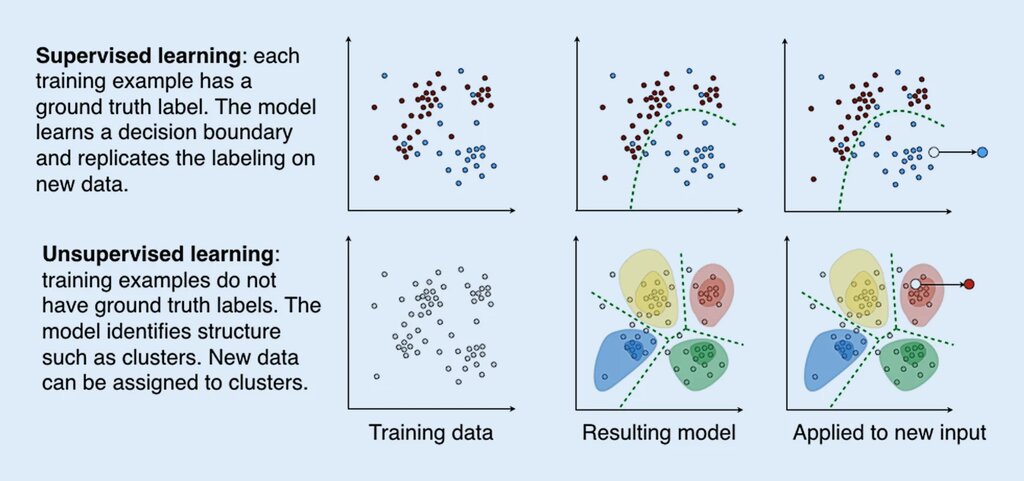
Both approaches are powerful, but they solve different kinds of problems. When you have a specific outcome to predict and a history of data with that outcome, supervised learning is the way to go.
Two Main Tasks
Supervised learning problems generally fall into two categories: classification and regression.
Classification predicts a category or a class. The output is a distinct label.
Regression predicts a continuous number. The output is a quantity.
A classic example of classification is an email spam filter. The model analyzes an incoming email and assigns it to one of two categories: 'spam' or 'not spam.' Other business uses include detecting fraudulent transactions ('fraud' or 'not fraud') or classifying customer support tickets ('billing,' 'technical issue,' 'general inquiry').
A common regression task is predicting a house price. The model looks at features like square footage, number of bedrooms, and location to estimate a specific dollar amount. Businesses use regression to forecast future sales, predict customer lifetime value, or estimate the demand for a new product.
What is the most crucial element required to train a supervised learning model?
A supervised learning model is only as good as the labeled data it's trained on.
These fundamental concepts form the basis for many powerful applications in the world of data.