Supervised and Statistical Learning Theory
Introduction to Supervised Learning
Learning with an Answer Key
Imagine teaching a toddler to identify different animals. You might show them a picture of a cat and say, "cat." Then a picture of a dog, and say, "dog." After seeing many examples with the correct labels, the child starts to learn the patterns and can eventually identify a new picture of a cat on their own. This is the core idea behind supervised learning.
Supervised learning is like teaching a kid using flashcards.
In machine learning, this process involves feeding an algorithm a dataset where all the data points are already labeled with the correct output. The goal is for the model to learn the relationship between the inputs (the pictures of animals) and the outputs (the labels like "cat" or "dog"). It's called "supervised" because the learning process is supervised by the labeled data, which acts like a teacher or an answer key.
Prediction Goals
Supervised learning models are typically used for two main types of prediction tasks: classification and regression.
Classification is about predicting a category. The output is a discrete label, not a number you can measure on a scale. Think of it as sorting items into predefined bins.
- Is this email spam or not spam?
- Will a customer click on this ad or not?
- What is the breed of this dog: a beagle, a poodle, or a bulldog?
Regression, on the other hand, is about predicting a continuous value, like a number. The output can be any value within a range.
- What will the temperature be tomorrow?
- What is the price of a house with three bedrooms and two bathrooms?
- How many minutes until the next bus arrives?
| Task | Goal | Example Output |
|---|---|---|
| Classification | Predict a category | Spam, Not Spam |
| Regression | Predict a number | $120,500 |
The Importance of Labeled Data
The entire process hinges on having high-quality labeled data. Without labels, the model has no way to check its work and learn from its mistakes. If you show it pictures of cats but label them all as "dog," it will learn the wrong patterns. The quality and quantity of the labeled data directly impact how well the model can learn and make accurate predictions.
Creating these datasets can be a major undertaking. It often involves human experts—called annotators—who manually label each piece of data. This process, known as data annotation or data labeling, is a crucial first step in any supervised learning project.
How Models Learn
Developing a supervised learning model involves splitting the labeled data into two main parts: a training set and a testing set. This separation is critical to ensure the model can generalize to new, unseen data.
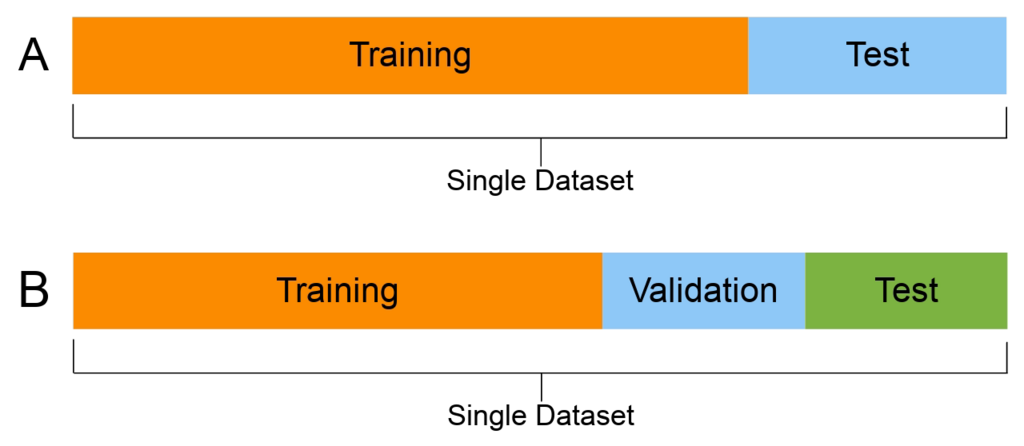
The training phase is where the learning happens. The model is shown the training data—both the inputs and their correct labels—over and over again. During this process, the algorithm adjusts its internal logic to find patterns that map the inputs to the correct outputs. It's trying to build a general rule from the specific examples it sees.
Once the model is trained, it's time for the testing phase. The model is given the test dataset, which it has never seen before. It makes predictions for each input in the test set, and we compare its predictions to the actual labels. This tells us how well the model performs on new data. A successful model is one that makes accurate predictions on the test set, proving it didn't just memorize the training data but learned the underlying patterns.
What is the most crucial element required to begin training a supervised learning model?
Which of the following problems would be solved using regression?
Let's recap what we've covered about the fundamentals of supervised learning.