Superparamagnetism Explained
Introduction to Magnetism
What Makes a Magnet?
Magnetism is a fundamental force of nature, like gravity or electricity. You can't see it, but you can definitely see its effects. The most familiar example is a refrigerator magnet, which sticks to the door through an invisible force. This force operates within a region called a magnetic field.
A magnetic field is an area around a magnet or a moving electric charge where a magnetic force can be felt.
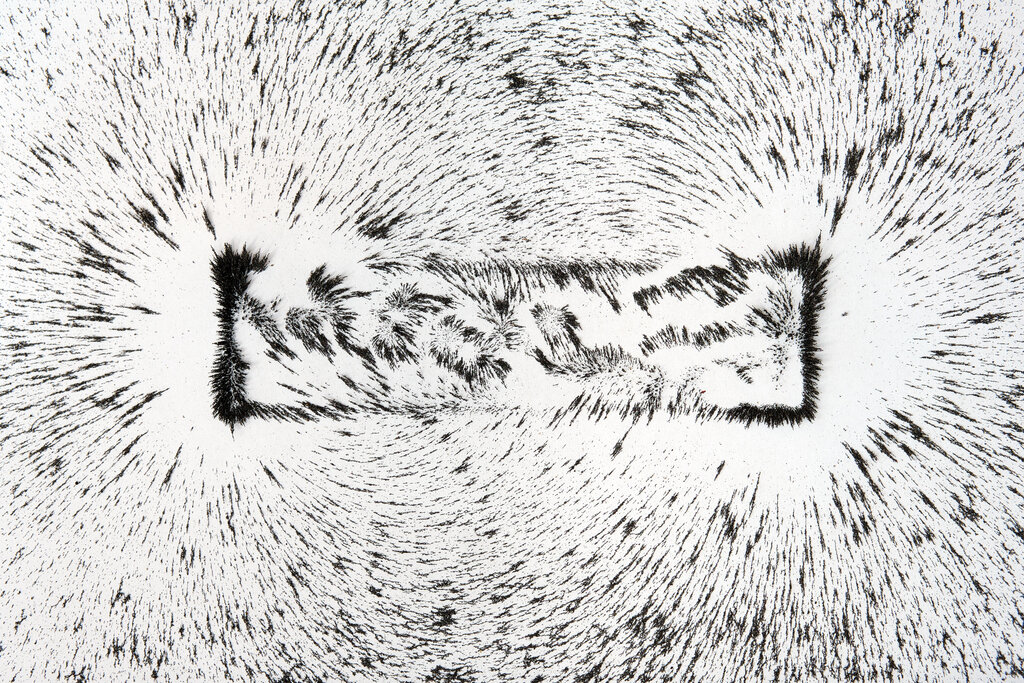
The lines formed by the iron filings trace the magnetic field. They show the direction and strength of the force. Where the lines are densest, at the ends of the magnet, the field is strongest. These ends are called the north and south poles.
But what creates this field? At the most basic level, magnetism is caused by moving electric charges. Even on the atomic scale, the electrons buzzing around an atom's nucleus act like tiny currents, generating their own microscopic magnetic fields. This inherent magnetic property of an atom or particle is called its magnetic moment.
Magnetic Moment
noun
A measure of an object's tendency to align with a magnetic field. It's a vector quantity, meaning it has both strength and direction.
In most materials, the magnetic moments of individual atoms point in random directions. They all cancel each other out, so the material as a whole isn't magnetic. However, when an external magnetic field is applied, these tiny atomic magnets can respond in different ways.
Three Types of Magnetism
How a material behaves in a magnetic field depends on the collective behavior of its atomic magnetic moments. We can group materials into three main categories based on their magnetic response: diamagnetic, paramagnetic, and ferromagnetic.
| Type | Response to Magnet | Strength | Example |
|---|---|---|---|
| Diamagnetic | Weakly repelled | Very Weak | Water, Copper |
| Paramagnetic | Weakly attracted | Weak | Aluminum, Oxygen |
| Ferromagnetic | Strongly attracted | Strong | Iron, Nickel |
Let's look at each of these in more detail.
Repulsion and Attraction
Diamagnetism is a property of all matter, but it's very weak. When a diamagnetic material like water or copper is placed in a magnetic field, it creates a weak magnetic field in the opposite direction. This results in a slight repulsion. It's usually too weak to notice without sensitive instruments. A famous example is the levitation of a frog in a very strong magnetic field; the water in the frog's body is diamagnetic and repels the magnet.
Paramagnetism occurs in materials with unpaired electrons, like aluminum or liquid oxygen. The magnetic moments of these atoms are randomly oriented. When an external magnetic field is applied, these moments tend to align with the field, causing a weak attraction. Once the external field is removed, the moments go back to their random arrangement, and the material loses its magnetism.
Think of it this way: paramagnetic atoms are like tiny compass needles that are free to spin. An external field makes them all point in the same direction, but without it, they point every which way.
Ferromagnetism is what most people think of as magnetism. It's the strong attraction we see in materials like iron, nickel, and cobalt. In these materials, the magnetic moments of adjacent atoms naturally align with each other, even without an external field. They form large regions called magnetic domains, where all the moments are locked in the same direction.
When you bring a strong magnet near a piece of iron, the domains that are aligned with the external field grow larger, while others shrink. If the field is strong enough, all the domains can align, turning the iron into a magnet itself. This alignment can persist even after the external field is removed, which is how permanent magnets are made.
Understanding these fundamental types of magnetism is the first step toward exploring the vast and powerful ways this force shapes our world, from data storage to medical imaging.