Superconductors Power Quantum Computers
Introduction to Superconductivity
The Resistance-Free World
Imagine electricity flowing without losing any energy. No heat, no waste, just a perfect, effortless current. This isn't science fiction; it's a real phenomenon called superconductivity. It's a state where certain materials, when cooled to extremely low temperatures, conduct electricity with absolutely zero resistance.
In a normal conductor like a copper wire, electrons bump into atoms as they flow, creating resistance and losing energy as heat. In a superconductor, this resistance vanishes completely.
An Accidental Discovery
The story of superconductivity begins in 1911 in a lab in Leiden, Netherlands. A Dutch physicist named Heike Kamerlingh Onnes was studying the properties of materials at temperatures colder than anywhere on Earth. He had recently figured out how to liquefy helium, which allowed him to reach a frigid 4.2 Kelvin, just a few degrees above absolute zero.
He decided to see what would happen to the electrical resistance of pure mercury at this temperature. As he cooled the mercury, its resistance dropped steadily, just as expected. But then, at 4.2 K, something astonishing happened. The resistance suddenly disappeared. Completely. The instruments read zero. Onnes had discovered superconductivity.
Critical Temperature
noun
The specific temperature at which a material transitions from a normal state to a superconducting state.
This transition temperature is unique to each material and is denoted as . Above its , the material behaves like a regular conductor. Below it, it becomes a superconductor.
More Than a Perfect Conductor
For years, scientists thought superconductivity was simply a case of perfect electrical conduction. But in 1933, Walther Meissner and Robert Ochsenfeld discovered another bizarre property that sets superconductors apart.
They found that when a material becomes superconducting, it actively expels all magnetic fields from its interior. This phenomenon is now known as the Meissner effect. It’s not just that magnetic fields can’t enter; any field that was already inside is pushed out.
A hypothetical "perfect conductor" would trap any existing magnetic fields inside it when cooled. A superconductor, by contrast, expels them. This is a fundamental difference.
This magnetic field expulsion is what allows for one of the most famous demonstrations of quantum mechanics: magnetic levitation.
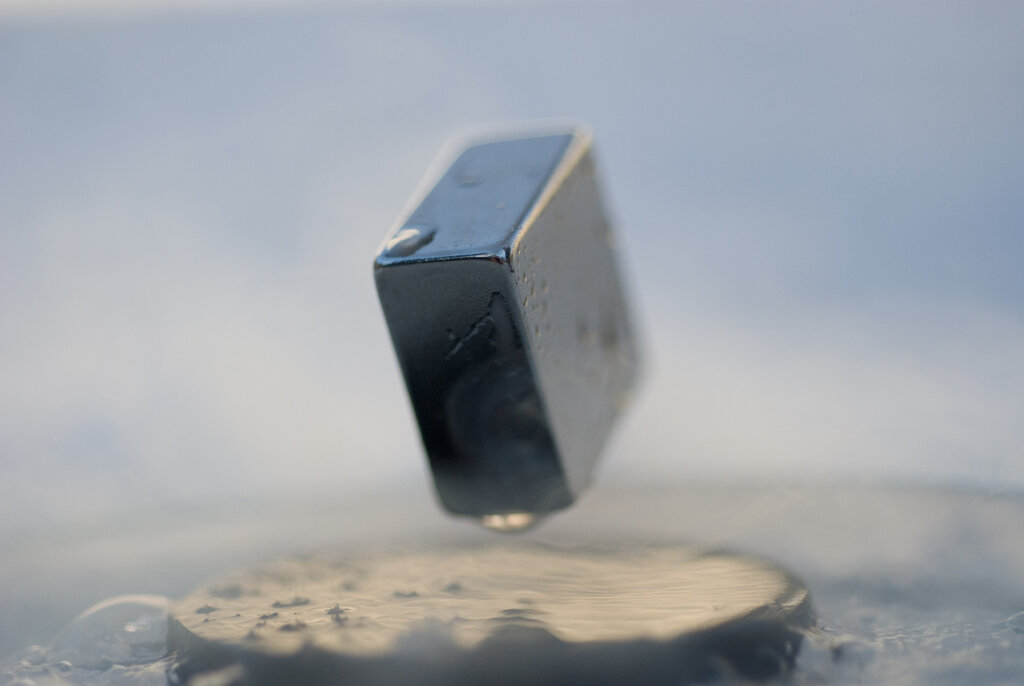
The levitating magnet is essentially floating on a cushion of its own magnetic field, which is being repelled by the superconductor. This effect confirms that superconductivity is a distinct state of matter with unique quantum properties, not just a classical phenomenon of perfect conductivity.
So, a superconductor is defined by two signature properties: zero electrical resistance and the active expulsion of magnetic fields. These two features are the bedrock of this fascinating quantum state.