Supercapacitors for Data Centers
Supercapacitor Basics
Meet the Supercapacitor
Imagine a component that combines the rapid-fire energy delivery of a capacitor with the storage capacity of a battery. That's a supercapacitor. Also known as ultracapacitors, they are designed to store and release large amounts of energy almost instantly.
While a traditional capacitor stores energy in an electric field between two plates, a supercapacitor takes this principle to a new level. It can hold hundreds or even thousands of times more charge. This unique ability allows it to bridge the gap between conventional capacitors and batteries, offering a different kind of power solution.
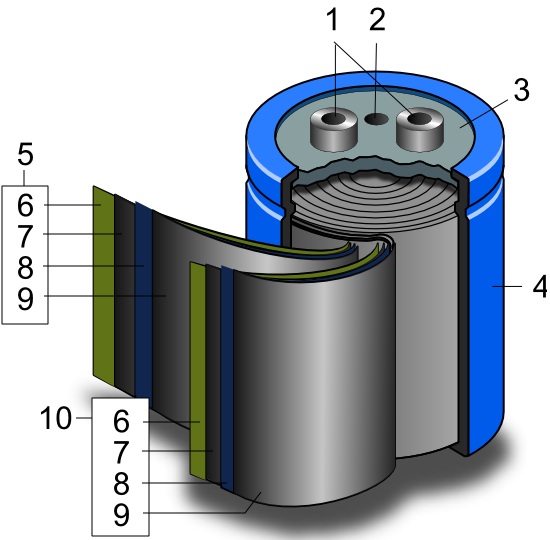
How They Work
The power of a supercapacitor comes from its unique internal structure and the clever physics at play. Inside, you won't find just two simple plates. Instead, there are two electrodes, typically made of a porous material like activated carbon, which are immersed in an electrolyte and separated by a thin membrane.
The key is surface area. The porous material creates an enormous surface area for storing charge, far greater than what's possible in a regular capacitor.
When a voltage is applied, two main mechanisms kick in to store energy. The first and most common is called electrostatic double-layer capacitance, or EDLC.
In EDLC, the ions in the electrolyte are drawn to the charged electrodes, forming two layers of charge at the interface between the electrode and the electrolyte—one in the electrode and an oppositely charged one in the electrolyte. This "electric double-layer" acts like an extremely thin capacitor, and because there are countless such sites across the porous material, the total capacitance is huge.
The second mechanism is called electrochemical pseudocapacitance. This method stores energy through fast, reversible chemical reactions, known as redox reactions, that occur on the surface of the electrode. This process is much faster than the chemical reactions in a battery, allowing for rapid charging and discharging, but it also contributes significantly to the supercapacitor's total storage capacity.
Electrolyte
noun
A substance that produces an electrically conducting solution when dissolved in a polar solvent, such as water. The dissolved electrolyte separates into cations (positively charged ions) and anions (negatively charged ions), which are free to move through the solution.
The Best of Both Worlds?
So how do supercapacitors stack up against traditional capacitors and batteries? It's best to think of them on a spectrum of power and energy.
| Feature | Traditional Capacitor | Supercapacitor | Battery |
|---|---|---|---|
| Energy Density | Very Low | Medium | High |
| Power Density | Very High | High | Low |
| Charge/Discharge | Instant | Very Fast (seconds) | Slow (minutes to hours) |
| Cycle Life | Nearly Infinite | High ( > 500,000) | Low ( < 5,000) |
Energy Density refers to how much energy can be stored in a given size or weight. Batteries are the clear winners here, able to store large amounts of energy for long-term use.
Power Density is about how quickly that energy can be delivered. Traditional capacitors are champions of speed, but they can't hold much energy. Supercapacitors sit in a sweet spot, delivering energy much faster than batteries and storing much more than conventional capacitors.
Cycle Life is the number of times a component can be charged and discharged before it degrades. Supercapacitors can be cycled hundreds of thousands, or even millions, of times with very little performance loss, far outlasting any battery.
This unique combination of traits—high capacitance, rapid charge and discharge, and an exceptionally long lifespan—makes supercapacitors ideal for applications that require frequent, quick bursts of power.
What is the primary mechanism by which an Electrostatic Double-Layer Capacitor (EDLC) stores energy?
When comparing a supercapacitor to a conventional battery of a similar physical size, the supercapacitor will generally have:
By blending the characteristics of capacitors and batteries, supercapacitors fill a critical gap in energy storage technology.