Sugar Industry Heat Exchanger Design
Heat Transfer Fundamentals
How Heat Moves
Heat is simply energy on the move. When there's a temperature difference between two things, energy flows from the hotter object to the colder one. This process, called heat transfer, happens in three primary ways: conduction, convection, and radiation. You've experienced all three, probably without even thinking about it.
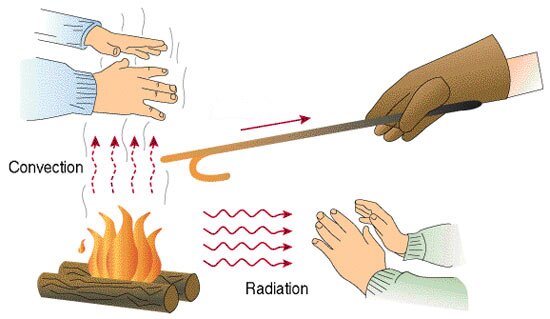
Understanding these three modes is the key to controlling heat, whether you're designing a cooling system for a laptop or a massive industrial furnace.
Conduction: Heat by Touch
Conduction is heat transfer through direct contact. If you touch a hot stove, the heat you feel is transferred by conduction. The fast-moving particles in the hot burner collide with the slower-moving particles in your hand, transferring energy and making your hand feel hot.
This type of transfer happens within solids, liquids, and gases, but it's most effective in solids where particles are packed tightly together. Metals like copper and aluminum are excellent conductors, which is why they're used for pots and pans. Materials that are poor conductors, like wood or plastic, are called insulators.
Thermal Conductivity
noun
A measure of a material's ability to conduct heat. It is denoted by the letter 'k'.
The rate of heat conduction is described by Fourier's Law. It states that the rate of heat transfer through a material is proportional to the negative gradient in the temperature and to the area through which the heat is flowing.
Here, is the rate of heat transfer, is the thermal conductivity, is the cross-sectional area, and is the temperature gradient, or how much the temperature changes over a certain distance.
Convection: Heat by Flow
Convection is heat transfer through the movement of fluids (liquids or gases). When a fluid is heated, it usually becomes less dense and rises. Cooler, denser fluid then sinks to take its place, gets heated, and rises in turn. This creates a continuous circulation called a convection current, which transfers heat.
A pot of boiling water is a perfect example. The water at the bottom gets hot, rises, and is replaced by cooler water from the top. This is also how a furnace heats a house. Hot air is blown into a room, rises to the ceiling, cools, sinks, and is drawn back to the furnace to be reheated.
There are two types of convection:
- Natural convection: Occurs due to density differences, like in the boiling pot.
- Forced convection: Occurs when an external force, like a fan or a pump, moves the fluid.
Forced convection is generally much more efficient at transferring heat than natural convection. That's why your computer has a fan to cool its processor.
The rate of convective heat transfer is calculated using Newton's Law of Cooling.
In this equation, is the rate of heat transfer, is the surface area, is the surface temperature, and is the temperature of the fluid far from the surface. The variable is the convective heat transfer coefficient. This coefficient is a complex property that depends on the fluid, its velocity, and the geometry of the surface. It's usually determined through experiments.
Radiation: Heat Through Waves
Radiation is the transfer of heat through electromagnetic waves, like infrared radiation. Unlike conduction and convection, radiation doesn't need a medium to travel through. It can move through the vacuum of space. This is how the Sun warms the Earth.
Everything with a temperature above absolute zero emits thermal radiation. The hotter an object is, the more radiation it emits. When you stand near a campfire, the warmth you feel on your face is primarily from radiation. The color and texture of a surface also affect how well it radiates and absorbs heat. Dark, matte surfaces are better absorbers and emitters than shiny, light-colored ones.
The Stefan-Boltzmann Law describes the power radiated from an object.
Here, is the net rate of heat transfer, is the radiating area, is the absolute surface temperature, and is the absolute temperature of the surroundings. The symbol is the Stefan-Boltzmann constant, and is the emissivity of the surface, a value between 0 and 1 that indicates how effectively it radiates energy.
In most real-world scenarios, these three modes of heat transfer happen at the same time. A hot cup of coffee, for example, loses heat through conduction to the mug and the table, through convection to the surrounding air, and through radiation to its environment.
Now, let's test your understanding of these core concepts.
When you stand a few feet away from a campfire, what is the primary way you feel the heat on your face?
Why are metal pots and pans typically used for cooking on a stove?