Subtraction Strategies Year 3
Understanding Subtraction
What Is Subtraction?
Subtraction is one of the four basic operations in arithmetic, along with addition, multiplication, and division. It's the process of taking one number away from another. Think of it as finding out what's left when you remove a certain amount from a group.
subtraction
noun
The process of taking one number or amount away from another.
The symbol for subtraction is the minus sign (—). When we see an equation like $7 - 4 = 3$, it means we start with 7, take away 4, and we are left with 3. In a subtraction problem, the number we start with is called the minuend, the number being subtracted is the subtrahend, and the answer is the difference.
Take Away and Find the Difference
We use subtraction in a couple of different ways. The most common way is 'taking away'. If you have 8 apples and you eat 3, how many do you have left? You're taking 3 away from 8.
$8 - 3 = 5$. You have 5 apples left.
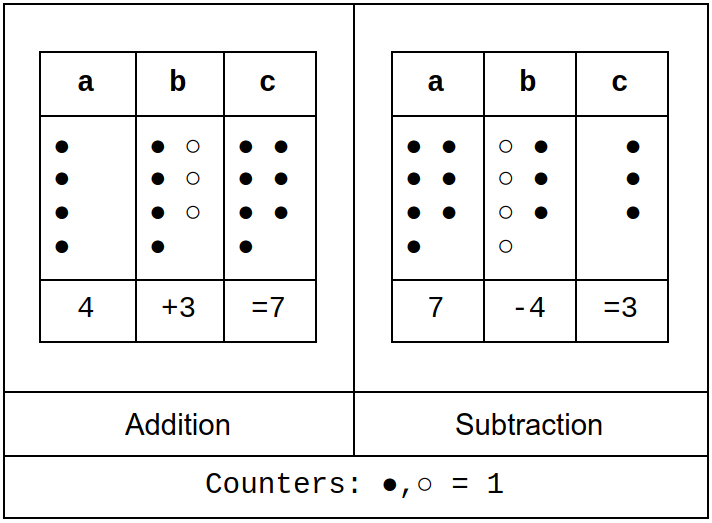
Another way to think about subtraction is 'finding the difference'. This is when you compare two numbers to see how much bigger one is than the other. For example, if Leo has 9 toy cars and Mia has 6, what is the difference?
To find out, you subtract the smaller number from the bigger one: $9 - 6 = 3$. The difference is 3. Leo has 3 more cars than Mia.
The Opposite of Addition
Subtraction and addition are opposites. They undo each other. This relationship is very useful because it lets you check your answers.
Let's say you solve a subtraction problem: $10 - 4 = 6$.
To check if you're right, you can use addition. Just add the number you took away (4) to your answer (6). If you get the number you started with (10), your answer is correct!
This shows that your subtraction was right. This group of related facts, like $10 - 4 = 6$ and $6 + 4 = 10$, is called a fact family.
Visualizing Subtraction
Sometimes it helps to see a problem. A number line is a great tool for this. To solve $9 - 5$, find 9 on the number line. Then, count back 5 spaces to the left. Where do you land?
You land on 4. So, $9 - 5 = 4$.
Another useful tool is a bar model. A bar model helps you see the relationship between the whole amount and its parts. For a problem like 'A shop has 7 skateboards. It sells 3. How many are left?', you can draw a bar model.
The bar shows that the whole (7) is made of two parts. You know one part (3), so you can find the other part by subtracting: $7 - 3 = 4$. There are 4 skateboards left.
Learning subtraction takes practice, just like any math skill.
Let's check what you've learned about subtraction.
In a subtraction problem, what is the answer called?
If you have 12 cookies and you eat 5, how many cookies are left?
Understanding subtraction is a key step in becoming more confident with maths. It helps you solve problems in school and in everyday life.