Structured Content for Enterprise Operations
Introduction to Structured Content
What Is Structured Content?
Think about a long article written in a word processor. It's a single, continuous block of text and images. The headline, the subheadings, the paragraphs, and the photo captions are all blended together. To reuse a paragraph from that article on a different webpage, you'd have to manually copy and paste it. This is unstructured content.
Now, imagine if every piece of that article—the headline, each paragraph, every image, every caption—was a separate, independent block. Each block would be stored on its own and tagged with information about what it is (e.g., 'headline,' 'body paragraph,' 'product image'). You could then assemble these blocks in any way you want, for any platform you need. That’s the core idea of structured content.
Structured Content
noun
Information that is intentionally broken down into its smallest reasonable components, organized in a predictable way, and tagged with metadata so that it can be dynamically assembled and published to any platform.
The key is the separation of content from presentation. With unstructured content, the information is trapped in its format (a webpage, a PDF). With structured content, the information is format-free. It’s just pure data, ready to be pulled into any design or layout.
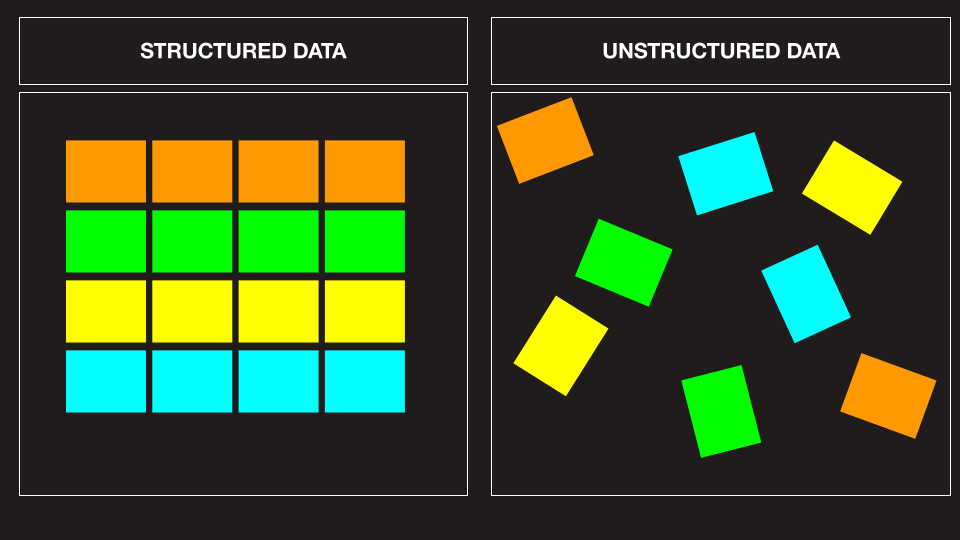
Structured vs. Unstructured
Let’s look at a direct comparison to make the distinction clear. Unstructured content is what most of us create every day. It’s free-flowing and easy to produce, but difficult for machines to understand and reuse.
Unstructured content is created for humans to read in a specific context. Structured content is created for machines to process and reassemble for humans to read in any context.
Structured content, on the other hand, is planned and organized from the start. It requires more initial effort but allows for incredible flexibility and automation down the line.
| Feature | Structured Content | Unstructured Content |
|---|---|---|
| Unit | Small, independent chunks (models) | Large, monolithic documents |
| Organization | Predictable, database-like | Free-form, narrative flow |
| Metadata | Richly tagged at a granular level | Minimal or document-level tags |
| Reusability | High (easy to mix and match) | Low (requires copy-pasting) |
| Automation | Easy for machines to parse | Difficult for machines to parse |
| Example | A product entry in a database | A blog post in a Word document |
The Building Blocks
Structured content relies on a few core principles to work.
Modularity: Content is broken into the smallest logical pieces, often called "chunks" or "components." For a recipe, this might mean separating the ingredient list, each step of the instructions, the cooking time, and the nutritional information into their own distinct fields.
Classification: Each chunk is identified by its type. This is done using metadata—data about the data. A chunk isn't just a block of text; it's tagged as a 'headline,' an 'introduction,' a 'legal disclaimer,' or a 'call to action.' This tells a system what the content is, not just what it says.
Format-Free: The content itself contains no styling information. There are no fonts, colors, or layout instructions attached to the raw content. This information is applied later, during publishing, based on the needs of the specific channel (like a website, mobile app, or even a voice assistant).
By understanding these basic concepts, you can see how structured content isn't just a different way of writing—it's a different way of thinking about information itself.