String Theory Explained
Introduction to String Theory
Beyond the Point
For centuries, physicists have pictured the fundamental components of the universe as tiny, zero-dimensional points. Electrons, quarks, photons—all were considered infinitesimal dots. Particle physics, which you've seen in the Standard Model, is built on this idea. But what if this is just an approximation?
String theory challenges this foundational concept. It suggests that at the most microscopic level, the basic building blocks of reality are not points but tiny, vibrating one-dimensional 'strings' of energy.
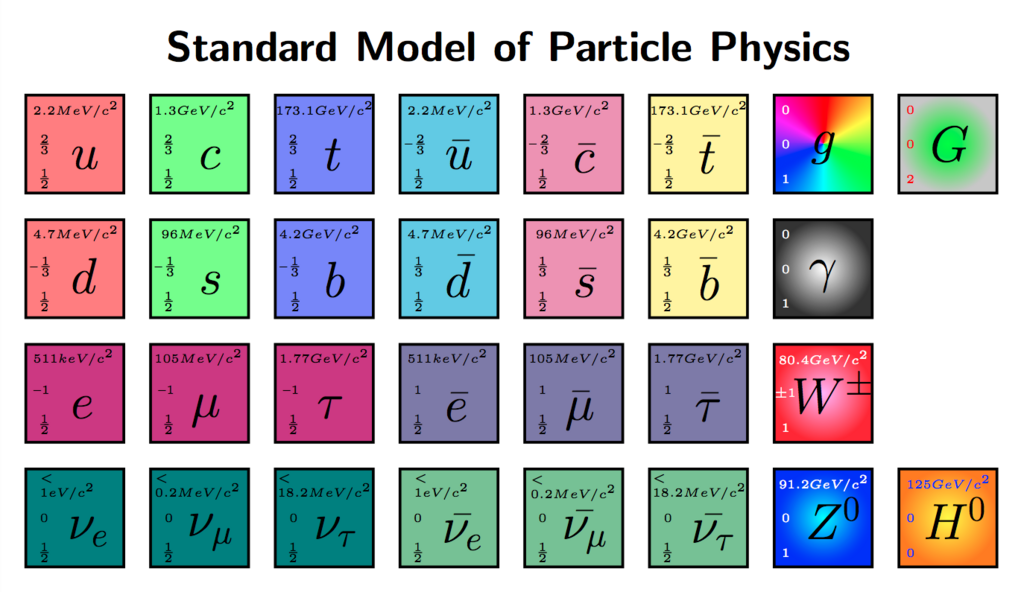
Think of a guitar string. By plucking it in different ways, you can produce a variety of distinct musical notes. String theory proposes something similar for the universe. A single, fundamental string can vibrate in different patterns or modes. One vibrational pattern might manifest as an electron. A different pattern would appear as a photon. Another, a quark.
From our perspective, these vibrating strings are so minuscule that they look like points. But according to the theory, their underlying nature as strings is what determines their properties, such as mass and charge.
Every particle we know of could simply be a different 'note' played on a fundamental string.
An Accidental Theory
String theory wasn't originally designed to be a 'theory of everything.' In the late 1960s, physicists were struggling to understand the strong nuclear force—the powerful glue that holds atomic nuclei together. They developed a model based on strings to describe the interactions between particles like protons and neutrons.
While the model had some success, it was eventually replaced by the theory of quantum chromodynamics (QCD), which provided a much better description of the strong force. For a while, string theory was largely forgotten.
Then, a remarkable discovery was made. Scientists realized that one of the vibrational modes of these strings perfectly matched the properties of the graviton—the hypothetical particle that carries the force of gravity. This was a stunning revelation. No other theory had successfully united gravity with quantum mechanics. Suddenly, the abandoned theory of the strong force was reborn as a promising candidate for a unified theory of all forces, including gravity.
Hidden Dimensions
For the mathematics of string theory to work, the universe must have more than the three spatial dimensions (length, width, height) and one time dimension we experience. Most versions of the theory require a total of ten dimensions.
So where are these extra six dimensions? The idea is that they are 'compactified,' or curled up into a tiny, complex shape at every single point in our familiar space.
Imagine a tightrope walker on a wire. From a great distance, the wire looks like a one-dimensional line. The walker can only move forward or backward. But for an ant on that same wire, there's another dimension: it can crawl around the wire's circumference. The extra dimensions of string theory are like that circumference—so incredibly small that we can't perceive or access them directly.
The geometry of these curled-up dimensions is not arbitrary. Their specific shape would determine the vibrational patterns of the strings, and therefore the kinds of particles and physical laws we observe in our universe.
A Universe in Balance
Most viable string theories also include a concept called supersymmetry. Supersymmetry proposes a fundamental relationship between the two basic classes of particles: fermions and bosons.
Fermions are the particles that make up matter, like electrons and quarks. Bosons are the particles that carry forces, such as photons (electromagnetism) and gluons (the strong force). Supersymmetry predicts that every known fermion has a 'superpartner' boson, and every known boson has a 'superpartner' fermion.
| Particle Type | Role in Universe | Example | Supersymmetric Partner |
|---|---|---|---|
| Fermion | Makes up matter | Electron | Selectron (boson) |
| Boson | Carries forces | Photon | Photino (fermion) |
This elegant symmetry would solve some deep problems in particle physics. However, none of these superpartner particles have ever been detected in experiments, which is one of the major challenges facing string theory today. If they exist, they must be much heavier than their standard counterparts, requiring more energy to create than our current particle accelerators can produce.
String theory remains a work in progress, a fascinating and mathematically beautiful framework that could potentially unlock the deepest secrets of our cosmos. It paints a picture of a universe richer and stranger than we ever imagined, all playing out on the tiniest of vibrating strings.
According to string theory, what are the most fundamental building blocks of the universe?
In string theory, how can a single type of fundamental string give rise to a wide variety of different particles, such as electrons and photons?