String Theory Explained
Introduction to String Theory
Beyond Points
For centuries, physicists have pictured the fundamental building blocks of the universe as tiny, zero-dimensional points. Electrons, quarks, photons — all were seen as infinitesimally small dots. This model, known as the Standard Model of particle physics, has been incredibly successful. It describes three of the four fundamental forces of nature: electromagnetism, the weak nuclear force, and the strong nuclear force. However, it leaves out gravity.
General relativity, Einstein's theory of gravity, works beautifully for large objects like planets and galaxies. But when you try to combine it with the quantum rules that govern point particles, the math breaks down. Calculations that should give sensible answers instead spit out infinities, a clear sign that something is wrong with the underlying picture.
String theory offers a radical solution. What if, at the most fundamental level, particles aren't points at all? What if they are tiny, one-dimensional vibrating loops of energy, like incredibly small rubber bands?
Its premise is simple: Everything is made of tiny strings.
By replacing point particles with strings, the problematic infinities that arise in quantum gravity calculations simply disappear. The
Cosmic Symphony
If everything is made of the same kind of string, how can there be so many different kinds of particles? The answer lies in how the strings vibrate.
Think of a guitar string. Plucking it in different ways produces different musical notes. A string in string theory is similar. It can vibrate in different patterns, or modes. Each distinct vibrational mode corresponds to a different particle with different properties, like mass and charge.
One vibrational pattern might appear to us as an electron. Another, a photon. Yet another, a quark. The universe, in this view, is a grand cosmic symphony played on these minuscule strings. All the particles and forces we see are just different
Remarkably, one of the vibrational modes predicted by string theory matches the expected properties of a particle that carries the force of gravity. This hypothetical particle is called the graviton.
graviton
noun
A hypothetical elementary particle that mediates the force of gravitation in the framework of quantum field theory.
This is a major breakthrough. For the first time, a theory that describes particles at the quantum level naturally includes gravity. It doesn't just make room for gravity; it requires it.
Hidden Dimensions
There's a catch, however. For the mathematics of string theory to be consistent, the universe must have more dimensions than the three of space (length, width, height) and one of time that we experience.
Most versions of string theory require a total of ten spacetime dimensions: nine of space and one of time. So where are these six extra spatial dimensions? The idea is that they are "compactified," or curled up on an incredibly small scale, so we can't perceive them directly.
Imagine a long, thin garden hose. From a great distance, it looks like a one-dimensional line. But for an ant walking on its surface, it clearly has a second dimension: the circular path around its circumference. In a similar way, string theory suggests that at every point in our familiar 4D spacetime, there exists a tiny, complex, 6D shape where the extra dimensions are curled up.
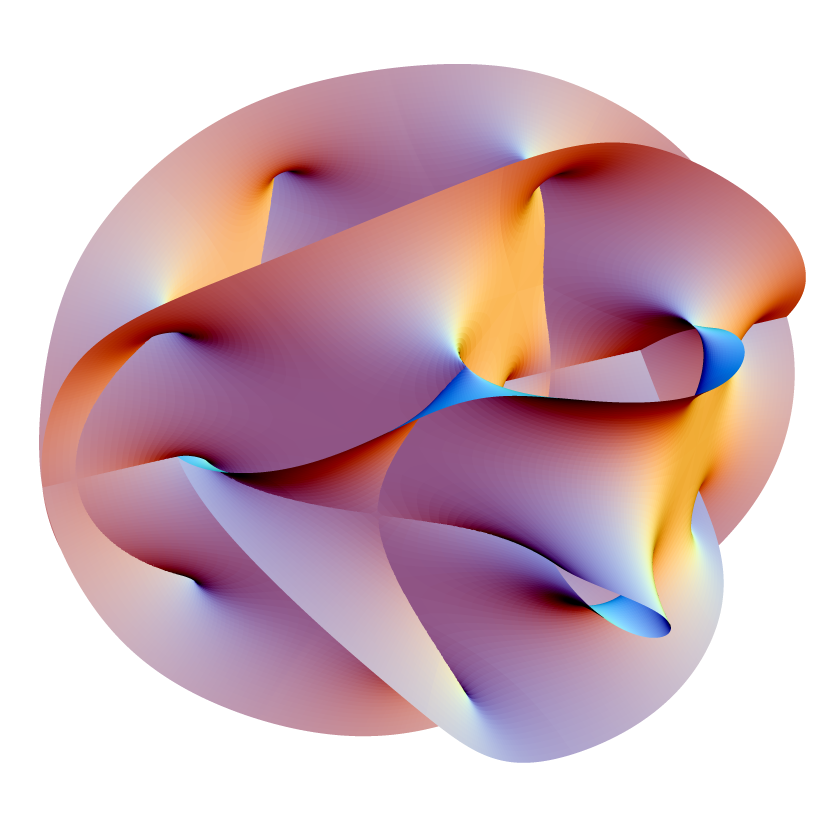
The geometry of these curled-up dimensions is crucial. It determines the ways the strings can vibrate, which in turn dictates the properties of the particles we observe in our large-scale world. The physics we see is a direct consequence of the shape of these hidden dimensions.
One Theory to Rule Them All?
In the 1980s, physicists discovered a puzzling fact: there wasn't just one consistent version of string theory. There were five. They were called Type I, Type IIA, Type IIB, SO(32) heterotic, and E8×E8 heterotic. This was a problem. A
In the mid-1990s, a second
This led to a
M-theory suggests that the five string theories are not fundamental rivals, but different approximations of a single, more profound theory that lives in 11 spacetime dimensions. They are like different perspectives on the same underlying reality, each valid in certain conditions.
String theory, and its extension M-theory, remains a work in progress. It is a mathematically complex and conceptually challenging framework that has not yet made testable predictions to confirm it experimentally. Still, it stands as our most promising candidate for a unified theory of physics, offering a compelling vision of a universe built from the music of vibrating strings.
What is the central problem in theoretical physics that string theory was developed to address?
According to string theory, how do different fundamental particles like electrons, quarks, and photons arise?