Street Art Social Commentary
Introduction to Street Art and Graffiti
The City as a Canvas
Walk down a street in any major city, and you'll see it: art that lives outside of galleries. It’s on brick walls, train cars, and storefront shutters. This is the world of street art and graffiti, two vibrant forms of public expression that turn urban landscapes into open-air museums.
Though often used interchangeably, they have distinct origins and purposes. Let's start with the older of the two.
Graffiti
noun
A style of writing or drawing, often illicitly, on a public surface. It is typically focused on stylized letters, words, or the artist's signature, known as a 'tag.'
The act of scratching or writing on walls is ancient. People have been doing it since the days of Pompeii. But modern graffiti exploded in the 1960s and 1970s, particularly in Philadelphia and New York City. The invention of the aerosol spray can gave rise to a new culture. Young artists, or 'writers,' began 'tagging' their names across the city, competing for fame and visibility. It was all about developing a unique, complex style for your name.
Over time, some artists began to move beyond just letters. They started creating images, characters, and more complex visual scenes. This evolution gave birth to what we now call street art.
Street Art
noun
A broad category of public art created in urban environments. Unlike traditional graffiti, it is often more image-focused and can encompass a wide variety of mediums, including stencils, posters, stickers, and murals.
Street art emerged in the later 20th century as a descendant of graffiti. Artists began using techniques like stenciling to create repeatable images quickly. The focus shifted from the artist's name to a recognizable symbol or character. While much of it is still done without permission, some street art is commissioned, turning a building's side into a planned mural.
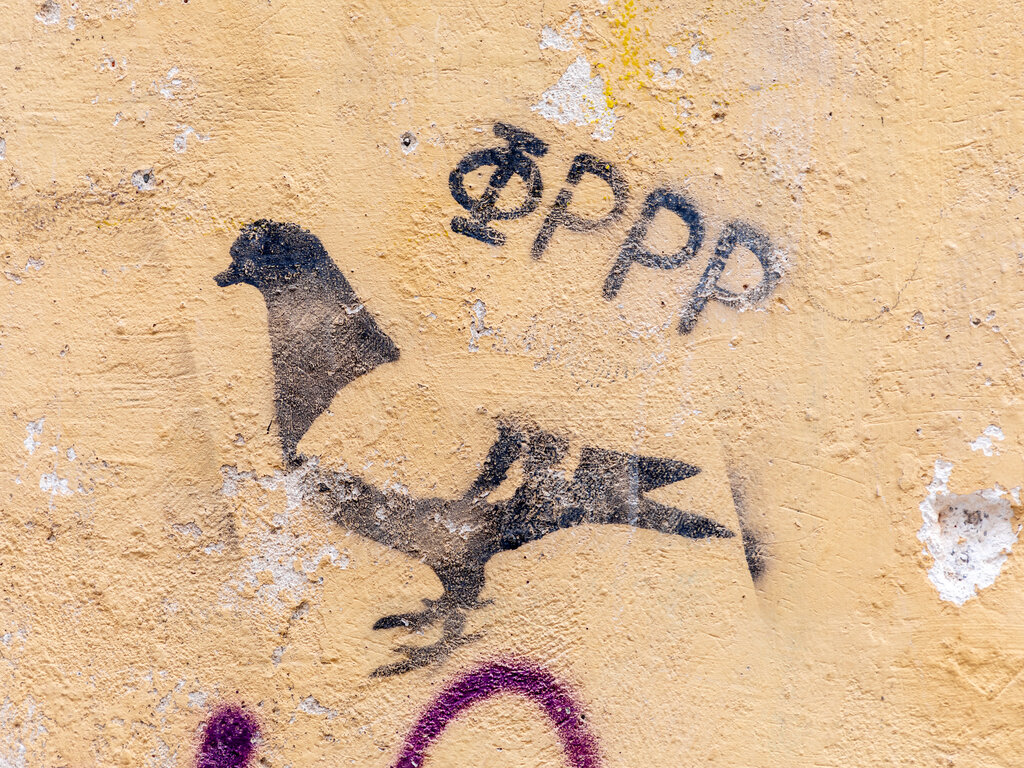
Tag vs. Image
So, what's the core difference? It often comes down to intent and form. Graffiti is a culture rooted in writing a name. Street art is a broader practice of placing imagery in the public sphere. The lines can be blurry, of course. A graffiti writer might paint a character next to their tag, and a street artist might incorporate stylized text. But a few general distinctions help tell them apart.
| Feature | Graffiti | Street Art |
|---|---|---|
| Primary Focus | Letters, tags, and names | Images, characters, and symbols |
| Common Mediums | Spray paint, markers | Stencils, posters, paint, stickers |
| Core Intent | Claiming space, personal fame | Communicating an idea or image |
| Cultural Roots | Hip-hop, tagging culture | Pop art, graphic design, activism |
A City's Visual Language
In the urban environment, both graffiti and street art play a role in shaping a place's identity. They add layers of color, creativity, and personality to spaces that might otherwise be gray and uniform. A stylized tag on a mailbox or a painted mural on a forgotten wall becomes part of the visual texture of daily life for the people who live there.
These art forms reflect the energy of a city. They show that public spaces are not just for passing through, but are also places for expression and creativity. They can transform a mundane commute into a brief encounter with art, offering a moment of surprise or beauty in the everyday.
What is the primary distinction between graffiti and street art, according to the text?
Modern graffiti, as a culture of 'tagging', first exploded in which era and location?