Strategic Use of Legal Entities for Financial and Legal Optimization
Understanding Legal Entities
What is a Legal Entity?
A legal entity is an organization that the law treats as its own “person.” This means it can enter into contracts, own property, sue, and be sued, all separate from the individuals who own or run it. Think of it as a legal container you can create for a business or a collection of assets.
The main reason to create a legal entity is to build a wall between your personal life and your business or financial activities. If the business runs into debt, creditors generally can only go after the business's assets, not your personal car or home.
Incorporation creates a separate legal entity for your business, distinct from its owners (shareholders).
Companies as Legal Shields
When most people think of legal entities, they think of companies. The primary purpose of forming a company is to limit liability. It establishes a legal barrier, often called a “corporate veil,” between the business's obligations and the owner's personal assets. If the company fails, the owners might lose their investment in the business, but their personal wealth is protected.
There are several types of companies, but two of the most common are corporations and limited liability companies (LLCs).
Corporation
noun
A legal entity that is separate and distinct from its owners, known as shareholders. It is more rigid in its structure, with required roles like a board of directors.
Corporations are often chosen by businesses that plan to raise money from investors or go public. They have a formal structure with shareholders, directors, and officers, and they are subject to more regulations.
LLC
noun
A business structure that combines the pass-through taxation of a partnership or sole proprietorship with the limited liability of a corporation.
Limited Liability Companies (LLCs) offer a more flexible and less formal alternative. They provide the same liability protection as corporations but are simpler to manage. Profits and losses can be passed directly to the owners' personal tax returns without the business itself being taxed, avoiding what is known as “double taxation.”
LLCs provide pass-through taxation, limited liability protection, and flexibility in ownership and management.
| Feature | Corporation | Limited Liability Company (LLC) |
|---|---|---|
| Liability | Limited liability for owners | Limited liability for owners |
| Taxation | Can be taxed separately (C Corp) or pass-through (S Corp) | Pass-through taxation by default |
| Structure | Formal: Shareholders, directors, officers | Flexible: Members and managers |
| Best For | Businesses seeking outside investment or to go public | Small businesses, freelancers, and partnerships |
Trusts for Managing Assets
A trust is a different kind of legal entity. It isn't a business, but rather a legal relationship where one party, the trustee, holds and manages assets for the benefit of another, the beneficiary. The person who creates the trust and puts assets into it is called the settlor or grantor.
Trusts are powerful tools for asset protection and estate planning. They allow you to control how your assets are used even when you're no longer managing them directly.
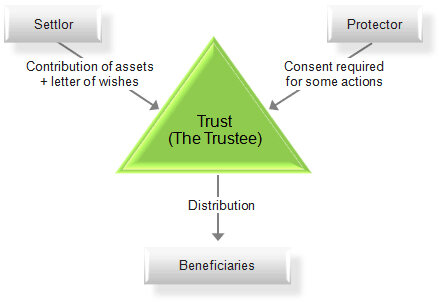
Two common types of trusts are discretionary and family trusts.
A discretionary trust gives the trustee the power to decide which beneficiaries will receive payments and how much they will get. This flexibility is useful when circumstances might change over time.
A family trust is simply a trust set up to benefit members of a single family. It's often a discretionary trust, designed to hold family assets like a business, investments, or a vacation home. The goal is to protect these assets from creditors and ensure they are passed down through generations in a controlled manner.
Now that you understand the basics of companies and trusts, let's test your knowledge.
What is the primary characteristic of a legal entity?
What is the main purpose of the 'corporate veil'?
Companies and trusts are foundational structures in finance. By creating a separate legal identity for assets or a business, you can protect personal wealth, manage liabilities, and control how assets are distributed.