Strategic Stock Market Investing
Advanced Market Mechanics
The Unseen Engine of the Market
When you place a trade, you're not just shouting into the void. On the other side of your order is a complex system designed to ensure there's almost always someone willing to buy what you're selling, or sell what you're buying. At the heart of this system are the market makers—specialized firms and traders who provide liquidity to the market.
Think of a market maker as a used car dealer for stocks. They don't necessarily want to own every car on the lot forever. Instead, their business is to always be ready to buy a car (for a slightly lower price) and sell a car (for a slightly higher price). This constant willingness to transact is what keeps the market moving smoothly. They are obligated to quote both a buy price (the bid) and a sell price (the ask) for a certain number of shares.
Market makers play an important role in providing liquidity to markets by continuously quoting prices at which they are willing to buy and sell, and managing inventory risk.
The difference between their bid price and their ask price is called the bid-ask spread. This spread is how they make their profit. For a highly traded stock like Apple, the spread might be just a penny. For a less common stock, it could be much wider. The spread is a direct measure of liquidity; a tight spread means high liquidity, while a wide spread signals the opposite.
During periods of high volatility, like a major news event, market makers face more risk. To protect themselves, they widen the bid-ask spread. This makes trading more expensive for everyone else and compensates the market maker for the increased danger of holding a position that could rapidly lose value.
This risk of holding shares they don't necessarily want is called inventory risk. If a market maker buys 10,000 shares of a company that then announces terrible earnings, they could be stuck with a significant loss. Their entire business model revolves around managing this inventory, constantly balancing their books by buying and selling to minimize their net exposure while capturing the spread.
Beyond the Market Order
While simple market orders get the job done, professional traders use more sophisticated tools to control their entries and exits. These advanced order types are crucial for managing risk and navigating the market's structure.
| Order Type | Description |
|---|---|
| Limit Order | Buys or sells at a specific price or better. A buy limit order will only execute at or below your limit price. A sell limit order will only execute at or above it. |
| Stop-Limit Order | A two-part order. Once the stock hits a specified "stop" price, it triggers a limit order to be placed at your "limit" price. This offers more price control than a standard stop order. |
| Iceberg Order | A large single order that has been algorithmically broken into smaller limit orders. Only a small portion, the "tip of the iceberg," is visible on the order book at any one time, concealing the full size of the trade. |
Iceberg orders are particularly important. A massive buy order placed all at once could spook the market, causing the price to jump before the full order can be filled. By revealing only a small piece at a time, institutional traders can acquire a large position without showing their hand and creating a major price impact against themselves. This is a form of hidden liquidity.
Looking at Market Depth
To truly understand the forces of supply and demand at any given moment, traders look at the order book, also known as Level 2 (L2) data. This isn't just the single best bid and ask price you see on a standard stock quote. It's a ranked list of all the buy and sell limit orders waiting to be executed at different price levels.
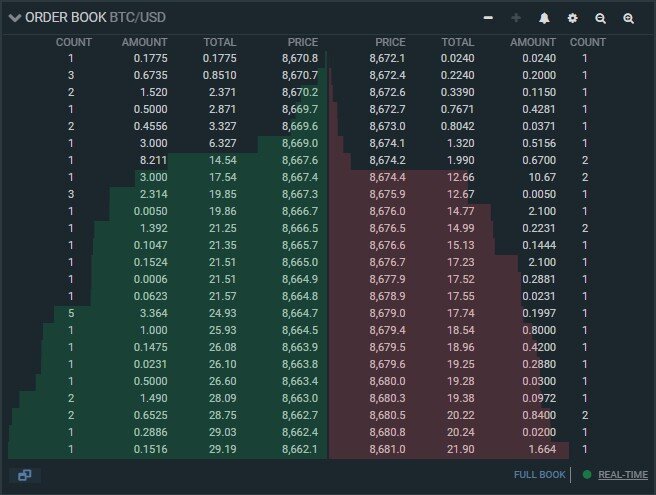
The order book shows market depth. A "deep" market has a large number of buy and sell orders stacked up at prices near the current market price. This means it can absorb large trades without the price moving much. A "thin" market has few orders, and even a moderately sized market order can chew through several price levels, causing a significant price swing.
This brings us to slippage. Slippage is the difference between the price you expected to get when you placed your order and the actual price at which the trade was executed. It's most common with market orders in fast-moving, thin markets. If you place a market order to buy 1,000 shares, but there are only 200 available at the current ask price, your order will consume those and then move to the next highest ask price to get the remaining 800 shares. Your average execution price will be higher than what you initially saw.
Understanding market depth and liquidity is key. It explains why a stock might suddenly jump or fall on what seems like no news. Often, a large institutional order simply exhausted the liquidity at a certain price level, causing a rapid move to the next.
Before we test your knowledge, let's review some key terms.
Ready to check your understanding?
What is the primary role of a market maker?
A market maker's primary source of profit is the bid-ask spread.
By understanding these behind-the-scenes mechanics, you can better interpret price action and make more informed trading decisions.