Strategic Option Trading and Risk Management
Spread Mechanics and Pricing
Beyond Single Options
Buying a call or a put is a straightforward bet on direction. You have unlimited potential profit but also risk losing your entire premium. Option spreads introduce a new dimension: trading one risk for another to create a more defined outcome. Instead of just buying an option, you simultaneously buy one and sell another of the same type (both calls or both puts) on the same underlying asset with the same expiration date.
This creates a position with capped profit and capped risk. It's like putting a ceiling and a floor on your trade. Why do this? Spreads are more capital-efficient. Because the option you sell helps finance the option you buy, the net cost (or credit) is often much lower than buying a single option outright. This means you can control the same amount of shares with less capital at risk.
A bull call spread involves buying a call option at a lower strike price and selling another call at a higher strike price, both with the same expiration.
This structure is called a vertical spread because the strike prices are different, appearing vertically on an option chain. There are two main types: debit spreads, where you pay a net premium to open the position, and credit spreads, where you receive a net premium.
Debit and Credit Spreads
A bull call spread is a classic example of a debit spread. You buy a call with a lower strike price and sell a call with a higher strike. Your view is moderately bullish; you expect the stock to rise, but perhaps not dramatically. Your maximum loss is the net debit you paid for the spread. Your maximum profit is the difference between the strike prices, minus the debit paid.
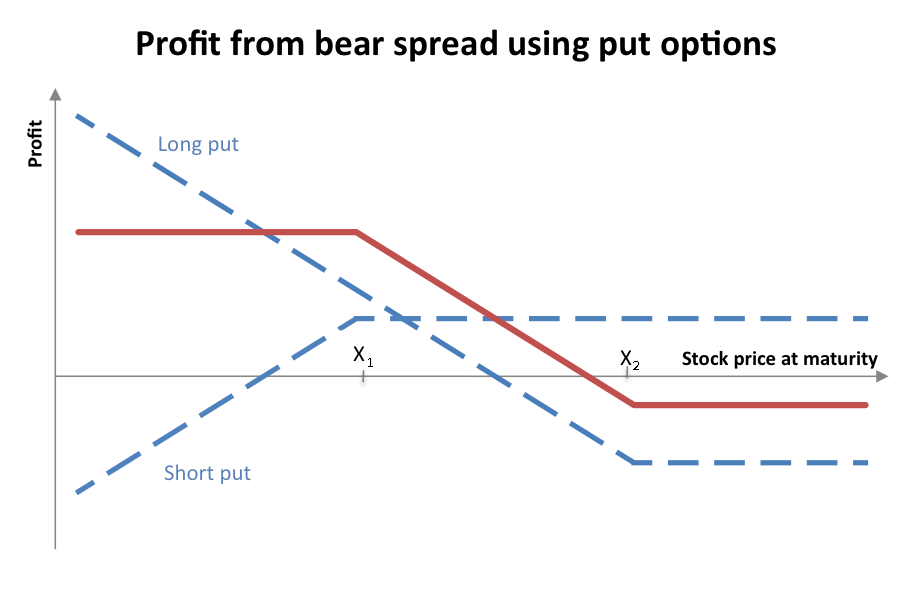
A bear put spread is another debit spread. You buy a put with a higher strike price and sell a put with a lower strike. This is for when you're moderately bearish. The mechanics are the mirror image of the bull call spread.
Credit spreads are the opposite. In a bull put spread, you sell a put with a higher strike and buy a put with a lower strike. You collect a credit, which is your maximum profit. You want the stock price to stay above the higher strike price at expiration. Your maximum loss is the difference in strikes minus the credit received.
Similarly, a bear call spread involves selling a call with a lower strike and buying a call with a higher one. You collect a credit and want the stock to stay below the lower strike price. These are popular strategies for generating income, as you profit from the stock staying within a certain range and from theta decay eroding the value of the options.
Calculating Your Breakeven
Finding the breakeven point is crucial for knowing when your spread becomes profitable. The calculation is simple and depends on whether it's a debit or credit spread.
For a debit spread (like a bull call or bear put), you are paying to enter the trade. Your breakeven is found by adjusting the strike price of the option you bought.
For a credit spread (like a bull put or bear call), you receive money to enter the trade. Your breakeven is found by adjusting the strike of the option you sold.
Capital Efficiency and Order Execution
One of the biggest advantages of spreads is their reduced margin requirement. When you sell a naked option, your broker requires you to hold a significant amount of capital in your account as collateral because your risk is theoretically unlimited. With a spread, your risk is defined. The long option acts as a hedge for the short one.
For a defined-risk spread, the maximum loss is typically the most you need to have in your account as collateral. This is far less than the requirement for a naked option.
This capital efficiency allows you to make trades with a higher potential return on capital. You're risking less to potentially make more, relative to the capital tied up.
However, executing multi-leg orders introduces a challenge: the bid-ask spread on each leg. If you place two separate market orders, one for each leg, you might experience "slippage" where the price moves between your first and second order. This can turn a profitable-looking trade into a loser before it even starts.
To combat this, traders use a combo order or spread order. This tells your broker to execute both legs simultaneously and only if they can be filled at a specific net price (a net debit or credit) or better. This ensures you get the price you want and don't get picked off by market makers.
Time to check your understanding of these spread mechanics.
What is the primary advantage of using a vertical option spread compared to buying a single naked call or put?
An investor expects a stock to rise moderately over the next month. Which debit spread strategy is most suitable for this outlook?
Understanding these mechanics is the bridge from simple option buying to constructing sophisticated, risk-managed strategies.