Strategic Decision Making Mastery
Strategic Game Theory
Strategy as a Game
Strategic decision-making isn't a solo sport. Every choice a business makes—from pricing a product to entering a new market—happens in an environment with other players. Your competitors, suppliers, and customers are all making their own moves. Game theory provides a powerful framework for thinking about these interactions not as chaotic events, but as a structured game where anticipating others' choices is critical.
Instead of just reacting to what happens, you can model the strategic landscape, predict likely outcomes, and choose the path that best serves your interests. This involves understanding that every player is rational and trying to maximize their own outcome, just like you are.
Finding the Balance Point
In any game, players eventually reach a point of stability. In game theory, this is called a Nash Equilibrium, a state where no player can improve their outcome by unilaterally changing their strategy, assuming everyone else sticks to their current plan. It's the point where everyone is doing the best they can, given what everyone else is doing.
In simple, symmetrical markets, finding this equilibrium can be straightforward. But real-world markets are rarely symmetrical. Imagine two companies, a dominant market leader and a smaller, agile startup, deciding whether to invest heavily in a new, unproven technology. The leader has more resources but is slow to adapt. The startup is nimble but can't afford a major loss. Their payoffs for investing or not investing are different, creating an asymmetrical game.
The Nash Equilibrium in this scenario might not be the best possible outcome for both, but it's the most stable one. For example, the equilibrium might be that the market leader invests while the startup waits, because the risk for the startup is too high, and the leader knows the startup can't compete head-on. Neither firm has an incentive to change its move, given the other's choice.
Thinking Backwards to Move Forward
Not all decisions happen at once. Many strategic situations unfold over time, with one player's move influencing the next. These are called extensive form games, and they're best visualized as a decision tree. Each node represents a decision point for a player, and each branch is a possible action.
Consider a classic market entry scenario. A new company is deciding whether to enter a market dominated by an incumbent firm. If the new company enters, the incumbent must decide whether to fight back with a price war or accommodate the new player. To solve this, we use a technique called backward induction .
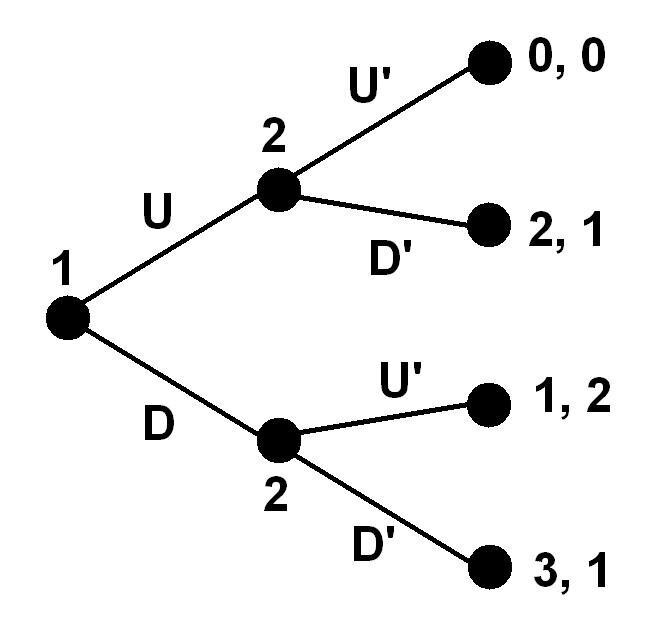
Instead of starting at the beginning, you start at the final decision in the game and work your way backward. First, determine the rational choice for the last player. In our example, the incumbent looks at the payoffs: a price war might hurt them more than just sharing the market. If accommodating yields a better payoff, that's their rational choice.
Knowing the incumbent will choose to accommodate, the new company can now make its decision. If entering the market and being accommodated leads to a positive outcome, they will choose to enter. By reasoning backward from the future, you find the optimal path forward.
The Power of Unpredictability
What if being predictable is a disadvantage? In pricing, for example, if your competitor knows you will always match their price cuts, they can manipulate the market to their advantage. The solution is to use a mixed strategy.
A mixed strategy involves randomly choosing between different pure strategies based on a set of probabilities. Instead of always cutting prices, you might decide to match a price cut 80% of the time and hold your price 20% of the time. This unpredictability prevents your competitor from confidently predicting your next move, making it harder for them to exploit your behavior.
This doesn't mean you're flipping a coin on major business decisions. It means you're creating a calculated and deliberate unpredictability that itself becomes a strategic weapon.
To make this work, you must also consider credible commitments. A threat that isn't credible is useless. If an incumbent firm threatens a price war it can't afford, the threat is empty. To deter a competitor, a commitment must be both visible and irreversible. For instance, a company might build excess production capacity—a costly and visible move—to signal to potential entrants that it has the ability and willingness to flood the market with cheap goods if they try to enter. This changes the payoffs in the game, making deterrence a believable strategy.
What is the core idea behind applying game theory to business strategy?
Two competing companies, Firm A and Firm B, are selling identical products. Both have set their price at $100. If Firm A lowers its price, it will gain market share but its profit margin will shrink, leading to a lower overall profit. If Firm A raises its price, it will lose all its customers to Firm B. Firm B faces the exact same situation. Neither company can improve its position by changing its price alone. This state is best described as a:
By moving beyond simple reactions and applying these game theory concepts, you can analyze the interdependent nature of strategy and make more robust, forward-looking decisions.