Strategic Cybersecurity Planning and Risk Management
Risk Management Frameworks
From Tools to Strategy
You already know the building blocks of security, like firewalls and antivirus software. But a pile of bricks isn't a house. To build a strong defense, you need a blueprint. A risk management framework is that blueprint. It's a structured process for making smart, consistent decisions about how to protect your organization.
Instead of reacting to every new threat, a framework helps you proactively identify what's most important, what could go wrong, and what you're going to do about it. It shifts the conversation from "Is this tool working?" to "Are we protecting the business effectively?" This approach ensures that security efforts are tied directly to business goals, not just technical checklists.
What Are We Protecting?
The first step is always to figure out what you have that's worth protecting. This process is called asset identification and valuation. An asset isn't just a server or a laptop; it's anything of value to the organization. This includes:
- Data: Customer lists, intellectual property, financial records.
- Systems: Databases, web servers, applications.
- People: Key personnel with specialized knowledge.
- Reputation: The trust your customers have in your brand.
Once you've listed your assets, you need to determine their value. For a server, this might be its replacement cost. But for a customer database, the value is much higher. It includes the revenue it generates, the cost of regulatory fines if it's breached, and the damage to your reputation. Assigning a dollar value can be tricky, but it's essential for making informed decisions later on.
Measuring the Risk
With a valued asset list, you can start assessing the risks to those assets. There are two main approaches: qualitative and quantitative.
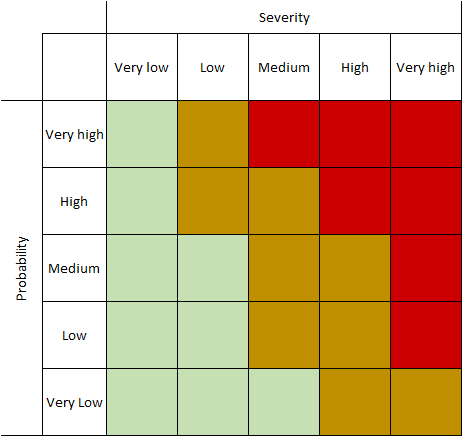
Qualitative risk assessment is subjective. It uses descriptive scales like "low," "medium," and "high" to rate the likelihood and impact of a risk. Teams often use a risk matrix to visualize these ratings, helping to prioritize which risks need immediate attention. It’s fast and great for getting a general sense of your risk landscape.
Quantitative risk assessment aims to assign a specific monetary value to risk. This is where you get to do some math. It's more complex but provides hard numbers that are useful for justifying security investments to leadership. The goal is to calculate the Annualized Loss Expectancy (ALE), which is the total amount of money you can expect to lose on an asset in a single year.
Let's say your customer database (Asset Value) is worth $1,000,000. A ransomware attack could corrupt half the data, making the Exposure Factor 0.5. Your SLE would be $500,000. If historical data suggests a similar attack happens once every five years (ARO = 0.2), your ALE is $100,000. Now you have a clear financial case for spending up to $100,000 a year to protect that database.
Choosing a Response
Once you understand a risk, you have to decide what to do about it. There are four standard risk treatment options.
| Strategy | Description | Example |
|---|---|---|
| Mitigate | Reduce the risk's likelihood or impact by implementing controls. | Installing multi-factor authentication to make account takeovers harder. |
| Transfer | Shift the financial impact of the risk to a third party. | Buying cybersecurity insurance to cover the costs of a data breach. |
| Avoid | Eliminate the risk by ceasing the activity that causes it. | Deciding not to collect sensitive user data that isn't critical for business operations. |
| Accept | Acknowledge the risk and do nothing, typically because the cost to address it outweighs the potential loss. | Acknowledging a minor bug in an internal, non-critical application. |
The right choice depends on the organization's risk appetite and the results of your risk assessment. For the database with an ALE of $100,000, accepting the risk is probably not an option. Mitigation would be the most likely path.
Frameworks in Action
Several established frameworks provide a repeatable process for managing risk. Two of the most common are the NIST Risk Management Framework (RMF) and ISO/IEC 27005.
The NIST RMF, widely used by the U.S. federal government and many private organizations, is a seven-step process:
- Prepare: Get the organization ready to manage security and privacy risks.
- Categorize: Determine the criticality of the information and systems.
- Select: Choose the appropriate security controls based on the categorization.
- Implement: Put the selected controls in place.
- Assess: Verify that the controls are implemented correctly and working as intended.
- Authorize: Make a formal decision to authorize the system to operate.
- Monitor: Continuously track the system and its controls for changes and new risks.
is an international standard that provides guidelines for information security risk management. It complements ISO/IEC 27001, which specifies the requirements for an Information Security Management System (ISMS). Its process is very similar, focusing on context establishment, risk assessment, risk treatment, and continuous monitoring.
By adopting a framework, you move beyond guesswork. You create a defensible, repeatable process for protecting what matters most to the business.
What is the primary purpose of using a risk management framework?
In the context of risk management, which of the following is NOT considered an asset?
These structured approaches transform security from a purely technical function into a core business strategy, ensuring that every decision is informed, justified, and aligned with organizational goals.