Strategic Alignment in Business
Strategic Management
Steering the Ship
Think of a company as a large ship. It can't just drift aimlessly in the ocean; it needs a destination and a captain to chart the course. Strategic management is the art and science of being that captain. It’s about looking ahead, deciding where the organization should go in the long run, and figuring out the best way to get there.
It's not about managing the day-to-day tasks like swabbing the deck. Instead, it’s about navigating through changing weather, avoiding icebergs, and ensuring the ship reaches its intended port successfully.
Strategic Management
noun
The ongoing process of planning, monitoring, analyzing, and assessing all that is necessary for an organization to meet its goals and objectives.
Without this forward-looking approach, a company is simply reacting to events as they happen. With it, a company can be proactive, shaping its own future. This is crucial for staying relevant and successful in a world that's always changing.
From Idea to Action
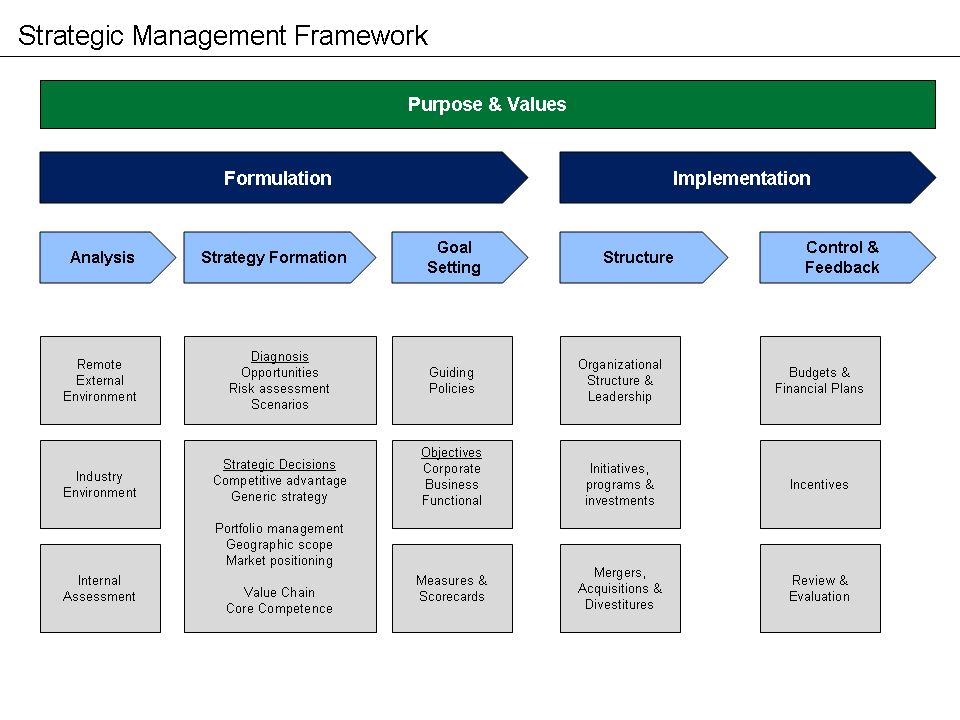
The strategic management process isn't a one-time event; it's a continuous cycle. It generally involves two key phases: formulation and implementation.
Strategic management is an ongoing process involving analyzing internal and external environments, formulating strategies, implementing plans, and evaluating outcomes to achieve organizational goals
Strategy Formulation is the thinking and planning phase. Here, leaders analyze the organization's current situation. They look internally at strengths and weaknesses, and externally at market opportunities and threats. Based on this analysis, they decide on a mission, set long-term objectives, and craft the strategies to achieve them. This is where the destination is chosen.
Strategy Implementation is the action phase. A brilliant plan is worthless if it stays on paper. This stage is about putting the strategy to work. It involves mobilizing resources, structuring teams, and developing policies to support the new direction. This is where the crew starts sailing the ship toward the destination.
The cycle is completed by Evaluation & Control, where the organization monitors its progress. Are we on course? Did our strategy work as expected? This feedback loop allows the organization to learn, adapt, and refine its strategy over time.
Aligning Resources for Success
A strategy is only as good as its execution. A core part of strategic management is ensuring that all of an organization's resources, from its budget and technology to its people and their skills, are aligned with its goals. If a company's strategy is to be a leader in customer service, it must invest in training its staff, implementing better support software, and creating policies that empower employees to help customers.
This alignment prevents different parts of the company from pulling in opposite directions. When everyone and everything is working toward the same objective, the organization moves forward with power and purpose.
Ultimately, the goal of strategic management is to gain a competitive advantage. This means creating superior value for customers in a way that rivals can't easily copy. It might be through lower prices, a better product, or outstanding service.
By carefully analyzing the market and its own capabilities, a company can find a unique position where it can excel. Strategic management provides the roadmap to get there and stay there, ensuring long-term health and success.
What is the primary purpose of strategic management for a company?
A company's leaders are analyzing the market for new opportunities and assessing their internal weaknesses. Which phase of the strategic management process are they in?