Strategic Agribusiness Management and Operations
Agribusiness Structures and Models
From Field to Enterprise
The journey from a family farm to a modern agribusiness involves more than just scaling up production. It requires a fundamental shift in structure. While traditional farming centers on cultivation, agribusiness encompasses the entire value chain, from seed production and equipment manufacturing to processing, marketing, and distribution. This complexity demands sophisticated organizational models to manage operations, secure capital, and navigate competitive markets.
Choosing the right structure is a critical strategic decision. It shapes everything from day-to-day governance and profit distribution to long-term growth potential. The two dominant frameworks in the agricultural sector are the corporate and cooperative models, each with distinct philosophies and operational mechanics.
Corporate vs. Cooperative Structures
The corporate model is familiar to most. It's a business entity owned by shareholders, who may or may not be involved in the daily operations. The primary objective is to generate profit for these investors. Decision-making is typically hierarchical, with a board of directors and executive leadership steering the company. This structure excels at raising capital through the sale of stock, enabling rapid expansion and large-scale investments in technology and infrastructure.
In contrast, a cooperative is owned and controlled by its members—the very people who use its services. In agriculture, this usually means the farmers themselves. Each member typically gets an equal vote in governance, regardless of the size of their individual operation, creating a democratic structure. The primary goal of a co-op isn't to generate returns for outside investors, but to provide benefits to its members, such as better prices for their products, lower costs for inputs like seeds and fertilizer, or access to shared processing and marketing resources. Profits, or surplus earnings, are often returned to members as patronage dividends.
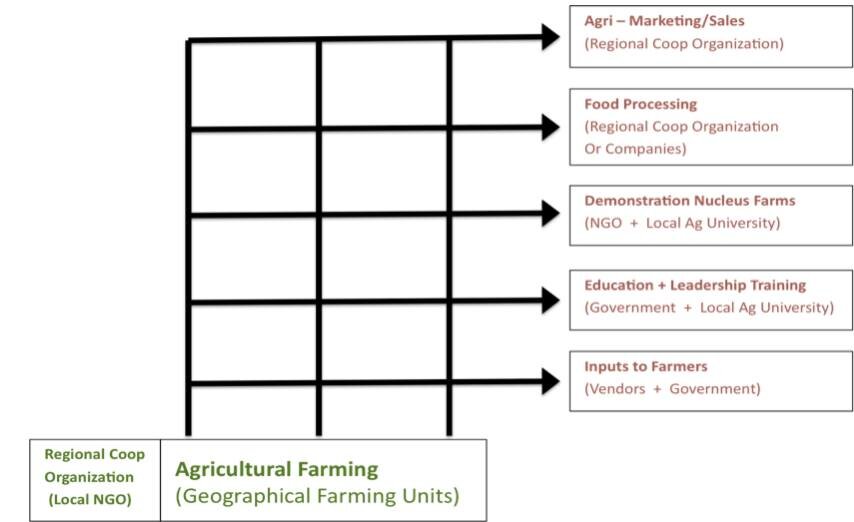
Both models have their place, and the choice depends on the goals of the producers involved.
| Feature | Corporate Model | Cooperative Model |
|---|---|---|
| Ownership | Investors/Shareholders | Member-Patrons (e.g., Farmers) |
| Control | Board of Directors (votes based on shares) | Democratic (one member, one vote) |
| Primary Goal | Maximize shareholder profit | Maximize member benefit |
| Profit Distribution | Dividends to shareholders | Patronage refunds to members |
| Capital Source | Sale of stock, private equity | Member investment, retained earnings, debt |
Strategies for Growth and Control
As an agribusiness grows, it often seeks to expand its control over the market and its supply chain. Two key strategies for achieving this are horizontal and vertical integration.
Horizontal integration is about growing bigger at one stage of the value chain. This usually happens when a company acquires or merges with a competitor. For instance, if two large dairy processing companies merge, they are integrating horizontally. The goal is to increase market share, achieve economies of scale, and reduce competition.
Vertical integration, on the other hand, involves expanding control across multiple stages of the supply chain. A company integrates vertically when it buys one of its suppliers (backward integration) or one of its distributors (forward integration). A classic example is a poultry company that owns everything from the chicken hatcheries and feed mills to the processing plants and trucking fleet that delivers the final product to grocery stores.
By consolidating these activities, agribusinesses gain more control, reduce dependency on third parties, and improve overall profitability.
This consolidation allows companies to capture profits from multiple stages, reduce costs, and ensure a stable supply of inputs and a reliable path to market. However, it also requires significant capital and management expertise across different types of businesses.
Models of Partnership and Production
Beyond a company's core structure, specific business models define how it interacts with producers. One of the most prevalent is contract farming . In this arrangement, an agricultural production company (the contractor) signs an agreement with a farmer to supply a specific quantity and quality of a commodity. The price is often agreed upon in advance.
The company often provides the farmer with inputs like seeds, fertilizer, and technical guidance. In return, the farmer gets a guaranteed market for their produce, reducing price risk. This model is common in poultry, pork, and many specialty crops. For the company, it ensures a predictable supply of raw materials that meet their exact specifications without the cost and risk of owning and managing the farms themselves. For the farmer, it provides stability but can also mean less autonomy over their own operations.
Successfully navigating the agribusiness landscape requires a firm grasp of these structures and strategies. The choice of business model, approach to growth, and method of production all have profound impacts on profitability, risk, and control.
What is the primary objective of an agricultural cooperative?
A large tomato processing company purchases a commercial farm that grows tomatoes and a trucking company that transports them. This is an example of: