Stoichiometry Made Simple
Introduction to Stoichiometry
Chemistry's Recipe Book
Think about baking a cake. You can't just throw random amounts of flour, sugar, and eggs into a bowl and expect a perfect result. You need to follow a recipe. The recipe tells you the exact quantities of each ingredient to use to get the desired outcome—one delicious cake.
Chemical reactions are a lot like that. They follow specific recipes. The study of these chemical recipes is called stoichiometry. It's how chemists figure out the amounts of substances involved in a reaction.
Stoichiometry
noun
The calculation of reactants and products in chemical reactions.
Essentially, stoichiometry lets us answer questions like, "If I start with this much of ingredient A, how much of product C can I make?" or "To produce a certain amount of product D, how much of ingredient B do I need?" It's a fundamental tool for planning and understanding chemical processes.
The Importance of Balance
In chemistry, our recipes are written as chemical equations. But for the recipe to be correct, the equation must be balanced. A balanced chemical equation is one where the number of atoms for each element is the same on both the reactant (starting ingredients) side and the product (final result) side.
This reflects a fundamental law of nature: the Law of Conservation of Mass. In any chemical reaction, matter is not created or destroyed. Atoms just get rearranged into new molecules. The total mass of what you start with must equal the total mass of what you end with.
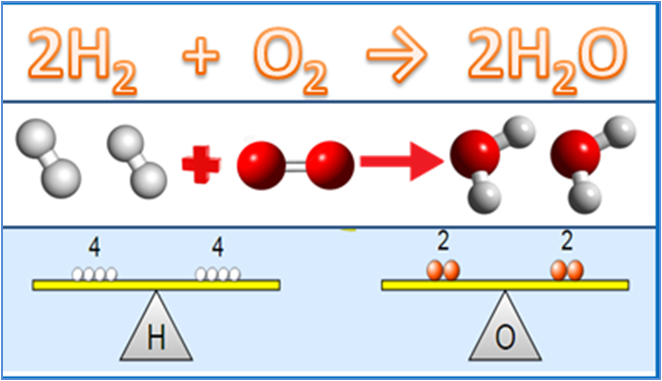
Look at the reaction for making water from hydrogen and oxygen:
On the left side (reactants), we have 4 hydrogen atoms (2 molecules of ) and 2 oxygen atoms (1 molecule of ). On the right side (products), we have 4 hydrogen atoms and 2 oxygen atoms (in 2 molecules of ). The atoms are all accounted for. The equation is balanced.
An unbalanced equation is like a recipe that's missing information. A balanced equation gives you the complete, correct instructions.
Reading the Recipe
The numbers in front of the molecules in a balanced equation are called coefficients. They are the heart of our chemical recipe. They tell us the proportion, or ratio, in which the substances react and are produced.
These proportions are called mole ratios. For now, you can think of a "mole" as a chemist's version of a dozen—it's just a standard amount of something. The coefficients tell us how many "moles" of each substance are involved.
From our water equation, , we can establish several mole ratios:
| Reactant A | Reactant B / Product C |
|---|---|
| 2 moles of | 1 mole of |
| 2 moles of | 2 moles of |
| 1 mole of | 2 moles of |
These ratios are conversion factors. They allow us to move from the quantity of one substance in the reaction to the quantity of another. For example, the ratio of hydrogen to oxygen tells us that we always need twice as many moles of hydrogen as we do oxygen.
Understanding these fundamental ratios is the first step in using stoichiometry to predict the outcomes of chemical reactions.
Now, let's test your understanding of these core concepts.
What is the primary focus of stoichiometry?
A chemical equation must be balanced because matter cannot be created or destroyed in a chemical reaction.
Grasping stoichiometry is all about understanding that chemical reactions are predictable and follow a strict set of rules, just like a well-written recipe.