Stoichiometry for Carbon Footprint Calculation
Stoichiometry Fundamentals
The Recipe of Chemistry
Think of a chemical reaction like a recipe. To bake a cake, you need specific amounts of flour, sugar, and eggs. You can't just throw random quantities into a bowl and expect a perfect result. Chemistry is the same. Chemical equations are the recipes, and the substances are the ingredients. Stoichiometry is the process of figuring out the exact amount of each ingredient you need and how much of the final product you'll make.
Stoichiometry is a subdomain of chemistry dealing with the quantitative relationship between the reactants and products in chemical reactions (Niaz & Montes, 2012).
Keeping It Balanced
The foundation of any chemical recipe is the law of conservation of mass. In a chemical reaction, atoms aren't created or destroyed; they just get rearranged. A balanced chemical equation reflects this law. It ensures that the number of atoms of each element is the same on both the reactant (starting ingredients) side and the product (final dish) side.
Let's look at a classic example: making water from hydrogen and oxygen.
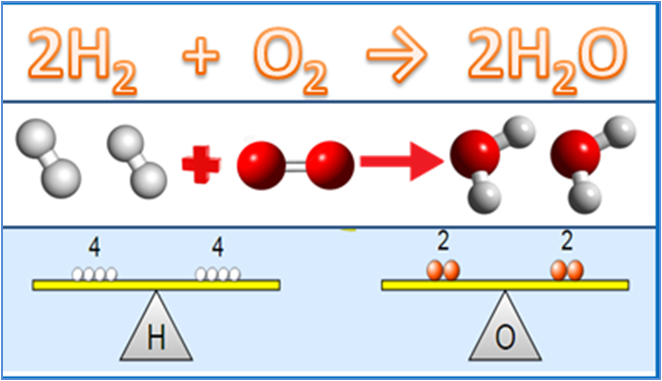
The numbers in front of the chemical formulas, called coefficients, are crucial. They tell us the ratio in which the substances react. Here, the ratio is 2 molecules of hydrogen to 1 molecule of oxygen to 2 molecules of water.
Counting with Moles
Atoms and molecules are incredibly tiny, so we can't count them one by one. To solve this, chemists use a unit called the mole. A mole is simply a specific number, much like a dozen is always 12. It's a way to connect the atomic-scale world with the grams we can measure in a lab.
mole
noun
A unit of measurement for the amount of a substance, defined as exactly 6.02214076 × 10²³ particles (atoms, molecules, ions, etc.). This value is known as Avogadro's number.
How much does one mole of something weigh? That depends on the substance. The mass of one mole of an element or compound is called its molar mass, measured in grams per mole (g/mol). You can find the molar mass of an element by looking at its atomic mass on the periodic table. For a compound, you just add up the molar masses of all the atoms in its formula.
For example, the molar mass of water () is the mass of two hydrogen atoms plus one oxygen atom. This comes out to approximately 18.02 g/mol.
Putting It All Together
Now we can combine these ideas to perform calculations. The coefficients in a balanced equation don't just tell us the ratio of molecules; they tell us the ratio of moles.
Let's return to our water recipe: . This means 2 moles of hydrogen react with 1 mole of oxygen to create 2 moles of water. This is the mole-to-mole ratio, and it's the heart of stoichiometry.
This roadmap lets us perform mass-to-mass conversions. If we know the mass of one substance in a reaction, we can calculate the mass of any other substance involved.
Let's say we want to produce 36 grams of water (). How many grams of oxygen () do we need?
-
Convert mass to moles: The molar mass of is about 18 g/mol. So, 36 g of is moles of .
-
Use the mole ratio: From our balanced equation (), the ratio of to is 1:2. To make 2 moles of , we need 1 mole of .
-
Convert moles back to mass: The molar mass of is about 32 g/mol. So, 1 mole of is 32 grams.
To produce 36 grams of water, we need 32 grams of oxygen.
Now, let's test your understanding of these foundational concepts.
What fundamental law provides the basis for balancing chemical equations?
In the balanced chemical equation , what do the coefficients tell us?
These principles are the building blocks for quantifying chemical reactions, from simple lab experiments to complex industrial processes.