Stoic Foundations and First Principles
Cosmic Reason and Logos
The Universe as a Single Mind
The Stoics viewed the universe not as a collection of dead matter, but as a single, living organism. This idea is called Monism—the belief that everything is fundamentally one substance. This contrasts sharply with Dualism, which splits reality into separate realms, like mind and body, or the physical and the spiritual. For the Stoics, there was no split. The cosmos itself was a rational, divine entity.
Everything is interconnected, woven into a single, cosmic tapestry.
They believed this single substance had two aspects. The first is the passive principle: matter itself, inert and formless. The second is the active principle, which they called Logos (λόγος). Logos is the divine reason, the cosmic intelligence that permeates and organizes all matter. Think of it like this: if the universe is a body, Logos is its soul. It's the universal law that gives shape, purpose, and order to everything, from the orbit of a planet to the growth of a plant.
The Divine Fire
The concept of Logos didn't originate with the Stoics. They borrowed heavily from an earlier philosopher, , who saw the cosmos as an “ever-living fire” constantly changing yet governed by a universal, rational principle. The Stoics took this idea and made it the bedrock of their physics and theology. They identified Logos directly with God and Nature. For them, these weren't three different things, but three names for the same thing: the rational, purposeful, and divine order of the universe.
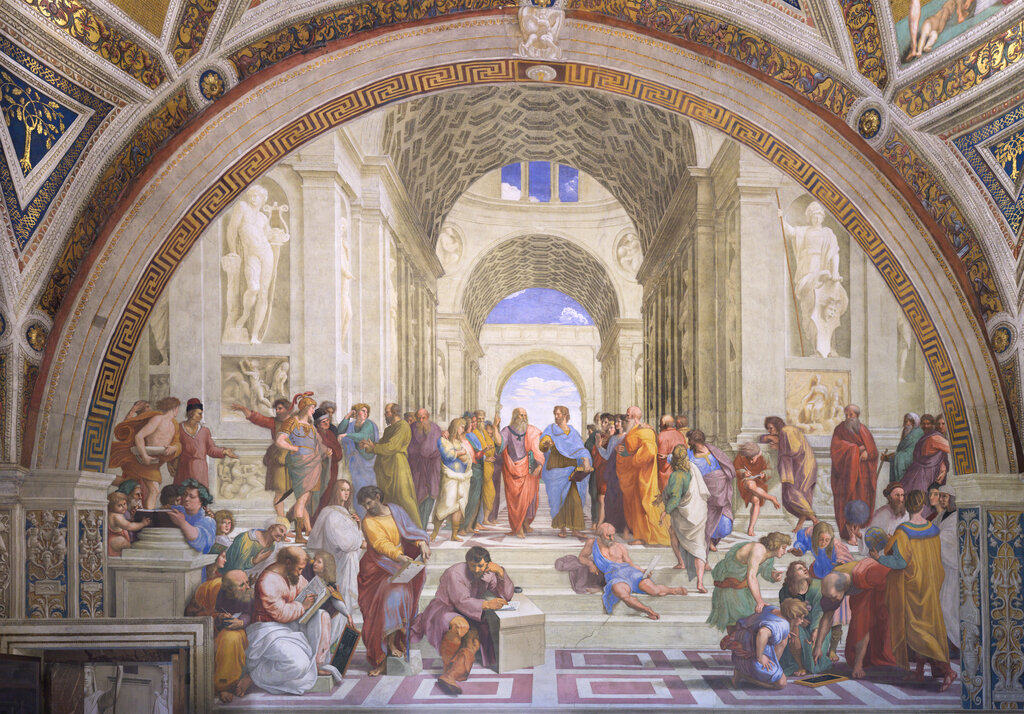
This belief in an ordered, rational universe has a major consequence: everything happens for a reason. There is no room for pure chance or randomness. The Stoics called this concept Providence (pronoia). The universe isn't just a machine; it's a benevolent and rational entity guiding all events toward a coherent end. Our individual lives are threads in this vast, perfectly woven fabric.
Providence Over Chance
This worldview placed the Stoics in direct opposition to other schools of thought, particularly . The Epicureans argued that the universe was nothing more than atoms moving randomly through a void. For them, there was no divine plan, no Providence, only the chaotic collision of particles. The gods, if they existed, were distant and uninterested in human affairs.
The Stoics found this view unacceptable. They saw overwhelming evidence of order, design, and purpose in the natural world. For them, the intricate structure of a spider's web or the predictable cycle of the seasons pointed not to random chance, but to an underlying cosmic intelligence.
If the universe is rational, then nothing that happens within it can be truly irrational or meaningless.
This brings us to the human mind. The Stoics believed that human reason is a fragment of the universal Logos—a spark of the divine fire within each of us. Our ability to think logically, to understand the world, and to make rational choices is our direct connection to the mind of the cosmos. Therefore, living a good life isn't just about following ethical rules. It's about aligning our personal, micro-Logos with the macro-Logos of the universe. To live according to reason is to live in harmony with Nature itself.
Time to check your understanding of these core concepts.
Which of the following best describes the Stoic concept of Monism?
The Stoic concept of Logos, the divine reason that organizes the universe, was heavily influenced by which earlier philosopher?
Understanding the Logos is key to understanding Stoicism. It transforms their ethics from a simple set of guidelines into a profound practice of cosmic alignment.