Stock Trading Essentials
Introduction to Stock Markets
Where Companies and Investors Meet
A stock market is a collection of markets where people buy and sell ownership stakes in public companies. Think of a company that wants to expand, maybe build a new factory or hire more people. To get the cash for these big projects, it can sell tiny pieces of itself to the public. These pieces are called stocks or shares.
stock
noun
A security that represents a fractional ownership in a company.
The stock market provides a place for these transactions to happen. It connects companies that need capital to grow with investors who want to put their money to work. This process starts in what's called the primary market.
Primary and Secondary Markets
When a private company first offers its stock to the public, it's called an Initial Public Offering, or IPO. This happens in the primary market. Investors buy shares directly from the company, and the money raised goes to the company itself to fund its operations and growth.

But what happens after the IPO? What if an investor who bought shares wants to sell them? That's where the secondary market comes in. This is the market most people are familiar with. Here, investors trade stocks among themselves without the company's direct involvement. The price of a stock in the secondary market is driven by supply and demand. If more people want to buy a stock than sell it, the price goes up. If more want to sell than buy, the price goes down.
In the primary market, money flows to the company. In the secondary market, money flows between investors.
The Role of Stock Exchanges
These trades need an organized and regulated place to occur. That's the job of a stock exchange. Exchanges are the marketplaces that facilitate the buying and selling of stocks. Famous examples include the New York Stock Exchange (NYSE) and the Nasdaq.
Exchanges do a few critical things:
- Provide Liquidity: They make it easy for investors to buy and sell stocks quickly. Without an exchange, finding someone to buy your specific shares at a fair price would be difficult.
- Ensure Fair Pricing: By bringing all buyers and sellers together, exchanges help ensure that the price of a stock reflects its current market value based on supply and demand.
- Set Rules: They establish and enforce rules for trading and for the companies listed on them, promoting transparency and fairness.
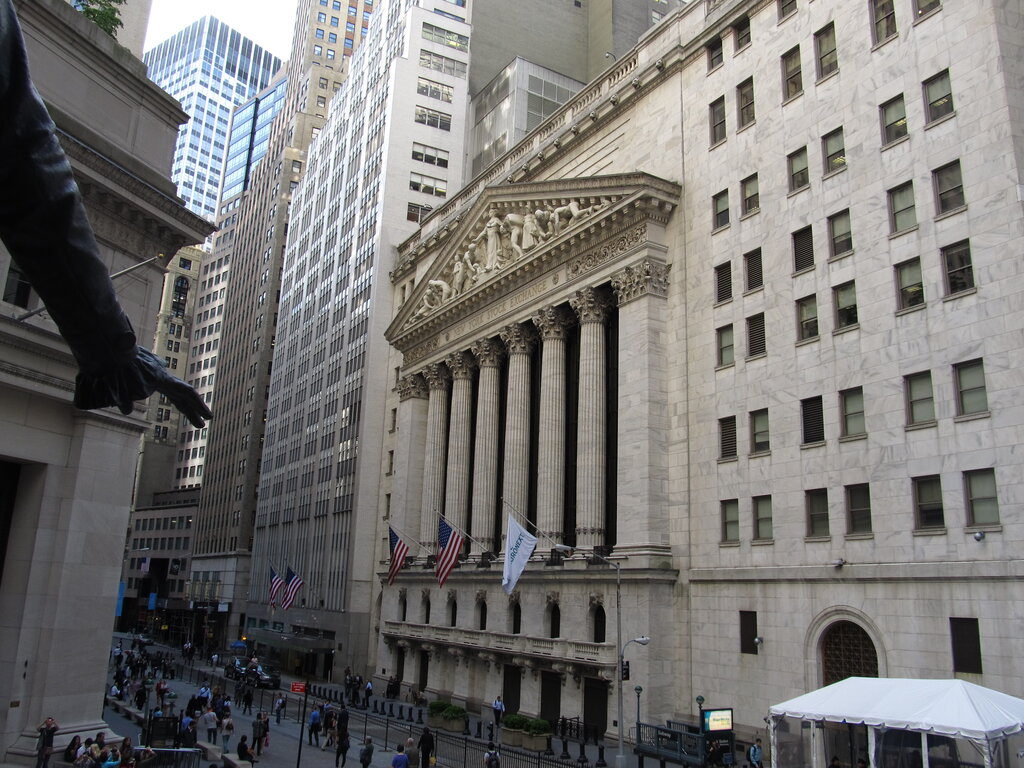
While some exchanges like the NYSE have physical trading floors, much of today's trading happens electronically on vast computer networks.
How We Measure the Market
With thousands of companies to follow, how can you get a quick snapshot of how the market is doing overall? That's the purpose of a market index.
A market index tracks the performance of a group of stocks that represents a portion of the market. It's like taking a poll to gauge the mood of a large group instead of asking every single person. If the index is up, it generally means that the stocks within it are, on average, doing well. If it's down, the opposite is true.
An index simplifies the complex market into a single number, making it easier to track general trends.
Some of the most well-known indices are:
- The S&P 500: Tracks 500 of the largest U.S. companies. It's often used as a benchmark for the health of the entire U.S. stock market.
- The Dow Jones Industrial Average (DJIA): Follows 30 large, well-established U.S. companies. Because it includes so few companies, it's more of a snapshot of prominent industry leaders than the market as a whole.
- The Nasdaq Composite: Includes most of the stocks listed on the Nasdaq exchange, which is heavy on technology companies.
By watching these indices, investors and analysts can quickly assess the market's direction and overall economic health.
Now let's review these core concepts.
In which market does a company sell its shares directly to the public for the first time to raise capital?
What is the main purpose of a stock market index like the S&P 500?