Stock Trading Essentials
Stock Market Basics
A Piece of the Pie
At its core, a stock is a simple idea: it's a small piece of ownership in a publicly traded company. When you buy a company's stock, you become a shareholder. You own a tiny fraction of that business, from its factories and patents to its brand and future profits.
Think of it like buying a slice of a giant pizza. The company is the whole pizza, and each share of stock is one slice. If the pizza parlor (the company) does well and becomes more popular, your slice becomes more valuable. If it struggles, the value of your slice might go down.
Why do companies sell these slices in the first place? To raise money. This process is called issuing stock. Selling ownership shares allows a company to get cash, known as capital, to fund its growth. They can use this money to build new facilities, develop new products, or expand into new markets without going into debt.
stock
noun
A security that represents a share of ownership in a corporation.
The First Sale and Beyond
Stocks aren't just bought and sold in one giant free-for-all. The market is split into two main parts: the primary market and the secondary market.
The primary market is where a stock is born. When a private company decides to "go public," it holds an Initial Public Offering, or IPO. This is the very first time the company sells its stock to the public. The money from this sale goes directly to the company itself.
An IPO is like the grand opening of a new store. The company sells its goods (stocks) for the first time directly to its first customers (investors).
After the IPO, things move to the secondary market. This is what most people think of as "the stock market." Here, investors trade those already-issued stocks among themselves. The company isn't directly involved in these transactions. If you buy shares of Apple today, you're buying them from another investor who decided to sell, not from Apple.
| Market | What Happens? | Who Gets the Money? |
|---|---|---|
| Primary | A company issues new stock for the first time (IPO). | The company. |
| Secondary | Investors trade already-existing stocks with each other. | The selling investor. |
Where Trading Happens
The secondary market needs an organized place to function. That's the role of a stock exchange. It's a marketplace that brings buyers and sellers together, ensuring that trading is fair and orderly. Two of the most famous exchanges in the world are in the United States.
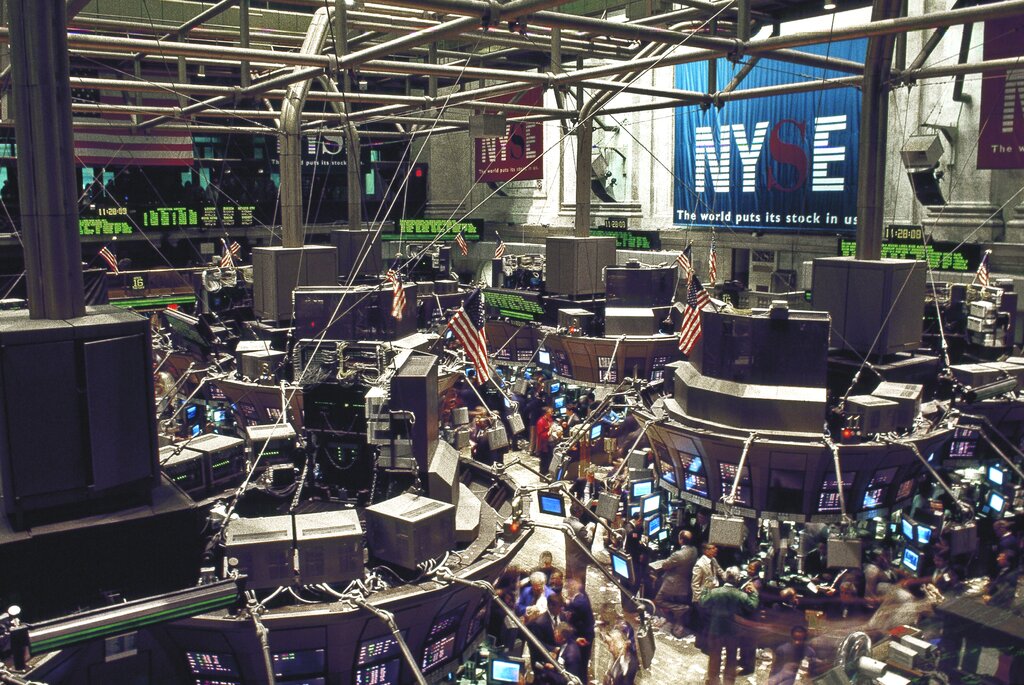
The New York Stock Exchange (NYSE) is the classic example. It operates as an auction market, where humans (and computers) match buyers and sellers. The NASDAQ is different. It's a dealer's market and was the world's first electronic stock market. Trades are made through a vast computer network rather than on a physical trading floor.
Several key players make these exchanges work:
- Investors: These are the individuals and institutions (like pension funds) buying and selling stocks.
- Brokers: These are the middlemen. Since you can't just walk onto the NYSE floor to buy a stock, you use a broker (often through an online platform) to execute trades on your behalf.
- Market Makers: These are firms that stand ready to buy or sell a particular stock at any time. They provide liquidity, ensuring there's always someone to trade with, which helps transactions happen smoothly.
Checking the Market's Pulse
With thousands of stocks trading every second, how can anyone know how the market is doing overall? That's where market indices come in. An index tracks the performance of a group of stocks, offering a snapshot of the market's health.
Think of it like a poll. Instead of asking every single person their opinion, you ask a representative sample. Similarly, an index tracks a sample of stocks to represent a larger trend.
Two of the most cited indices are:
- The Dow Jones Industrial Average (DJIA): Often just called "the Dow," this is one of the oldest and most famous indices. It tracks the stock prices of 30 large, influential U.S. companies.
- The S&P 500: This is a much broader index. It follows the performance of 500 of the largest publicly traded companies in the U.S. Because it includes so many companies from different industries, many experts see it as a better representation of the overall U.S. market.
When you hear a news report say "the market was up today," they are usually referring to the performance of a major index like the S&P 500 or the Dow.
These indices help investors quickly gauge market sentiment and compare the performance of their own investments against a broad benchmark.
Ready to check your understanding? Let's see what you've learned.
What does owning a share of a company's stock fundamentally represent?
When a company conducts an Initial Public Offering (IPO), the money from the sale of shares goes directly to the company. In which market does this take place?
Understanding these core components—what a stock is, where it's traded, and how we measure performance—is the first step to making sense of the financial world.