Stock Market Fundamentals for Smart Investing
Stock Market Basics
What Is a Stock Market?
Think of the stock market as a massive, global marketplace. But instead of selling fruits or crafts, this market trades tiny pieces of ownership in companies. These pieces are called stocks or shares.
When a company wants to grow, it might decide to sell off parts of itself to the public to raise money. This is called 'going public.' By buying a share, you become a part-owner, or shareholder, in that company. If the company does well and grows in value, the value of your share might go up too. If it does poorly, your share's value could fall.
The main purpose of the stock market is twofold: it allows companies to raise capital to fund their operations and expansion, and it gives investors an opportunity to profit from the growth of those companies.
Where Trading Happens
You can't just buy stocks on the street. These transactions happen in organized, regulated markets called stock exchanges. Think of them as the official venues for the marketplace.
Two of the most famous exchanges are in the United States: the New York Stock Exchange (NYSE) and the Nasdaq. The NYSE has a physical trading floor where some business is still conducted in person, like an auction. The Nasdaq, on the other hand, is a completely electronic market where all buying and selling happens on a network of computers. Most modern exchanges around the world operate electronically.

These exchanges ensure that trading is fair and orderly. They set rules for the companies listed on them and the brokers who trade there.
The Key Players
Several groups interact to make the stock market work. The main participants are companies, investors, and brokers.
| Player | Role |
|---|---|
| Companies | They issue and sell stocks to raise money. |
| Investors | Individuals or institutions who buy and sell stocks, hoping to make a profit. |
| Brokers | Intermediaries who execute buy and sell orders on behalf of investors. |
| Exchanges | The organized markets where brokers trade stocks with each other. |
As an individual investor, you can't trade directly on an exchange. You need a broker to act on your behalf. In the past, this meant calling a person on the phone. Today, most investors use online brokerage firms or mobile apps to place their trades.
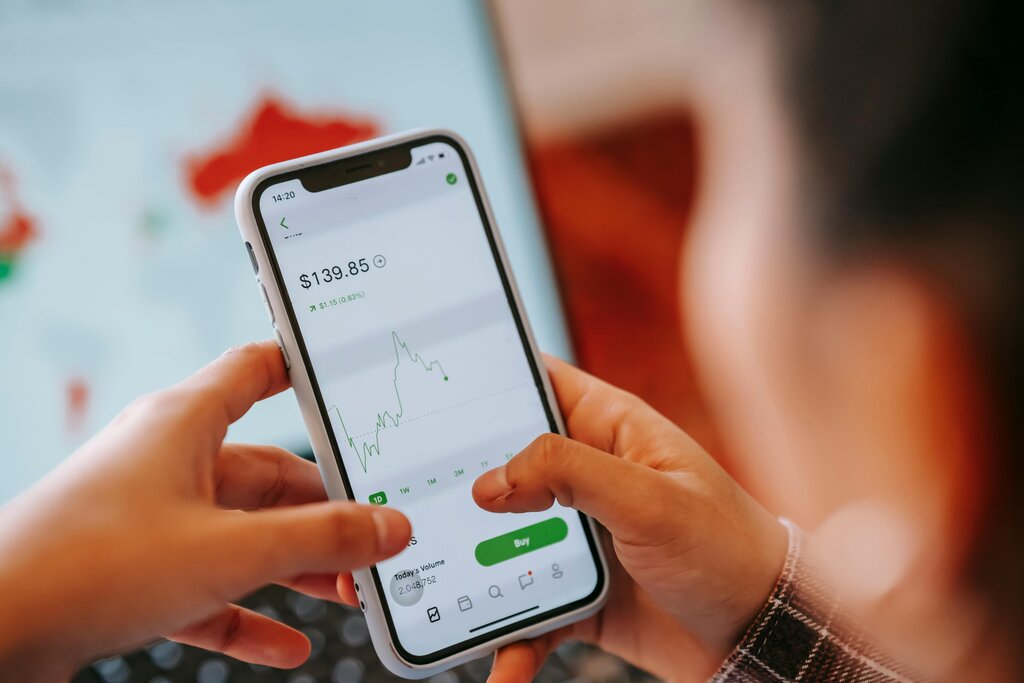
The entire process works like a chain of communication. You tell your broker you want to buy a stock, and the broker sends that order to the exchange to find a seller.
How Prices Are Set
What makes a stock's price go up or down? At its core, it's all about supply and demand.
Supply refers to the number of shares available for sale. Demand is the number of shares that investors want to buy.
If more people want to buy a stock (high demand) than sell it (low supply), the price goes up. Sellers can ask for more money because they know someone will be willing to pay it.
Conversely, if more people are trying to sell a stock (high supply) than buy it (low demand), the price goes down. Sellers might have to lower their asking price to attract a buyer.
A stock's price is simply the last price a buyer and seller agreed upon for a trade. It's a constant negotiation.
Many factors can influence supply and demand. Good news about a company, like strong profits, can increase demand. Bad news, like a product recall, can cause people to sell, increasing supply and lowering demand. Broader economic trends, interest rates, and even investor sentiment all play a role in shifting prices from one moment to the next.
Now, let's test your understanding of these core concepts.
What is the primary reason a company decides to 'go public'?
If many investors suddenly want to sell a particular stock and very few want to buy it, what will happen to the stock's price?
Understanding these fundamentals provides the foundation for exploring how to participate in the market.