Stock Market Fundamentals for Savvy Investors
Stock Market Basics
What is a Stock Market?
Think of the stock market as a giant, global marketplace. But instead of selling fruits or antiques, this market trades tiny pieces of ownership in companies. These pieces are called stocks or shares.
When you buy a stock, you're buying a small fraction of a publicly-traded company, like Apple or Ford. You become a part-owner, or shareholder.
The market has two main purposes. For companies, it’s a way to raise money. By selling shares to the public, a company gets cash—called capital—to fund new projects, build factories, or hire more people. For investors, it's an opportunity to grow their money. If the company does well and its value increases, the price of its stock may also go up, making the investor's shares worth more.
Where Trading Happens
This buying and selling doesn’t happen in a random online forum. It takes place in organized markets called stock exchanges. These exchanges act as central locations where buyers and sellers can trade shares in a regulated and fair environment. While there are exchanges all over the world, two of the most famous are in the United States.
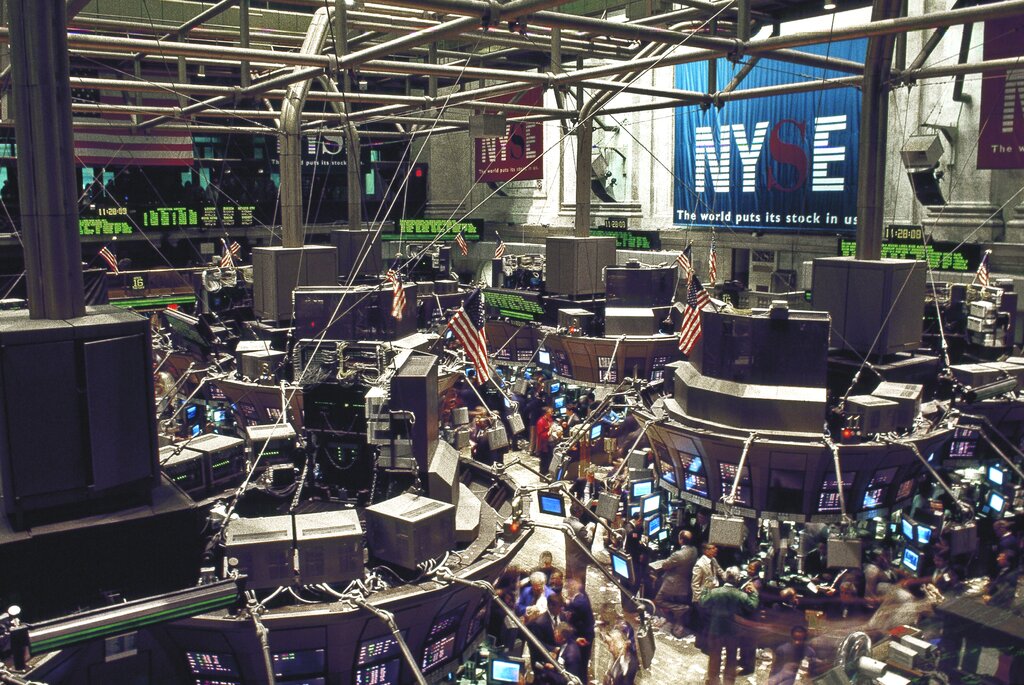
The New York Stock Exchange (NYSE) is one of the oldest and largest. It has a physical trading floor on Wall Street, though most of its trading is now electronic. It's home to many large, well-established companies.
The NASDAQ is a newer, all-electronic exchange. There's no physical trading floor where brokers shout orders. All trades are made through a network of computers. NASDAQ is known for being the home of many technology giants, such as Apple, Microsoft, and Amazon.
Who's in the Market?
Several key players keep the market running smoothly.
Investor
noun
An individual or institution (like a pension fund or mutual fund) that commits money to the stock market with the expectation of achieving a profit.
Investors are the buyers and sellers of stocks. They can be anyone from a person buying a few shares through a smartphone app to a massive university endowment managing billions of dollars.
You can't just call up the NYSE and buy a share of Coca-Cola. You need a middleman. That's where brokers come in.
Brokers are firms licensed to buy and sell stocks on behalf of investors. In the past, you'd call your broker on the phone to place an order. Today, most investors use online brokerage firms like Fidelity, Charles Schwab, or Robinhood to place trades with just a few clicks.
Market makers are the third key group. These are high-volume trading firms that are always ready to both buy and sell a particular stock. Their role is to provide liquidity, which means ensuring that there are always shares available to buy and someone willing to buy the shares you want to sell. This keeps the market flowing efficiently.
Prices and Trades
A stock's price is a direct reflection of supply and demand. If more people want to buy a stock (demand) than sell it (supply), the price goes up. If more people want to sell a stock than buy it, the price goes down.

What drives this supply and demand? Many factors, including:
- Company Performance: Strong profits or exciting new products can increase demand for a stock.
- Industry Trends: If a whole sector, like electric vehicles, becomes popular, stocks in that sector might see higher demand.
- Economic News: Broader news about inflation, interest rates, or unemployment can affect the entire market.
When you decide to buy or sell, you place an order through your broker. Let’s say you want to buy 10 shares of Company X. Your broker sends that order to an exchange. The exchange’s computer system then looks for someone selling at least 10 shares of Company X at a price you’re willing to pay. This is called matching. Once a match is found, the transaction happens in a fraction of a second.
| Order Type | Description |
|---|---|
| Bid | The highest price a buyer is willing to pay for a stock. |
| Ask | The lowest price a seller is willing to accept for a stock. |
| Spread | The small difference between the bid and the ask price. |
When you look at a stock quote, you'll often see both a bid and an ask price. The transaction happens when a buyer and seller agree on a price, which is typically somewhere between the bid and ask.
To get started, let's review the key players and places we've covered.
Ready to check your understanding?
What is the primary reason for a company to sell shares of its stock to the public?
Which of the following best describes a key difference between the New York Stock Exchange (NYSE) and the NASDAQ?
Understanding these core components—what the market is, where it happens, who participates, and how it works—is the first step to navigating the world of investing.