Stock Market Fundamentals for Savvy Investors
Stock Market Basics
What Is a Stock Market?
When you buy a stock, you're buying a small piece of ownership in a public company. Think of a company like a giant pizza. Each share of stock is like a tiny slice of that pizza. If the company does well, your slice might become more valuable. If it does poorly, your slice could lose value.
The stock market is simply the collection of markets and exchanges where these slices are bought and sold. It’s like a massive, organized marketplace for company ownership. This marketplace serves two main purposes. First, it allows companies to raise money by selling ownership slices (stocks) to the public. They use this cash to grow, innovate, and hire people. Second, it allows investors to buy those slices, hoping to share in the company's future success.
Where Trading Happens
You can't just walk up to a company and buy a share. The process is a bit more structured and involves two key players: stock exchanges and brokers.
A stock exchange is the central location where buyers and sellers come together. It's an organized and regulated market that ensures trading is fair and orderly. The most famous examples are the New York Stock Exchange (NYSE) and the Nasdaq. While we often picture a chaotic trading floor, most trading today happens electronically through a vast network of computers.
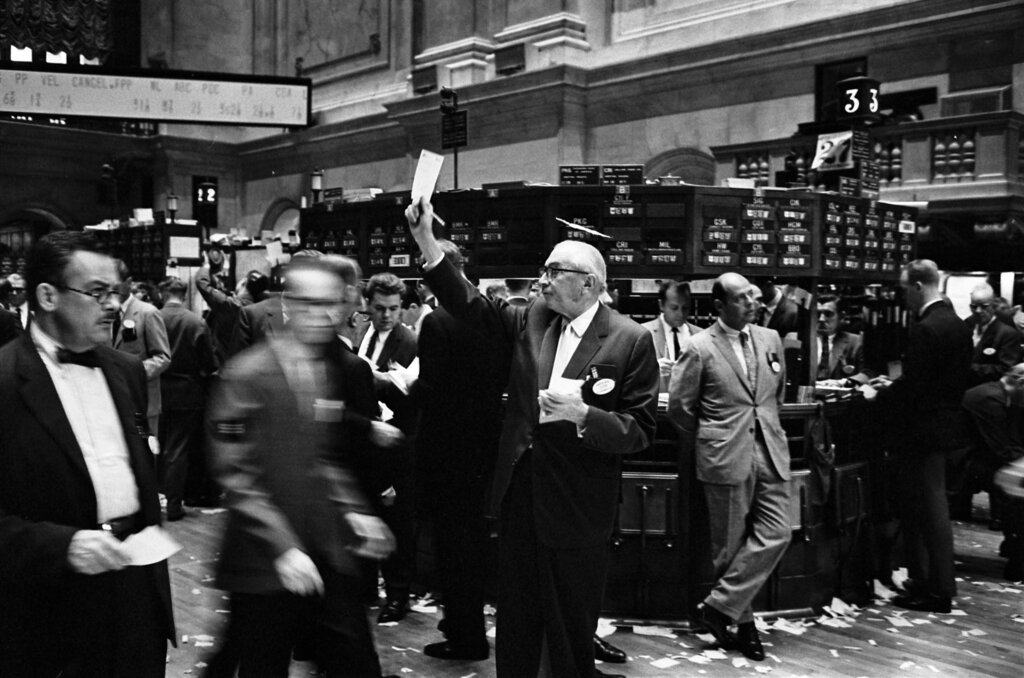
Most individuals don't trade directly on an exchange. Instead, we use a broker. A broker is a company or person licensed to buy and sell stocks on your behalf. In the past, you'd have to call your broker on the phone. Today, most people use online brokerage firms, which let you place trades from your computer or phone with just a few clicks.
Think of it this way: Exchanges are the markets, and brokers are your personal shoppers who go to the market for you.
How a Trade Works
Let's say you've decided to buy a share of a company. The process from your decision to owning the stock is a quick, highly automated journey.
When you place an order, you're not just saying "I want to buy." You're participating in an auction. For every stock, there are two important prices at any given moment: the bid price and the ask price.
Bid Price
noun
The highest price a buyer is willing to pay for a stock at that instant.
Ask Price
noun
The lowest price a seller is willing to accept for a stock at that instant.
The small difference between these two prices is called the bid-ask spread. When you place an order with your broker, you'll usually specify what kind of order it is.
| Order Type | Description |
|---|---|
| Market Order | Buys or sells a stock immediately at the best available current price. It prioritizes speed. |
| Limit Order | Buys or sells a stock only at a specific price or better. It prioritizes price over speed. |
So, a market order to buy will likely execute at the current ask price, while a market order to sell will execute at the current bid price. If you place a limit order, your trade will only go through if the stock's price hits your target.
Ready to check your understanding of these core concepts?
When you purchase a share of stock, what are you actually buying?
What is the primary purpose of a stock exchange like the NYSE or Nasdaq?
Understanding this basic machinery is the first step. It's the foundation upon which all investing knowledge is built. Now you know how the market operates behind the scenes.