Stock Market Fundamentals
Stock Market Basics
What Is a Stock Market?
The stock market is essentially a giant, organized marketplace. But instead of buying and selling fruits or antiques, people trade stocks. Stocks, also known as shares or equities, are tiny pieces of ownership in a public company.
When you buy a stock, you're buying a small fraction of that company. If the company does well and its value increases, the value of your stock may go up too. If it does poorly, your stock's value might fall.
The main purpose of the stock market is to connect companies that need money to grow with people who have money to invest. Companies sell shares to raise capital for things like building new factories or developing products. Investors buy those shares hoping to earn a return on their investment.
In its most basic form, the stock market is where regular people are investors – and they make money by buying and selling shares of companies.
Where Trading Happens
This buying and selling doesn't just happen randomly. It takes place on organized platforms called stock exchanges. Think of them as the specific venues within the larger marketplace. They provide a regulated environment where trading is fair and transparent.
Two of the most famous stock exchanges in the world are in the United States.
New York Stock Exchange (NYSE)
noun
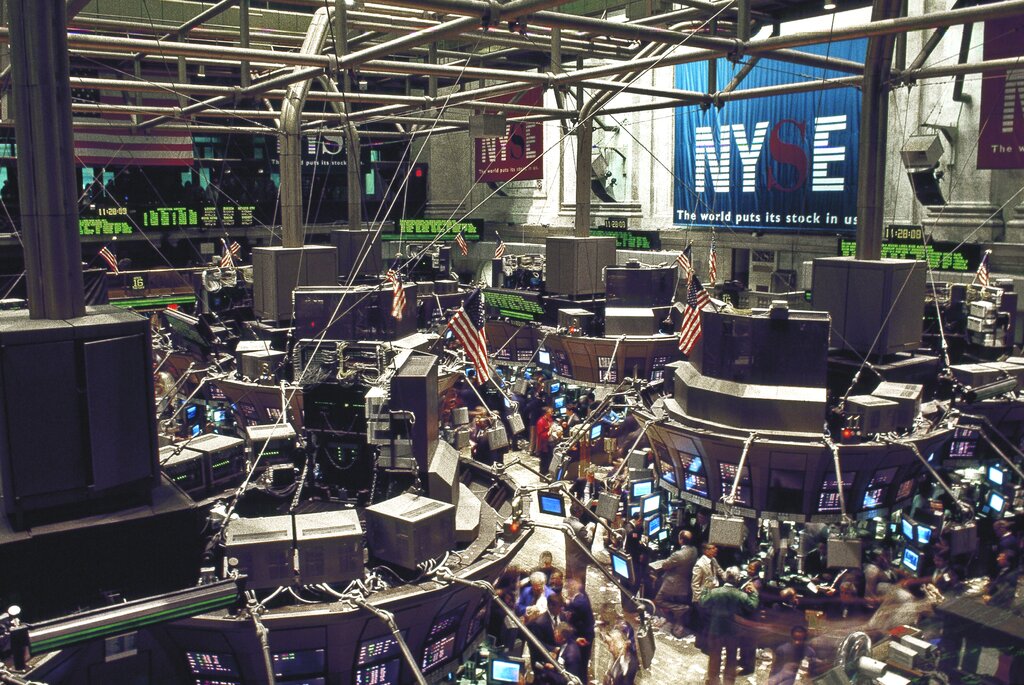
Often pictured with a chaotic trading floor, the NYSE is one of the oldest and largest exchanges. It combines a physical trading floor with modern electronic trading.
NASDAQ
noun
The NASDAQ is a fully electronic exchange with no physical trading floor. It's known for being home to many of the world's largest technology companies, like Apple and Microsoft.

While these are the biggest in the U.S., every major country has its own stock exchange, like the London Stock Exchange or the Tokyo Stock Exchange.
The People Involved
A few key players keep the market moving.
| Participant | Role |
|---|---|
| Investors | The buyers and sellers of stocks. This can be anyone from an individual with a retirement account to a massive pension fund managing billions of dollars. |
| Brokers | The intermediaries who execute trades on behalf of investors. You can't just walk onto the NYSE to buy a stock; you need a licensed broker to do it for you. Online platforms like Robinhood, Fidelity, and Charles Schwab are examples of modern brokers. |
| Market Makers | Firms that stand ready to buy or sell a particular stock at any time. They provide liquidity, ensuring that you can always find someone to trade with. They profit from the small difference between the price they're willing to buy at (the bid) and the price they're willing to sell at (the ask). |
Tracking the Market
With thousands of companies listed on exchanges, how do we know how the market is doing overall? We use stock indices.
A stock index is a curated collection of stocks that represents a portion of the market. Its performance gives us a quick snapshot of the health and direction of that market segment. When you hear a news reporter say "the market was up today," they're usually referring to a major index.
An index is like a poll. It doesn't survey every single person (or stock), but by sampling a representative group, it gives you a good sense of the overall sentiment.
Two of the most closely watched indices are:
-
The S&P 500: This index tracks the performance of 500 of the largest U.S. companies. Because it's so broad, it's often used as the primary benchmark for the entire U.S. stock market.
-
The Dow Jones Industrial Average (DJIA): Often just called "the Dow," this index tracks 30 large, well-established U.S. companies. While it includes far fewer companies than the S&P 500, it's one of the oldest and most famous market indicators.
By following these indices, investors can quickly gauge the market's mood and compare the performance of their own investments against the broader trend.
Ready to check your understanding?
What does owning a stock fundamentally represent?
What is the primary role of a stock exchange?
These are the fundamental building blocks of the stock market. Understanding these core concepts—what the market is, where it operates, who participates, and how it's measured—is the first step toward making sense of the world of investing.