STM32 Microcontroller Essentials
STM32 Architecture
The Brains of the Operation
At the heart of every STM32 microcontroller is a processor core designed by a company called ARM. Think of this core as the device's brain. Specifically, STM32s use ARM Cortex-M cores, which are designed for real-time embedded systems—things that need to respond to events instantly.
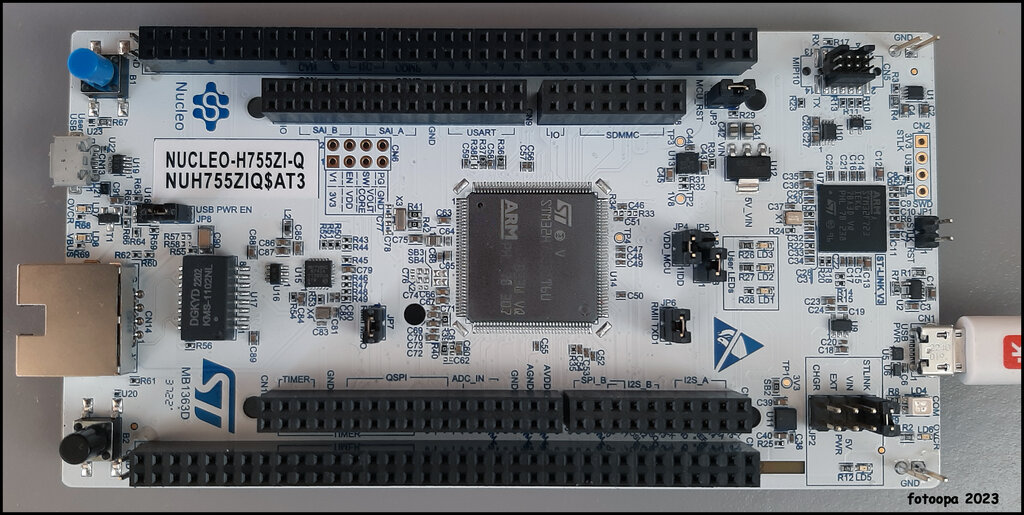
Not all brains are the same, and STM32s come with different Cortex-M cores depending on the task at hand. Just as you wouldn't use a supercomputer to run a toaster, you choose the core that fits the job.
- Cortex-M0/M0+: These are the efficiency experts. They're perfect for simple, low-power applications like a fitness tracker or a smart sensor where battery life is critical.
- Cortex-M3: A step up in performance. It offers a good balance of power and efficiency, suitable for devices like home automation controllers.
- Cortex-M4: This core adds digital signal processing (DSP) instructions. It's great for tasks involving audio processing or sensor data filtering, like in a smart speaker or a drone's flight controller.
- Cortex-M7: This is the powerhouse. It's designed for high-performance applications that need to crunch a lot of data quickly, such as advanced robotics or graphical user interfaces.
| Core | Key Feature | Typical Use Case |
|---|---|---|
| Cortex-M0/M0+ | Ultra-low power consumption | Simple sensors, wearables |
| Cortex-M3 | Balanced performance | Home automation, alarms |
| Cortex-M4 | DSP & Floating Point Unit | Audio processing, motor control |
| Cortex-M7 | Highest performance | Graphics, advanced control |
Highways for Data
A processor core is useless if it can't talk to other components like memory and peripherals. This communication happens over a system of connections called buses. You can imagine these buses as a network of highways inside the chip.
To keep things running smoothly, STM32 microcontrollers use a multi-bus architecture. Instead of one giant, congested road, they have separate highways for different speeds of traffic.
This design prevents slow peripherals from holding up high-speed components like the core and memory.
The two main buses are:
-
AHB (Advanced High-performance Bus): This is the express lane. It connects the most critical components that need to exchange data at high speeds: the Cortex-M core, the Flash memory (where the program is stored), and the SRAM (where data is temporarily held).
-
APB (Advanced Peripheral Bus): This is the local side street. It runs at a lower speed and connects to less time-sensitive peripherals like timers, communication interfaces (UART, I2C), and general-purpose input/output (GPIO) pins. By putting these on a separate, slower bus, the AHB is left free for high-priority traffic.
Storing Code and Data
A microcontroller needs a place to store its program instructions and the data it works with. STM32 devices use two primary types of memory, each with a distinct purpose.
Understanding the hardware architecture, such as microcontrollers, processors, and memory interfaces, allows you to write code that effectively leverages these features, improving performance and reliability.
Flash Memory is like a computer's hard drive. It's where your program code and any constant data are permanently stored. When you turn the microcontroller off and on again, the contents of the Flash memory are still there. This is known as non-volatile memory.
SRAM (Static Random Access Memory) is the device's short-term memory or scratchpad. It's where the program stores variables and other data that it needs to access and change quickly while it's running. Unlike Flash, SRAM is volatile—when the power is cut, everything stored in it is lost.
Code executes from Flash, while data is manipulated in SRAM. Both are connected to the high-speed AHB for fast access by the processor core.
Now that you understand the core components, it's time to check your knowledge.
In an STM32 microcontroller, which bus is considered the "express lane," connecting high-speed components like the core, Flash memory, and SRAM?
You are designing a simple, battery-powered smart sensor that only needs to wake up periodically and take a reading. Which Cortex-M core would be the most suitable and power-efficient choice?
This foundational knowledge of the core, buses, and memory is the first step in mastering STM32 development. Understanding how these pieces work together is key to writing efficient and effective code for any embedded project.