STI2D Math and Physics Foundations
Mathematical Foundations
The Language of Science and Tech
Before diving into physics and technology, you need to speak the language they're written in: mathematics. This isn't about memorizing complex formulas. It’s about understanding a few core tools that will help you describe, predict, and engineer the world around you. We'll focus on the essentials you'll use constantly.
Your Algebraic Toolkit
Algebra is the bedrock. It's the set of rules for rearranging and solving the equations you'll encounter in every other topic. Think of it like grammar. Just as grammar helps you form clear sentences, algebra helps you build logical arguments with numbers and symbols. A big part of this is simplifying expressions to make them easier to work with. For instance, if you have an expression like , you can simplify it to by dividing both terms in the numerator by 2.
Often, the goal is to find the value of an unknown variable. You do this by isolating the variable on one side of the equation. If you have a linear equation like , you can solve for by adding 5 to both sides and then dividing by 3.
Sometimes you'll face quadratic equations, which include a term with . These often look like . While some can be factored, the quadratic formula is a reliable tool that solves for every time.
This formula gives you the one or two possible values for that make the equation true.
Functions as Machines
A function is one of the most fundamental ideas in math. You can think of it as a machine that takes an input and produces a specific output. For every input you give it, you get exactly one output back. We often write them as , which is read "f of x". Here, is the input, and is the resulting output.
For example, the function takes any number , squares it, and adds 1. If you put in , the function outputs . If you put in , it outputs .
Functions are powerful because they model relationships between variables. The relationship between time and distance for a moving object can be a function. The relationship between the price of a product and the demand for it can also be a function.
Trigonometry for Cycles and Angles
Trigonometry is the study of triangles, but its applications go far beyond simple geometry. It's essential for anything involving waves, rotations, or vibrations, from sound waves to alternating electrical currents.
The three main trigonometric functions are sine (), cosine (), and tangent (). In a right-angled triangle, they are defined as ratios of the lengths of the sides relative to an angle .
A more powerful way to view these functions is with the unit circle, a circle with a radius of 1. For any angle measured from the positive x-axis, the coordinates of the point on the circle are . This perspective shows why sine and cosine are periodic, repeating their values every 360 degrees (or radians). This periodic nature is what makes them perfect for describing cyclical phenomena.
A First Look at Calculus
Calculus might sound intimidating, but its two core ideas are quite intuitive: derivatives and integrals. At its heart, calculus is the mathematics of change.
Derivative
noun
The derivative of a function at a certain point measures its instantaneous rate of change. Graphically, this is the slope of the line tangent to the function's curve at that point.
Imagine you're driving a car. Your speedometer doesn't tell you your average speed for the whole trip, it tells you your speed at that exact moment. That's a derivative. It answers the question, "How fast is this value changing right now?" In physics, velocity is the derivative of position, and acceleration is the derivative of velocity.
Integral
noun
The integral of a function calculates the cumulative total or accumulation. Graphically, a definite integral represents the area under the function's curve between two points.
If you know a car's velocity at every moment over a period of time, how can you find the total distance it traveled? You can use an integral. Integration is the process of summing up infinite tiny pieces to find a whole. It's like adding up the areas of incredibly thin rectangles under the velocity graph to find the total area, which represents the total distance.
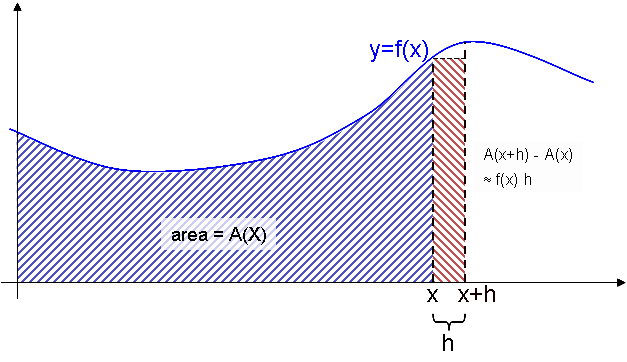
Derivatives and integrals are inverse operations, a discovery that formed the Fundamental Theorem of Calculus. This powerful connection is a cornerstone of science and engineering.
What is the value of in the equation ?
Given the function , what is the value of ?
These mathematical tools are the foundation upon which everything else is built. A solid grasp of them will make your journey into more advanced topics much smoother.