Stellar Kinematics and Galactic Motion
Stellar Velocity Components
A Star in Motion
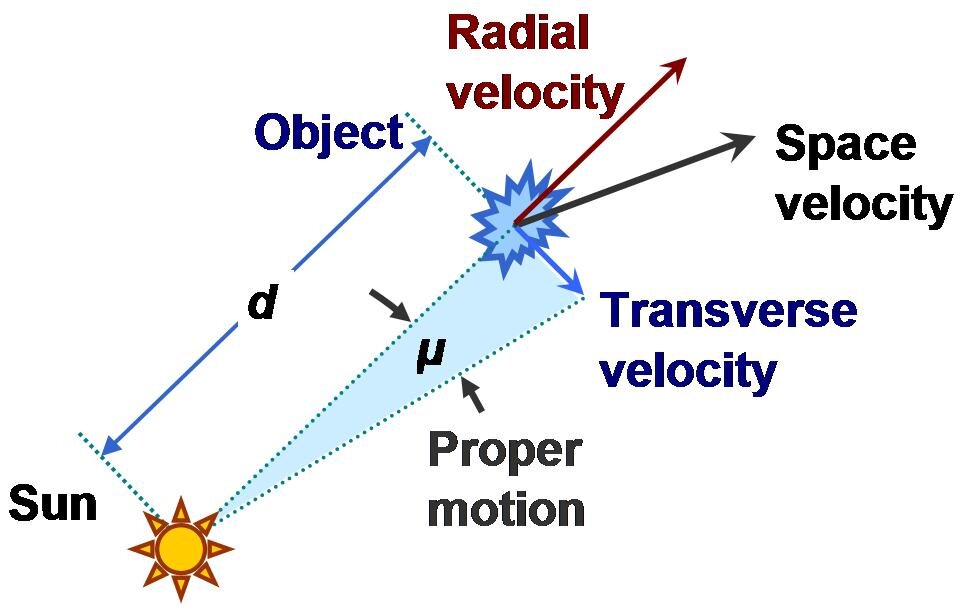
To the naked eye, stars seem fixed in the night sky. But they are all in constant, three-dimensional motion, hurtling through space at incredible speeds. To understand a star's true path, we first have to break its motion down into components we can actually measure from Earth.
The first component is radial velocity (). This is the speed at which a star is moving directly toward or away from us, along our line of sight. We measure this using the Doppler effect on the star's light. If a star is moving towards us, its light waves get compressed, shifting its spectrum to shorter, bluer wavelengths—a blueshift. If it's moving away, the light waves are stretched out, causing a redshift.
Across the Sky
The second component is tangential velocity (). This is the star's motion perpendicular to our line of sight—essentially, its movement across the sky. Because stars are so incredibly far away, this motion is almost imperceptible over a human lifetime. Even a star moving at thousands of kilometers per second will only appear to shift its position by a tiny amount.
This apparent angular change in position on the celestial sphere is called proper motion. It's not a speed, but an angle, measured in arcseconds per year.
Proper Motion
noun
The rate at which a star's position in the sky changes, as seen from the Sun. It is a measure of angular velocity, typically expressed in arcseconds per year (μ).
Putting It All Together
A star's radial and tangential velocities are perpendicular components of its total movement. By treating them as the legs of a right triangle, we can calculate the star's true velocity through space, often called its space velocity (). This gives us a complete picture of its journey through the galaxy.
This relationship is described by the Pythagorean theorem.
Here's a quiz to check what you've learned.
How do astronomers measure the speed at which a star is moving directly towards or away from Earth?
An astronomer observes that the light from a distant star is "blueshifted." What does this tell us about the star's motion?
By breaking down a star's complex 3D motion into these two measurable parts, astronomers can begin to chart the movements of stars and unravel the structure of our galaxy.