States and Civil Society Dynamics
Understanding the State
What Is a State?
In everyday conversation, we might use the word “state” to refer to places like California or Texas. In political science, however, the term has a much more specific meaning. A state is a political community that occupies a definite territory and has an organized government with the power to make and enforce laws without approval from any higher authority.
To be considered a state, a community needs four key ingredients: a population, a defined territory, a government, and sovereignty.
Sovereignty
noun
The supreme and independent authority of a state to govern itself. It means the state's government can make its own decisions without being subordinate to any other power.
Let’s break those four characteristics down:
- Population: A state must have people. The size of the population doesn't matter, from tiny San Marino to massive China.
- Territory: A state must have established boundaries. These borders can sometimes be a source of conflict with neighboring states.
- Government: This is the institution through which the state maintains social order, provides public services, and enforces its decisions.
- Sovereignty: This is the big one. It means the state is its own boss. Its government has supreme authority within its territory. The United States, for example, can make its own laws and is not subject to the authority of Canada or Mexico.
The Rise of the Modern State
The idea of the state hasn't always existed. For much of human history, people were organized into tribes, city-states, or vast, loosely controlled empires. The modern state system, based on sovereign, independent entities, began to take shape in Europe several centuries ago.
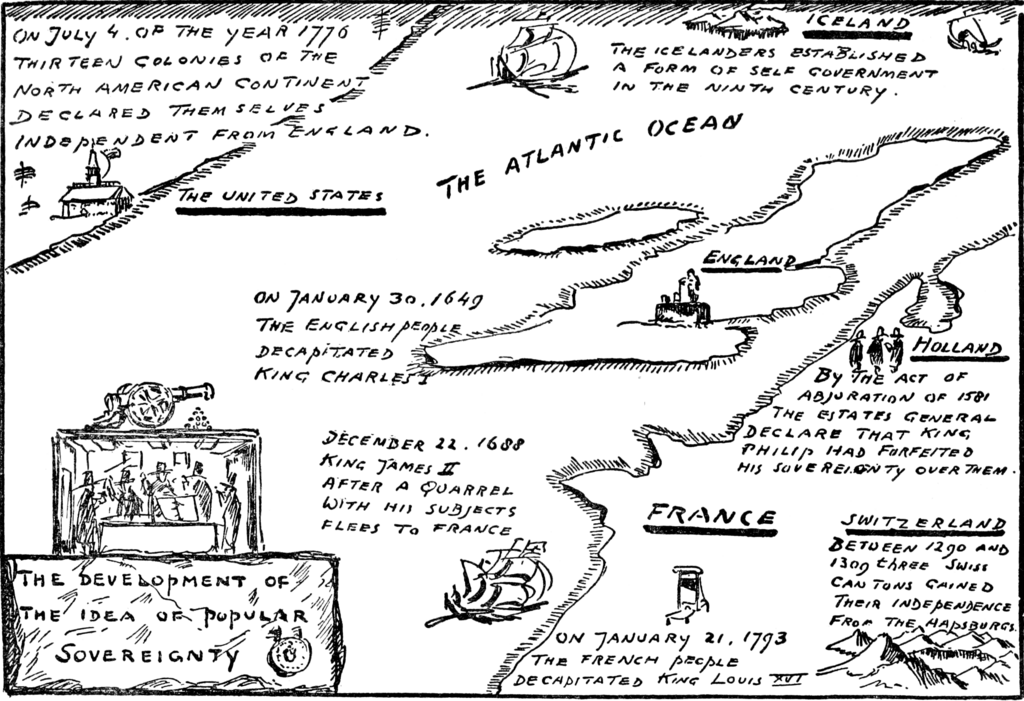
A key moment was the Peace of Westphalia in 1648. This series of treaties ended major religious wars in Europe and established the principle that each state had sovereignty over its territory and domestic affairs, free from external interference. This laid the groundwork for the international system of states we know today.
What Do States Do?
Governments are the machinery of the state, and they perform several essential functions to keep society running. While the scope of these functions can vary dramatically from one state to another, most serve a few core purposes.
First, states maintain order. They establish legal systems and create law enforcement agencies to protect citizens from violence and crime. Second, they provide public services that individuals cannot easily provide for themselves, such as building roads, ensuring clean water, and running schools. Finally, they protect national security by maintaining a defense against outside threats.
How States Are Organized
Not all states are structured the same way. The way power is distributed geographically is a key difference. The two most common systems are unitary and federal.
In a unitary system, the central government holds nearly all the power. It may create lower levels of government, like provinces or districts, but it can also change their powers or even abolish them. The United Kingdom and Japan are examples.
In a federal system, power is divided between a central government and several regional governments (like states or provinces). Each level has its own areas of authority, often outlined in a constitution. The United States, Germany, and India use federal systems.
| Feature | Unitary State | Federal State |
|---|---|---|
| Power Distribution | Central government is supreme. | Power is shared between central & regional gov'ts. |
| Regional Authority | Limited; granted by central gov't. | Constitutionally protected and often significant. |
| Examples | France, Japan, United Kingdom | USA, Germany, Australia, India |
Beyond its structure, the nature of a state is also defined by its system of governance, which determines who holds power and how they can use it.
Broadly, these systems fall into two categories: democratic and authoritarian.
Democratic states are based on the principle of popular sovereignty. Citizens have the power, which they typically exercise by electing officials to represent them. These states are characterized by free and fair elections, the protection of individual rights and freedoms, and the rule of law, which means everyone, including the government, is subject to the law.
Authoritarian states concentrate power in the hands of a single leader or a small group. The government is not accountable to the people, and it often restricts individual freedoms to maintain control. Citizens have little to no say in how they are ruled. Forms of authoritarianism include absolute monarchies, military dictatorships, and one-party states.
The key difference lies in the source of power. In a democracy, power flows from the people up. In an authoritarian regime, power flows from the ruler down.
With this understanding of what a state is, how it's structured, and how it functions, we can better analyze its role in the world and its relationship with the people it governs.