Startup Valuation Fundamentals
Introduction to Startup Valuation
What's a Startup Worth?
Putting a price tag on a young, unproven company sounds like guesswork. In many ways, it is. But this process, called startup valuation, is the backbone of the entrepreneurial world. It's how founders and investors agree on how much of the company a certain amount of cash is worth.
The valuation put on the business is a critical issue for both the entrepreneur and the venture capital investor.
Think of it as a negotiation. A founder wants a high valuation to give away less of their company for the money they need to grow. An investor wants a fair valuation that reflects the company's potential and the risk they're taking. A good valuation finds a middle ground that allows both sides to succeed.
Before and After the Deal
When talking about valuation, you'll always hear two terms: pre-money and post-money. They're simple concepts that describe the value of the company at two different points in an investment deal.
Pre-money valuation is what the company is deemed to be worth before an investment is made.
Post-money valuation is its worth after the investment is added. The math is straightforward.
Let's say a startup and an investor agree that the company is worth $4 million. This is the pre-money valuation. The investor then puts in $1 million. The post-money valuation is now $5 million.
This distinction is crucial because it determines how much ownership the investor gets. In our example, the investor contributed $1 million to a company with a $5 million post-money value. Their ownership is $1M / $5M, or 20% of the company.
The Cost of Growth
When a founder accepts outside investment, they sell a piece of their company. This process is called equity dilution. Each time new shares are issued to an investor, the ownership percentage of existing shareholders—including the founders—decreases.
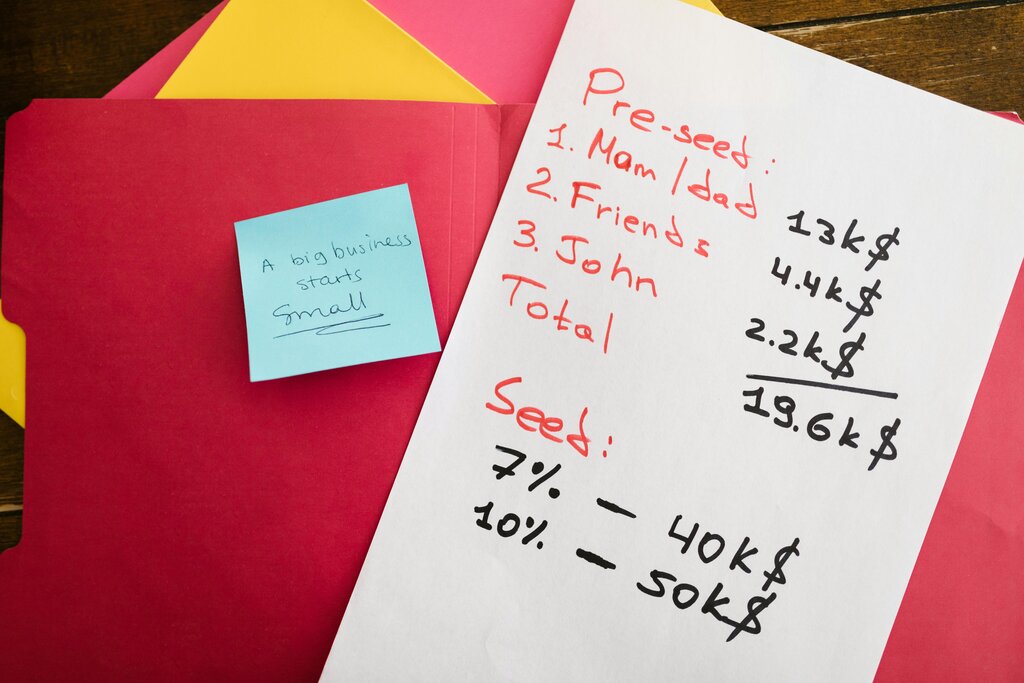
Dilution isn't necessarily a bad thing. While the founder's ownership percentage goes down, the value of their smaller slice should go up. Owning 80% of a $5 million company is much better than owning 100% of a $4 million company. The goal is to grow the pie so that everyone's slice becomes more valuable, even if it's a smaller fraction of the whole.
The challenge for founders is to balance the need for capital with the desire to retain as much ownership as possible. This is where valuation plays a key role. A higher valuation means less dilution for the same amount of investment.
An Art, Not a Science
Valuing an established public company like Apple is relatively straightforward. You can look at its revenue, profits, assets, and stock price. Startups are different. They often have no revenue, no profits, and sometimes not even a finished product.
Because of this uncertainty, early-stage valuation relies on qualitative factors instead of hard numbers. Investors look at things like:
- The Team: Is the founding team experienced, resilient, and capable of executing their vision?
- Market Size: How big is the potential market for the product or service? Is it a growing industry?
- Traction: Does the startup have any early customers, users, or positive data, even if it's not generating revenue?
- Competition: What is the competitive landscape like? Does the startup have a unique advantage?
These factors don't fit neatly into a spreadsheet. They require judgment, experience, and a belief in the startup's potential. That's why the same company might get very different valuation offers from different investors.
A startup is valued at 1.5 million. What is the company's post-money valuation?
Using the previous example (a 7.5M post-money valuation), what percentage of the company does the new investor own?
Understanding these core concepts is the first step in navigating the world of startup finance. They form the language of fundraising and are essential for any entrepreneur looking to build and grow a company.