Startup Fundraising Strategies
Funding Stages
The Fundraising Ladder
Startup funding isn't a single event. It's a series of steps, known as rounds, each designed to fuel a specific phase of growth. As a company matures and proves its potential, it climbs this ladder, attracting different types of investors and larger amounts of capital at each stage. Think of it as levelling up in a game, where each level unlocks new resources and higher stakes.
A startup may go through many stages of venture capital funding as it develops, such as a seed investment, early-stage funding rounds, and late-stage funding rounds.
This progression allows founders to give away as little of their company as possible at each stage, raising just enough money to hit the next set of milestones. Let's walk through the typical funding journey, from a simple idea to a well-established company.
Planting the Seed
The earliest stages are all about turning a concept into a reality. This is where the foundation is laid for everything that follows.
Pre-Seed funding is the very first money a startup raises. Often, it's not even a formal 'round'. The goal here is simple: to validate an idea. This capital is used for initial market research, developing a business plan, and building a minimum viable product (MVP). Investors are typically the founders themselves, their friends, and their family. They're betting on the person and the idea, long before there are any metrics to show.
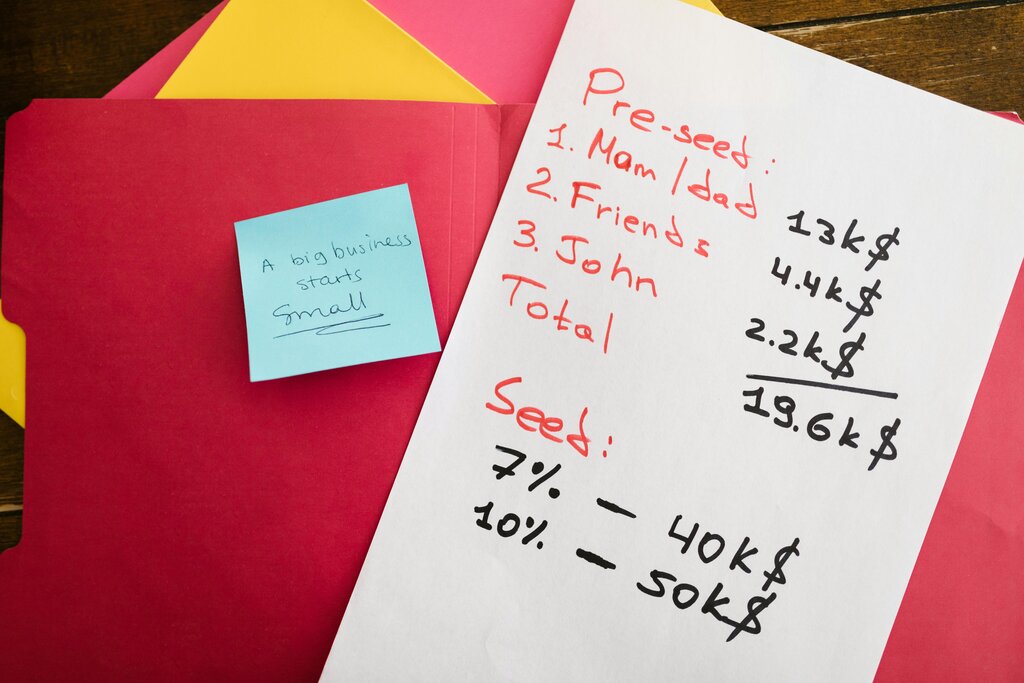
Once there's an MVP and a clear strategy, the company is ready for Seed funding. This is the first formal equity round. The objective shifts from validating an idea to finding product-market fit. The funds are used to hire a core team, begin marketing efforts, and acquire the first set of customers. Investors at this stage include angel investors, who are wealthy individuals, and early-stage venture capital (VC) funds that specialise in high-risk, high-reward opportunities.
At the seed stage, investors are primarily focused on the strength of the founding team, the size of the market opportunity, and the potential of the product.
| Stage | Objective | Typical Investors | Typical Amount |
|---|---|---|---|
| Pre-Seed | Validate the idea, build an MVP | Founders, friends, family | £10k - £200k |
| Seed | Find product-market fit, build a team | Angel investors, early-stage VCs | £200k - £2m |
Scaling the Business
With a proven concept and initial traction, a startup is ready for its growth-focused rounds. These are known as the Series A, B, and C rounds, and they are typically led by venture capital firms.
Series A funding is for scaling. The company has figured out what it's doing; now it needs to do it for a much larger audience. The focus is on optimising the business model and building repeatable processes for sales and marketing. The money is used to hire key executives, expand marketing campaigns, and open new geographic markets. Investors are looking for strong metrics, like consistent revenue growth and user engagement. They want to see a clear path to profitability.
In Series A, startups typically raise between $2 million to $15 million to accelerate growth activities.
Next comes Series B funding. At this point, the company is a well-oiled machine that has proven its business model at scale. The goal of Series B is to expand aggressively and capture more market share. The funds are often used for business development, major hiring pushes across all departments, and sometimes acquiring smaller competitors. The investors are often VCs who specialise in later-stage growth, and the company's valuation is significantly higher than in Series A.
Finally, Series C funding is about cementing market leadership. Companies raising a Series C are already successful and well-known. They use this capital to develop new products, expand into international markets, or prepare for an Initial Public Offering (IPO). The funding amounts can be substantial, often exceeding £100 million. Investors include late-stage VCs, private equity firms, and sometimes even investment banks.
While this Pre-Seed to Series C path is typical, it's not the only one. Some companies might raise more rounds (Series D, E, etc.), while others might get acquired or reach profitability without needing so much outside capital. Each company's funding journey is unique to its goals, market, and growth rate.
Now, let's test your understanding of these funding stages.
What is the primary goal of a Pre-Seed funding round?
A startup that is focusing on aggressive expansion, major hiring pushes, and capturing more market share is most likely raising which round of funding?
Understanding these stages is crucial for founders and anyone interested in the startup ecosystem. It provides a clear framework for how great ideas are transformed into lasting businesses, one funding round at a time.