Startup Fundraising Essentials
Startup Funding Stages
The First Steps
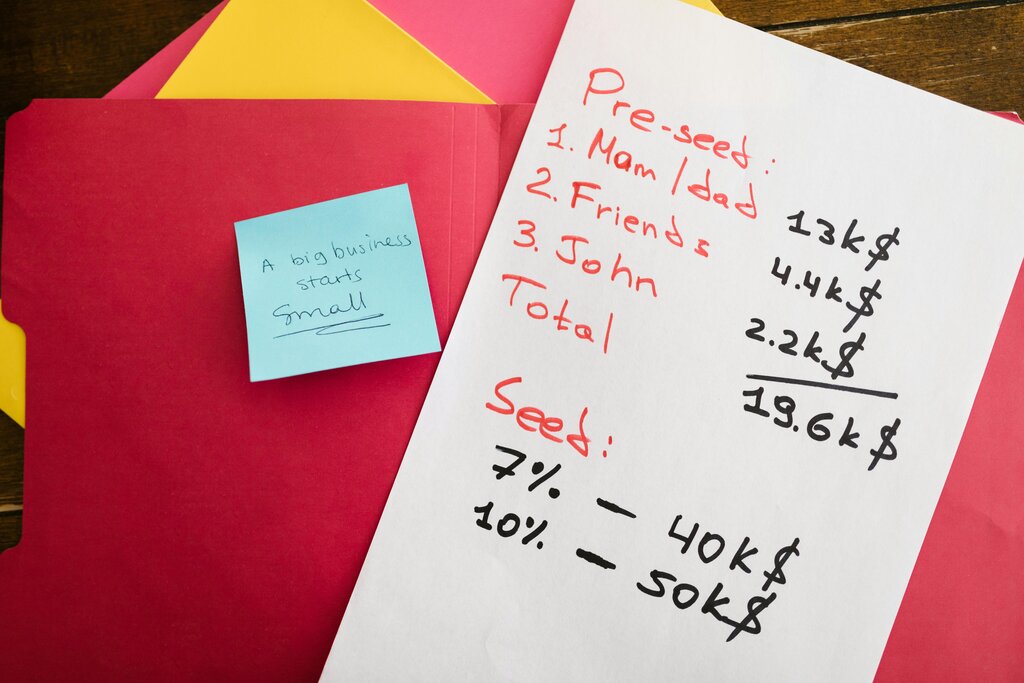
Every big company starts with a small idea. Before a startup can attract major investors, it needs to prove its core concept is viable. This earliest phase is called the pre-seed stage. The main goal here isn't to build a polished, final product. It's about exploration and validation: Is there a real problem to solve? Does the proposed solution have potential?
Funding at this stage is typically small, just enough to get the idea off the ground. It often comes from the founders' own savings, or from close contacts like friends and family. Sometimes, an early believer known as an "angel investor" might provide a small amount of capital. The key milestone is developing a Minimum Viable Product (MVP) and gathering initial feedback to prove the concept is worth pursuing.
Minimum Viable Product
noun
A version of a new product which allows a team to collect the maximum amount of validated learning about customers with the least effort.
Planting the Seed
Once a startup has a working MVP and some early data suggesting people want what they're building, it's ready for seed funding. The goal of this stage is to find product-market fit—that sweet spot where the product satisfies a strong market demand. The company isn't just an idea anymore; it has a tangible product and some initial users or customers.
Seed funding provides the resources to hire key team members, refine the product, and begin marketing efforts. This round is typically the first time a startup raises money from institutional investors, like early-stage venture capital (VC) firms, in addition to angel investors. Funding amounts are larger than in the pre-seed stage, often ranging from several hundred thousand to a few million dollars. The milestone here is clear: demonstrate consistent growth and a repeatable way to acquire customers.
At the seed stage, what convinces investors is your ability to communicate vision, traction, and a credible path forward.
Time to Scale
With product-market fit achieved and a steady stream of users, a startup is ready for a Series A round. This is where things get serious. The focus shifts from finding a market to dominating it. The objective is to scale operations, optimize the business model, and build out departments like sales, marketing, and customer support.
Investors in a Series A round are looking for a company with a proven business model and strong metrics, like monthly recurring revenue and customer acquisition cost. They want to see a clear plan for how their investment will fuel significant growth. This funding, typically in the range of $5 million to $20 million, is used to pour fuel on the fire, turning a promising small business into a major player in its industry.
| Stage | Main Goal | Key Metric Focus | Typical Investors |
|---|---|---|---|
| Seed | Find Product-Market Fit | User Engagement & Growth | Angel Investors, Early-Stage VCs |
| Series A | Scale the Business | Revenue & Profitability | Venture Capital Firms |
Accelerating Growth
After a successful Series A, a company has a well-oiled machine. The next stages, Series B and beyond, are all about acceleration. A Series B round is for companies that are already successful but want to expand their reach. This could mean entering new markets, acquiring smaller competitors, or developing new product lines.
By this point, the business model is no longer in question; it's a proven success. Investors are betting on the company's ability to capture a larger share of the market. Funding rounds become significantly larger, often tens or even hundreds of millions of dollars.
If a company continues to grow, it might raise a Series C, D, or more. These later-stage rounds are for aggressive scaling, often solidifying a company's position as a market leader. This is the final push before a major event like an Initial Public Offering (IPO) or a large acquisition.
Each funding stage represents a new chapter in a startup's life, with its own set of challenges and expectations. Understanding this journey is key for any founder looking to turn a great idea into a lasting company.
What is the primary goal of the pre-seed funding stage?
The main objective of the seed funding stage is to find _____, which is the point where a product satisfies strong market demand.