Starting Your Japanese Journey
Japanese Writing Systems
The Three Scripts of Japanese
Welcome to the world of Japanese writing. Unlike English, which uses one alphabet, Japanese uses a combination of three different scripts: Hiragana, Katakana, and Kanji. Don't worry, we're not learning all three at once.
Think of them as different tools for different jobs. For now, we'll focus on the two phonetic scripts, Hiragana and Katakana. Together, they are called kana and they form the phonetic backbone of the language. Master these, and you can technically write any Japanese word.
Kanji
noun
Logographic characters borrowed from Chinese. Each character represents an idea or word, rather than just a sound. There are thousands of them, but we'll get to them much later.
Meet Hiragana
Hiragana (ひらがな) is the first script every Japanese child learns. It’s used for native Japanese words, grammatical particles, and verb endings. Its characters have a curvy, flowing appearance. There are 46 basic hiragana characters, each representing a specific syllable, like 'ka', 'ki', 'ku', 'ke', or 'ko'. This is different from English, where 'k' is just a consonant. In Japanese, the consonant and vowel are almost always bundled together.
The fundamental rule: one character, one sound. This makes pronunciation incredibly consistent.
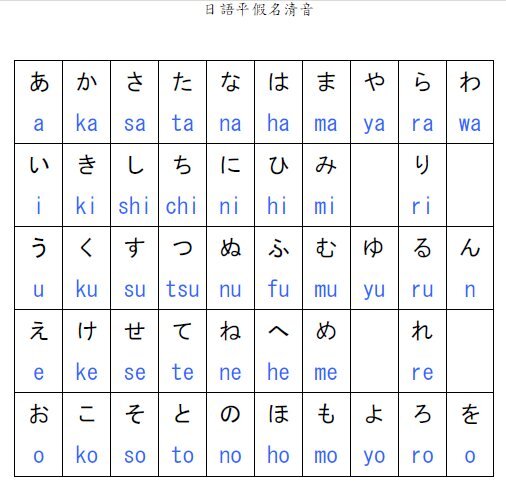
The basic set of 46 characters is organized in a grid called the gojūon (五十音), which means "fifty sounds." It's arranged by the five vowels (a, i, u, e, o) and the consonants that can precede them.
| a | i | u | e | o | |
|---|---|---|---|---|---|
| Vowels | あ (a) | い (i) | う (u) | え (e) | お (o) |
| k | か (ka) | き (ki) | く (ku) | け (ke) | こ (ko) |
| s | さ (sa) | し (shi) | す (su) | せ (se) | そ (so) |
| t | た (ta) | ち (chi) | つ (tsu) | て (te) | と (to) |
| n | な (na) | に (ni) | ぬ (nu) | ね (ne) | の (no) |
| h | は (ha) | ひ (hi) | ふ (fu) | へ (he) | ほ (ho) |
| m | ま (ma) | み (mi) | む (mu) | め (me) | も (mo) |
| y | や (ya) | ゆ (yu) | よ (yo) | ||
| r | ら (ra) | り (ri) | る (ru) | れ (re) | ろ (ro) |
| w | わ (wa) | を (o/wo) | |||
| Special | ん (n) |
Notice the gaps? That's because sounds like 'yi', 'ye', and 'wu' don't exist in modern Japanese. Also, see し (shi), ち (chi), and つ (tsu)? Some sounds are irregular. The character を is pronounced 'o' but is only used as a grammatical particle. Finally, ん (n) is the only character that's a single consonant.
Katakana The Sharper Sibling
Katakana (カタカナ) is the second phonetic script. It has the exact same 46 sounds as Hiragana, but the characters look different. They are more angular and sharp. Katakana is used for specific purposes, much like italics in English.
Use Katakana for: foreign loanwords (like 'computer' or 'coffee'), names of foreign people and places, onomatopoeia (sound effects), and for emphasis.
Here’s how the same sounds look in Katakana. Learning them at the same time as Hiragana can be very effective, as you’re just learning a second way to write a sound you already know.
| a | i | u | e | o | |
|---|---|---|---|---|---|
| Vowels | ア (a) | イ (i) | ウ (u) | エ (e) | オ (o) |
| k | カ (ka) | キ (ki) | ク (ku) | ケ (ke) | コ (ko) |
| s | サ (sa) | シ (shi) | ス (su) | セ (se) | ソ (so) |
| t | タ (ta) | チ (chi) | ツ (tsu) | テ (te) | ト (to) |
| n | ナ (na) | ニ (ni) | ヌ (nu) | ネ (ne) | ノ (no) |
| h | ハ (ha) | ヒ (hi) | フ (fu) | ヘ (he) | ホ (ho) |
| m | マ (ma) | ミ (mi) | ム (mu) | メ (me) | モ (mo) |
| y | ヤ (ya) | ユ (yu) | ヨ (yo) | ||
| r | ラ (ra) | リ (ri) | ル (ru) | レ (re) | ロ (ro) |
| w | ワ (wa) | ヲ (o/wo) | |||
| Special | ン (n) |
Expanding the Sounds
The basic 46 characters are just the start. We can modify them to create more sounds. It’s like adding accents to letters in other languages.
Voiced Sounds
Adding two small tick marks, called dakuten, to the upper right of certain characters makes the initial consonant sound
voiced. For example, the voiceless 'k' sound in か (ka) becomes a voiced 'g' sound in が (ga). The voiceless 's' in さ (sa) becomes a 'z' in ざ (za).
A small circle, called a , is used only on the 'h' characters. It changes the 'h' sound to a 'p' sound. For example, ひ (hi) becomes ぴ (pi).
Contracted Sounds
To make sounds like 'kya', 'shu', or 'cho', you combine a character from the 'i' column (like き, し, or ち) with a small version of や (ya), ゆ (yu), or よ (yo). These are called sounds.
For example:
- き (ki) + ゃ (small ya) = きゃ (kya)
- し (shi) + ゅ (small yu) = しゅ (shu)
- ち (chi) + ょ (small yo) = ちょ (cho)
Double Consonants & Long Vowels
To double a consonant, you place a small つ (tsu) or ツ (Tsu) before the character. This creates a small pause, like the 'p' sound in 'stop politely'. For example, きて (kite) is 'ki-te', but きって (kitte) is 'kit-te' (stamp).
To make a vowel sound longer, you usually add another vowel character. For 'a', 'i', 'u', or 'e' sounds, you just add that same vowel. For an 'o' sound, you usually add う (u). In Katakana, a long dash (ー) is used for all long vowels.
Let's test your knowledge of these new concepts.
What are the two phonetic scripts that form the backbone of the Japanese writing system, collectively known as kana?
Which script is characterized by its curvy, flowing appearance and is used for native Japanese words and grammatical particles?