Star Trek Warp Drive Explained
Introduction to General Relativity
Gravity Reimagined
For centuries, Isaac Newton’s law of universal gravitation was the final word on gravity. It described gravity as a force, an invisible rope pulling objects toward each other. This idea works beautifully for sending rockets to the moon or predicting the orbits of planets. But Albert Einstein saw a deeper truth.
He began with a simple but profound thought experiment. Imagine you're in a windowless elevator. If the elevator is sitting on Earth, you feel the familiar pull of gravity holding you to the floor. Now, imagine the elevator is in deep space, far from any planet, but is accelerating upwards at a constant rate of . The floor would push against your feet with the exact same feeling as gravity. Without looking outside, you would have no way to tell the difference between being accelerated and being in a gravitational field.
This is the Equivalence Principle: the effects of gravity are completely equivalent to the effects of acceleration.
This seemingly simple idea has radical implications. If gravity and acceleration are indistinguishable, then whatever is true for acceleration must also be true for gravity. For example, if you shine a beam of light across the accelerating elevator, the light's path will appear to curve downwards because the floor is moving up to meet it. By the Equivalence Principle, this means that gravity must also bend light.
The Shape of Spacetime
Einstein realized that gravity isn't a force pulling objects through space. Instead, gravity is a feature of spacetime itself. Massive objects don't create a force; they warp or curve the very fabric of spacetime around them. Other objects then move along these curves.
Think of spacetime as a stretched-out rubber sheet. If you place a heavy bowling ball in the center, it creates a dip in the sheet. Now, if you roll a marble nearby, it won't travel in a straight line. It will follow the curve created by the bowling ball, spiraling inward. The marble isn't being pulled by the bowling ball; it's simply following the shape of the space it's moving through. This is how gravity works.
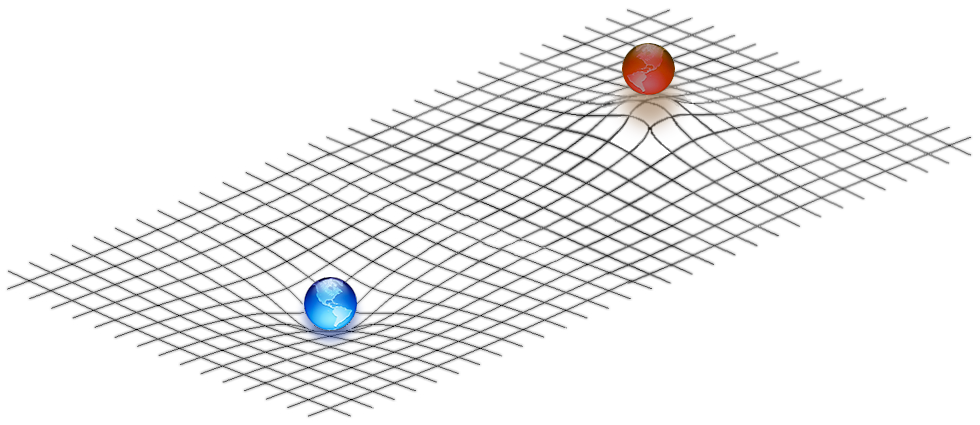
Earth is orbiting the Sun for the same reason. The Sun is so massive that it creates a huge curve in spacetime, and Earth is just following that curve. We are stuck to the surface of the Earth not because of a mysterious pull, but because Earth's mass has warped the spacetime around us, and we're moving through that warped geometry.
The Master Equation
To describe this relationship between mass, energy, and the curvature of spacetime, Einstein developed a set of ten equations that form the core of his theory. Collectively, they are known as the Einstein Field Equations.
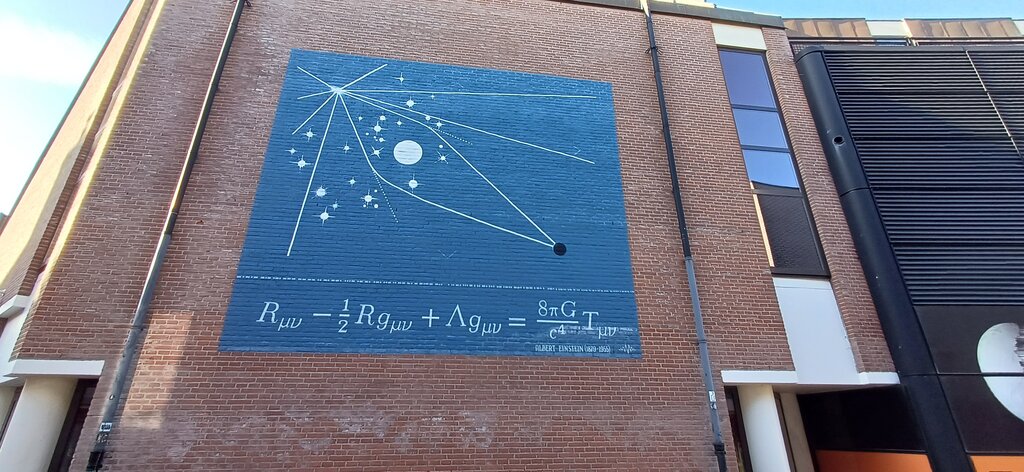
In its most compact form, the equation looks like this:
You don't need to be a physicist to grasp the beautiful idea it represents. The left side of the equation () describes the geometry of spacetime—how it's stretched, twisted, and curved. The right side of the equation () describes the distribution of mass and energy within that spacetime. The equals sign connects them, creating a profound cosmic dialogue.
In the words of physicist John Archibald Wheeler, "Spacetime tells matter how to move; matter tells spacetime how to curve."
This set of equations revealed a dynamic, active universe where space and time are not just a static backdrop for events, but active participants. They can bend, ripple, and expand. Understanding this principle—that the shape of spacetime can be altered—is the first step toward exploring even the most fantastic ideas about space travel.
According to Albert Einstein's theory of general relativity, what is gravity?
Einstein's elevator thought experiment is designed to illustrate the equivalence of which two phenomena?