SQL Fundamentals
Introduction to Relational Databases
Organizing Information
Imagine trying to find a specific book in a massive library with no catalog system. The books are just piled everywhere. It would be a nightmare. Databases solve this problem for digital information, acting as a highly organized system for storing and retrieving data efficiently.
A relational database is a specific type of database that organizes data into a simple, intuitive structure. It's built on a model that connects different pieces of information, making it easy to see how they relate to one another. This is the most common type of database you'll encounter, powering everything from online stores to banking systems.
The Building Blocks
At its core, a relational database is made up of a few simple components. The main container for your data is called a table. You can think of a table just like a spreadsheet.
Each table has columns and rows.
- Columns define the categories of information. If you had a table for customers, your columns might be
CustomerID,FirstName,LastName, andEmail. - Rows represent individual records. Each row contains the actual data for one specific customer, filling in the values for each column.
| CustomerID | FirstName | LastName | |
|---|---|---|---|
| 1 | Maria | Anders | maria.a@example.com |
| 2 | Ana | Trujillo | ana.t@example.com |
| 3 | Antonio | Moreno | antonio.m@example.com |
In this Customers table, each row is a unique person, and the columns ensure we collect the same type of information for everyone. This structure keeps data consistent and predictable.
Connecting the Dots
The real power of a relational database comes from its ability to form relationships between tables. An online store wouldn't keep customer information and order information in the same massive table. That would be messy and repetitive. Instead, you'd have a Customers table and a separate Orders table.
But how does the database know which orders belong to which customer? It uses special columns called keys.
Primary Key
noun
A column (or set of columns) that uniquely identifies each row in a table. A primary key cannot have duplicate values or null values.
Think of a primary key like a Social Security Number or a student ID. It's a unique identifier that guarantees you can pinpoint a specific record without any confusion.
Foreign Key
noun
A column in one table that refers to the primary key of another table. It acts as a link or a bridge between the two tables.
To link an order to a customer, we would add a CustomerID column to our Orders table. This CustomerID in the Orders table is a foreign key because it refers back to the primary key in the Customers table. This simple connection allows us to pull up a customer and see all the orders they've ever placed.
The Blueprint
How is all this structure—the tables, columns, and key relationships—defined and organized? That's the job of the schema.
A database schema is the blueprint of the database. It outlines the structure of the tables, the attributes (columns) within them, and the relationships between tables.
The schema doesn't hold the actual data. It's just the framework that dictates how the data is organized. It ensures that every piece of information has a logical place to go and that the relationships between them are clearly defined from the start. A well-designed schema is the foundation of a reliable and efficient database.
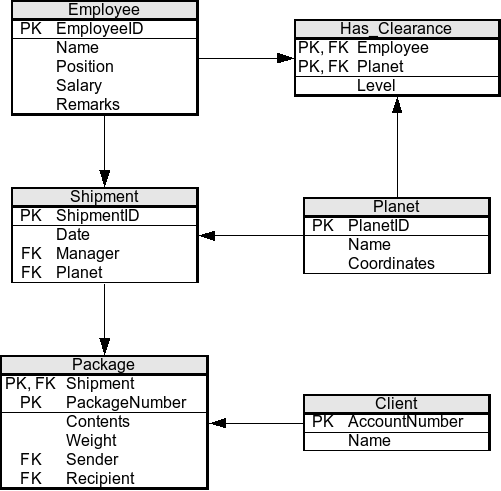
Understanding these core concepts—tables, rows, columns, keys, and schemas—is the first step toward mastering how to interact with relational databases. With this foundation, you can begin to see how data is structured logically, no matter how complex the system.