Spotting Flawed Arguments
Introduction to Critical Thinking
What Is Critical Thinking?
Critical thinking isn't about finding fault or being negative. It's the skill of thinking clearly and rationally to understand the logical connection between ideas. Think of it like being a detective for information. A detective doesn't just accept the first story they hear. They gather clues, examine them, and piece them together to figure out what really happened. Critical thinking is applying that same careful process to the things you read, hear, and see every day.
Critical thinking is clear, reasonable, reflective thinking focused on deciding what to believe or do.
This skill is more important now than ever. We're constantly surrounded by information from social media, news sites, and conversations. Critical thinking helps you sort through the noise, identify what's credible, and form your own well-reasoned conclusions instead of just accepting what you're told.
The Rules of the Road
The engine that drives critical thinking is logical reasoning. It’s the framework we use to build arguments and evaluate them. At its core, an argument isn't a fight; it's a structured way to present a case. It's made of two key parts: premises and a conclusion.
Premises are the statements of fact or evidence that an argument is built on.
A conclusion is the main point the argument is trying to prove.
A strong argument is one where the conclusion follows logically from the premises. If the premises are true, the conclusion should also be true.
In the classic example above, the conclusion that Socrates is mortal is undeniable if you accept the two premises are true. This simple structure is the foundation of logical reasoning. When you encounter an argument, your first step is to identify these parts: what is this person claiming (the conclusion), and what reasons are they giving (the premises)?
Back It Up
A logical structure is essential, but it’s not enough. The premises themselves must be supported by solid evidence. Evidence is the information used to show that a premise is true. It can come in many forms.
| Type of Evidence | Description |
|---|---|
| Empirical | Data gathered through observation and experiment. |
| Statistical | Numerical data and analysis. |
| Testimonial | Firsthand accounts from experts or witnesses. |
| Anecdotal | Personal stories or isolated examples. |
Not all evidence is created equal. A scientific study (empirical evidence) generally carries more weight than a personal story (anecdotal evidence). A critical thinker always asks, “What is the evidence for this claim?” and “How strong is that evidence?” Weak or non-existent evidence is a major red flag that an argument may be flawed.
A Healthy Dose of Skepticism
Skepticism is another crucial tool for critical thinkers. It doesn't mean rejecting everything outright. It means approaching new information with a questioning mindset rather than passive acceptance. It’s about pausing to ask questions before you believe.
A skeptic asks questions like:
- Who is making this claim, and what might be their motive?
- Is this a fact or an opinion?
- Is there another way to interpret this information?
- What information might be missing?
Skepticism is your defense against misinformation. It encourages you to investigate claims, especially surprising or emotionally charged ones, before sharing them. By withholding belief until you have good reasons, you can make more informed and reliable judgments.
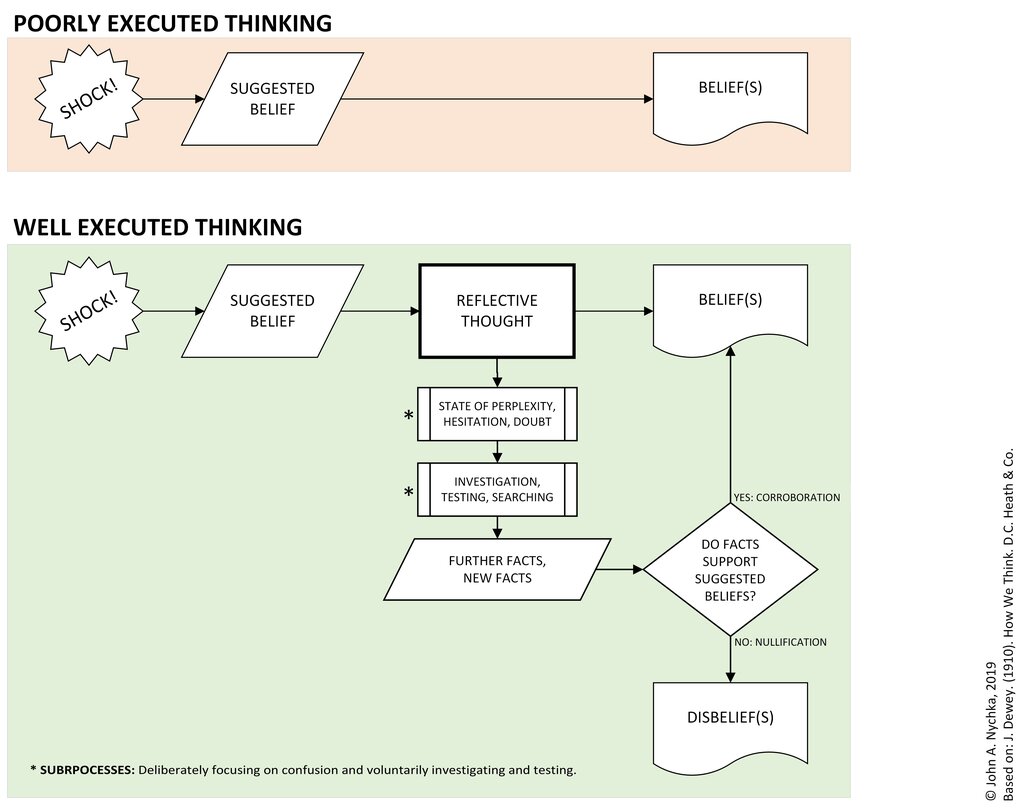
Here's a quick recap of the key ideas we've covered.
Time to test your understanding.
What is the primary goal of critical thinking?
In a logical argument, the statements of fact or evidence are known as the ______, and the main point being proven is the ______.
These core principles—understanding arguments, weighing evidence, and maintaining a healthy skepticism—are the building blocks of critical thinking. With them, you're ready to analyze information more effectively.