Splunk for Enterprise Architects
Distributed Architecture Design
Designing a Scalable Splunk Environment
When moving beyond a single-instance setup, Splunk’s power is unlocked through a distributed architecture. This approach decouples core functions into specialized components, a pattern familiar from systems like Snowflake or Databricks. The goal is to scale each function independently to handle enterprise-level data volumes and user loads.
The main players in this architecture are:
- Forwarders: Lightweight agents that collect data from source machines and send it to the indexers. They are the data collectors.
- Indexers: The workhorses. They receive, parse, index, and store the incoming data. This is where the raw data is transformed into searchable events.
- Search Heads: The user interface. They handle search requests, distribute them to the indexers, and then consolidate the results to present back to the user.
Indexer Clustering for Data Resiliency
To prevent data loss and ensure search availability, indexers are grouped into a cluster. An indexer cluster consists of one manager node and several peer nodes. The manager node orchestrates the cluster, while the peer nodes handle the indexing and data storage.
The key mechanism here is data replication. When a forwarder sends data to the cluster, the receiving peer node indexes it and also streams copies to other peers. This is governed by two settings:
- Replication Factor (RF): The total number of copies of data the cluster maintains. An RF of 3 means there will be one primary copy and two replicas.
- Search Factor (SF): The number of those copies that are immediately searchable. An SF of 2 means that two out of the three copies can participate in searches. A higher search factor improves search performance but increases the resource load on the indexers.
This setup ensures that if a peer node goes offline, no data is lost, and searches can continue uninterrupted using the replicated data on other nodes. The manager node handles rebalancing data and promoting replicas to primary status if an outage occurs.
The replication factor ensures data durability, while the search factor provides search availability and performance. Both are critical for a highly available system.
Search Head Clustering for Scalability
As the number of concurrent users and searches grows, a single search head can become a bottleneck. Search Head Clustering (SHC) addresses this by grouping multiple search heads to act as a single, coordinated unit. This provides horizontal scalability and high availability for the search tier.
An SHC has a dynamically elected 'captain' that coordinates the cluster. The captain replicates search artifacts, configurations, and scheduled jobs across all members. If a user runs a search on one member, the results and artifacts are available on all other members. If one search head fails, users can seamlessly connect to another without losing their work.
This architecture reflects the principles of the CAP theorem. In the event of a network partition, the Splunk SHC prioritizes consistency and availability within the remaining quorum of nodes. The captain ensures that all members have a consistent view of configurations and artifacts, preventing conflicting states.
Deployment Patterns and Architectures
To guide organizations in building robust environments, Splunk provides Splunk Validated Architectures (SVAs). These are blueprint patterns tested to meet specific performance and availability requirements. They offer a reliable starting point for designing a new deployment.
A common advanced pattern is the multi-site cluster, designed for disaster recovery. In this model, the indexer and search head clusters are stretched across two or more physical locations, like separate data centers.
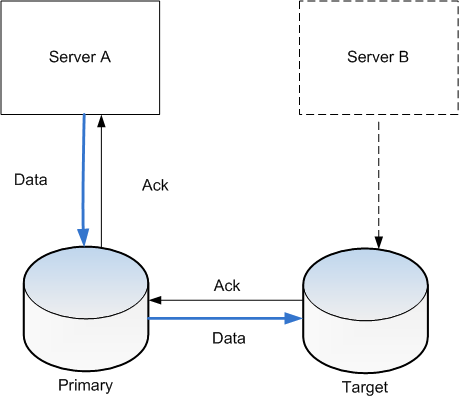
For example, in a two-site indexer cluster, the replication factor would be configured to ensure that a full copy of the data exists in each data center. If one site goes completely offline, the other site can take over all indexing and search workloads. This is crucial for business continuity.
The search heads are also typically distributed across sites, so users have low-latency access to the Splunk environment regardless of their location or the status of a specific data center.
A major architectural decision is whether to deploy Splunk on-premises or use Splunk Cloud (SaaS). This choice involves a trade-off between control and convenience. An on-premise deployment offers granular control over the infrastructure, network, and data pipelines, which can be essential for complex or highly regulated environments. However, it also means your team is responsible for all infrastructure management, patching, and scaling.
Splunk Cloud abstracts away the infrastructure management, allowing the team to focus on using the platform. It offers rapid scaling and is managed by Splunk experts, but you have less control over the underlying architecture and specific configurations.
| Feature | On-Premises Deployment | Splunk Cloud (SaaS) |
|---|---|---|
| Management | Full infrastructure and software management by your team | Managed by Splunk; team focuses on data and usage |
| Control | Granular control over OS, hardware, and network | Limited to configurations available in the service |
| Scalability | Manual; requires provisioning new hardware | Elastic; scale up or down as needed via service plan |
| Upgrades | Performed and scheduled by your team | Handled automatically by Splunk |
| Cost Model | Capital expenditure (hardware) and operational costs | Subscription-based operational expenditure |
Choosing the right model depends on your organization's operational capabilities, security requirements, and long-term strategy for infrastructure management.
In a distributed Splunk architecture, which component is primarily responsible for receiving data, transforming it into searchable events, and storing it?
An administrator configures a Splunk indexer cluster with a Replication Factor (RF) of 3 and a Search Factor (SF) of 2. What is the direct consequence of this configuration?
Understanding these architectural components and patterns is the foundation for building a Splunk environment that can grow with your organization and remain resilient in the face of failures.