Spinal Cord and Brainstem Connections
Spinal Cord Anatomy
The Body's Information Highway
The spinal cord is the central pathway for information connecting your brain to the rest of your body. It's a long, thin, tube-like structure made of nervous tissue, extending from the brainstem down the middle of your back. On average, it's about 18 inches (45 cm) long in men and 17 inches (43 cm) in women, roughly the diameter of your little finger.
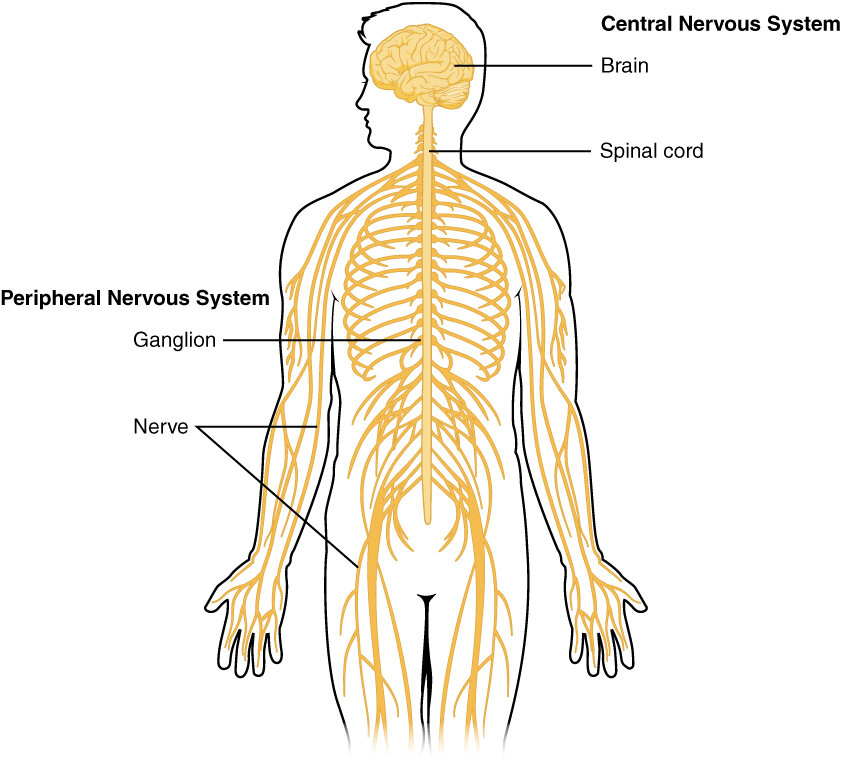
This vital structure doesn't run the entire length of your spine. It typically ends around the first or second lumbar vertebra, in the lower back. Below this point, a collection of nerve roots called the cauda equina (Latin for "horse's tail") continues down.
A cross-section of the spinal cord reveals two distinct areas. The inner, butterfly-shaped region is called gray matter, which contains neuron cell bodies. The outer region is white matter, composed of bundles of nerve fibers, or axons, that transmit signals up and down the cord.
Segments of the Spine
Though it's one continuous structure, the spinal cord is segmented. It's divided into 31 segments, each giving rise to a pair of spinal nerves that exit the vertebral column to communicate with specific parts of the body. These segments are grouped into five regions, named after the vertebrae that protect them.
| Region | Nerve Pairs | General Area Controlled |
|---|---|---|
| Cervical | 8 | Head, neck, diaphragm, arms, and hands |
| Thoracic | 12 | Chest and abdominal muscles |
| Lumbar | 5 | Leg muscles |
| Sacral | 5 | Bowel, bladder, and sexual function |
| Coccygeal | 1 | Skin over the tailbone |
The cervical region at the top controls everything from your breathing to the movement of your arms. The thoracic region corresponds to your chest and abdomen. Further down, the lumbar and sacral regions manage your legs, bowel, and bladder control. The single coccygeal nerve pair at the very bottom serves a small patch of skin.
Protective Layers
Such a critical structure needs robust protection. The spinal cord is shielded first by the bony vertebral column. But between the bone and the cord itself are three protective membranes called the spinal meninges. These layers provide stability and act as a shock-absorbing system.
The outermost layer is the dura mater, a tough, fibrous membrane. Next is the arachnoid mater, a thinner, web-like layer. The innermost layer, the pia mater, is delicate and clings tightly to the surface of the spinal cord. Between the arachnoid and pia mater is the subarachnoid space, which is filled with cerebrospinal fluid (CSF). This fluid provides cushioning, delivers nutrients, and removes waste.
Together, the vertebrae and meninges create a secure, multi-layered defense system for the spinal cord, ensuring this critical communication channel remains protected from injury.