Spectral Submanifolds and Latent Spaces
Introduction to Manifolds
Locally Flat, Globally Curved
For centuries, people thought the Earth was flat. It’s an easy mistake to make. From any single vantage point, the ground stretches out like a vast, flat plane. Only when you travel far enough, or see the planet from space, does its true spherical shape become obvious.
This simple observation is the key to understanding a powerful mathematical concept: the manifold. A manifold is a space that, when you zoom in far enough on any point, looks like familiar Euclidean space—the world of flat planes and straight lines we learn about in basic geometry.
Manifold
noun
A topological space that locally resembles Euclidean space near each point. Each point on an n-dimensional manifold has a neighborhood that is topologically the same as an open ball in n-dimensional Euclidean space.
The “Euclidean space” part is just a formal name for the flat, grid-like space of a certain dimension. A line is 1D Euclidean space (), a flat plane is 2D Euclidean space (), and the space we move through is 3D Euclidean space (). So, a 1-manifold is a space that looks like a line when you zoom in, a 2-manifold looks like a plane, and so on. The local flatness allows us to use the tools of calculus and geometry, even on complex, curved shapes.
Manifolds All Around Us
Once you know what to look for, you start seeing manifolds everywhere.
A simple circle is a 1-manifold. Pick any point on its curve. If you look at a tiny enough segment around that point, it becomes practically indistinguishable from a straight line.
The surface of the Earth is a 2-manifold. It's a sphere, but any small patch of it is, for all practical purposes, a flat plane. This is why we can use flat maps to navigate our cities. The surface of a donut, called a torus in mathematics, is also a 2-manifold. No matter where you are on the donut, your immediate surroundings look like a flat sheet.
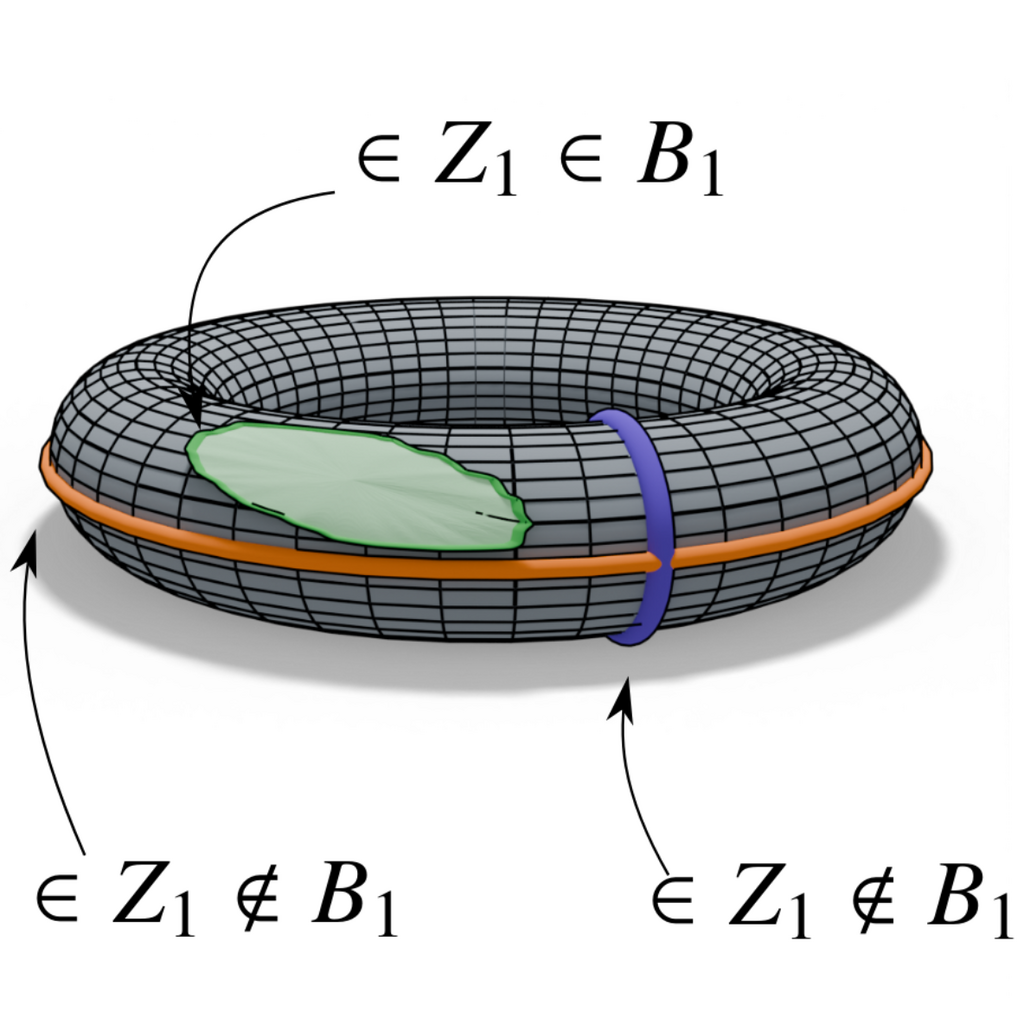
We can't easily visualize manifolds in higher dimensions, but they are just as important. For example, the configuration space of a robotic arm—the set of all possible positions its joints can be in—forms a high-dimensional manifold. Each “point” in this manifold corresponds to a specific pose of the robot.
The Rules of the Game
For a space to be a manifold, it must follow a few rules. One key property is that it must have a well-defined dimension. A space can't be a 1-manifold in one area and a 2-manifold in another. For example, two spheres touching at a single point do not form a manifold, because the neighborhood around the touching point doesn't look like flat Euclidean space of any single dimension.
In many fields, especially physics and calculus, we are interested in differentiable or smooth manifolds. These are manifolds without any sharp corners, cusps, or edges. A sphere is a smooth manifold, but the surface of a cube is not, due to its sharp edges and vertices. Smoothness is crucial because it allows us to define concepts like tangent vectors and to perform calculus on the manifold's surface.
Formally, mathematicians describe the local flatness of a manifold using an 'atlas' composed of 'charts'.
Think of a globe and a paper atlas of the world. The globe is the manifold. You can't flatten the whole globe onto a single sheet of paper without distorting or tearing it. Instead, an atlas represents the Earth using many overlapping flat maps. Each map is a chart. A chart is a mathematical function that maps a small patch of the manifold onto a flat piece of Euclidean space. The entire collection of maps is the atlas, and it must cover the whole manifold.
By using an atlas of charts, mathematicians and scientists can apply the familiar rules of calculus and linear algebra locally on any patch of a manifold, and then stitch the results together to understand the global properties of the entire curved space. This powerful idea is the foundation for everything from Einstein's theory of general relativity, which describes spacetime as a 4D manifold, to modern techniques in data science.
In essence, manifolds give us a rigorous way to handle curved spaces by breaking them down into manageable, flat pieces. They are a fundamental building block of modern geometry and physics.