Speaker Enclosure Design Fundamentals
Sound Wave Basics
What Is a Sound Wave?
Sound is all around us, but what is it, really? At its core, a sound is a vibration. When you clap your hands, the motion pushes nearby air molecules together, creating a tiny region of high pressure. These molecules then push on their neighbors, which push on their neighbors, and so on. This creates a chain reaction, a wave of pressure that travels through the air.
Think of it like a ripple in a pond, but instead of moving up and down, the wave is a series of compressions (where molecules are bunched up) and rarefactions (where they're spread apart).
This vibration needs something to travel through, which is called a medium. Air is the most common medium we experience, but sound can also travel through liquids like water and solids like a wall. In the vacuum of space, where there are no molecules to vibrate, there is no sound.
The Building Blocks of Sound
To describe a sound wave, we use a few key properties. These characteristics determine whether a sound is loud or soft, high-pitched or low-pitched.
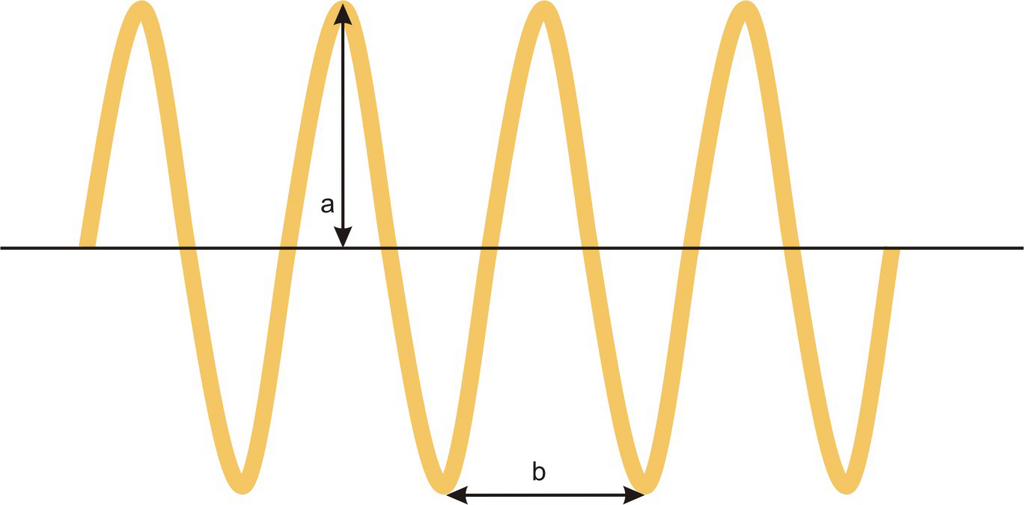
Amplitude
noun
The maximum displacement or distance moved by a point on a vibrating body or wave measured from its equilibrium position.
Amplitude is essentially the wave's intensity, which we perceive as loudness. A wave with a large amplitude shoves air molecules with more force, creating a louder sound. A small amplitude results in a quieter sound.
Wavelength is the distance between two consecutive peaks of a wave. In a sound wave, this is the distance from one compression to the next.
Frequency is how many of these waves pass a certain point per second. We measure it in Hertz (Hz). Frequency is what determines a sound's pitch. A high-frequency wave sounds high-pitched (like a whistle), while a low-frequency wave sounds low-pitched (like a bass drum).
Wavelength and frequency are inversely related. When one goes up, the other goes down. Their relationship is tied together by the speed of sound.
Sound on the Move
The speed of sound isn't constant; it depends on the medium it's traveling through. Specifically, it depends on how tightly packed the molecules are. Sound travels much faster through solids than through liquids, and faster through liquids than through gases.
| Medium | Speed of Sound (approx.) |
|---|---|
| Air (20°C) | 343 m/s |
| Water (20°C) | 1,484 m/s |
| Steel | 5,960 m/s |
As sound waves travel and interact with their environment, they behave in interesting ways.
Reflection is when a sound wave bounces off a surface. This is the principle behind echoes. Hard, smooth surfaces like a cliff face or a large wall are great at reflecting sound.
Refraction is the bending of a sound wave as it passes from one medium to another. This happens because the speed of sound changes, causing the wave to change direction. For example, sound waves can refract when moving through layers of air at different temperatures.
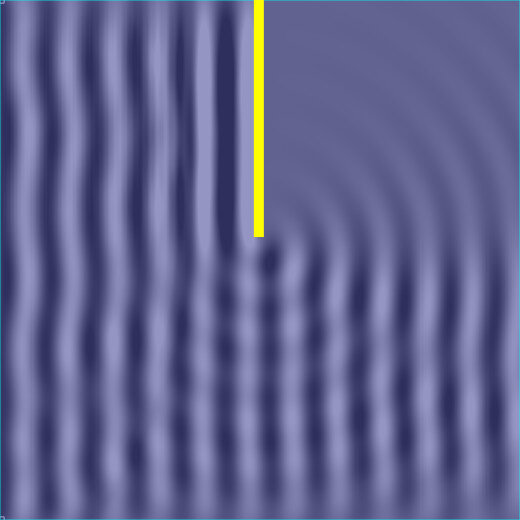
Diffraction describes how waves bend and spread out as they pass around an obstacle or through an opening. This is why you can hear someone talking in another room even if you can't see them. The sound waves travel through the doorway and spread out, filling the space you're in.
Let's review these core concepts.
Ready to test your knowledge?
What is the fundamental nature of sound?
If a sound wave's amplitude increases, what is the perceived effect?
Understanding these fundamental properties is the first step in learning how to control and shape sound.