Speak Basic Arabic
Arabic Alphabet
The Arabic Script
Before diving into phrases, we need to start with the building blocks: the alphabet. The Arabic script might look intricate, but it’s more systematic than you might think. It’s written from right to left, which will take some getting used to. Also, it’s an abjad, which means it primarily consists of consonants. Vowels are usually marked with small signs above or below the letters, but in most everyday writing, they're often omitted and understood from context.
Don't worry about vowels for now. The first step is to get comfortable with the 28 core letters.
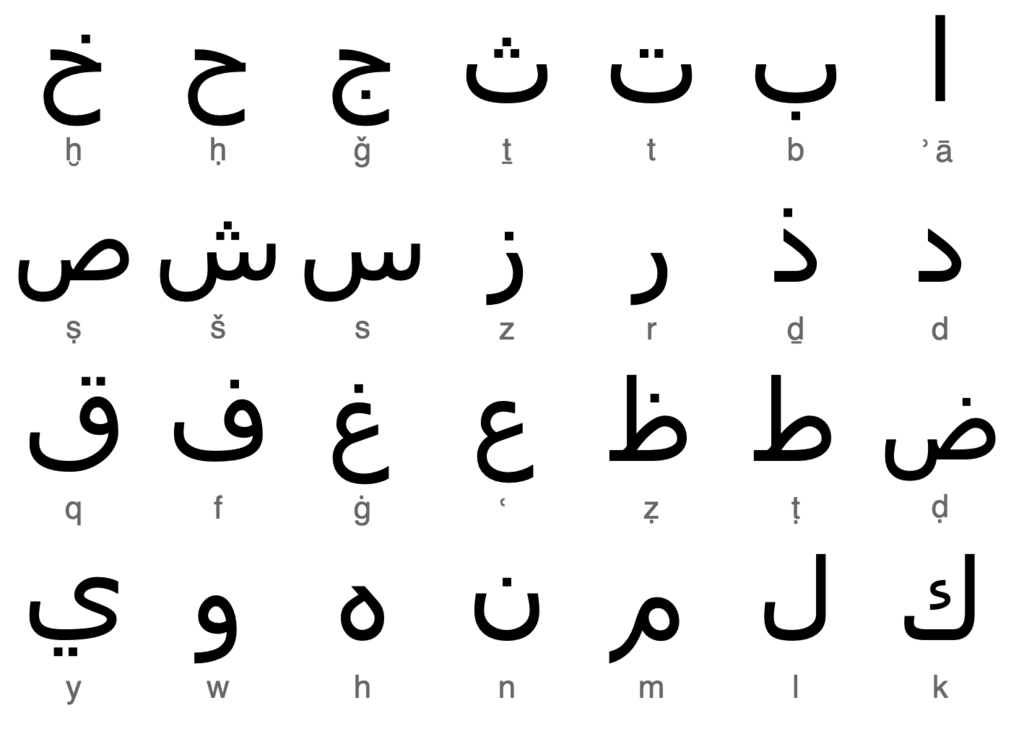
Each letter has a name and a sound. Some sounds will be familiar to English speakers, while others will be new. For example, some letters are pronounced from the back of the throat. The key is to listen carefully and practice imitating the sounds. Let's look at the full alphabet.
| Letter | Name | Transliteration | Sound |
|---|---|---|---|
| ا | Alif | ā | Long 'a' as in 'father' |
| ب | Bā' | b | 'b' as in 'bed' |
| ت | Tā' | t | 't' as in 'top' |
| ث | Thā' | th | 'th' as in 'three' |
| ج | Jīm | j | 'j' as in 'jam' |
| ح | Ḥā' | ḥ | A sharp, breathy 'h' from the throat |
| خ | Khā' | kh | 'ch' as in Scottish 'loch' |
| د | Dāl | d | 'd' as in 'dog' |
| ذ | Dhāl | dh | 'th' as in 'this' |
| ر | Rā' | r | A rolled 'r' like in Spanish |
| ز | Zāy | z | 'z' as in 'zoo' |
| س | Sīn | s | 's' as in 'sun' |
| ش | Shīn | sh | 'sh' as in 'shoe' |
| ص | Ṣād | ṣ | A heavy, deep 's' sound |
| ض | Ḍād | ḍ | A heavy, deep 'd' sound |
| ط | Ṭā' | ṭ | A heavy, deep 't' sound |
| ظ | Ẓā' | ẓ | A heavy, deep 'dh' sound |
| ع | 'Ayn | ' | A deep sound from the back of the throat |
| غ | Ghayn | gh | A gurgling sound, like French 'r' |
| ف | Fā' | f | 'f' as in 'fish' |
| ق | Qāf | q | A 'k' sound from the deep throat |
| ك | Kāf | k | 'k' as in 'king' |
| ل | Lām | l | 'l' as in 'love' |
| م | Mīm | m | 'm' as in 'moon' |
| ن | Nūn | n | 'n' as in 'no' |
| ه | Hā' | h | 'h' as in 'hat' |
| و | Wāw | w | 'w' as in 'water' or long 'oo' sound |
| ي | Yā' | y | 'y' as in 'yes' or long 'ee' sound |
Letters Change Shape
One of the most important concepts in Arabic writing is that letters change their shape depending on their position in a word. Think of it like cursive handwriting in English, where letters connect to each other. Most Arabic letters connect to the letter that follows them (on the left).
A letter can have up to four forms:
- Isolated: When the letter stands alone.
- Initial: When it's at the beginning of a word.
- Medial: When it's in the middle of a word.
- Final: When it's at the end of a word.
Obtain an Arabic alphabet chart that displays all the letters in their isolated, initial, medial, and final forms.
Let's see this in action with the letter Bā' (ب). You can see how it keeps its main identity—the single dot below—but changes its body to connect with its neighbors.
Notice how the initial and medial forms are open on the left, ready to connect. The final form closes off, often resembling its isolated shape but with a connection from the right.
Not all letters connect. Six letters, sometimes called the "non-connectors," only connect to the letter on their right. They never connect to the letter on their left. This creates a small gap in the middle of a word.
These non-connecting letters are: ا (Alif), د (Dāl), ذ (Dhāl), ر (Rā'), ز (Zāy), and و (Wāw).
Writing Practice
The best way to learn the letters is to write them yourself. Grab a pen and paper. As you write each letter, say its name and sound out loud. This connects the visual shape with the auditory sound and the muscle memory of writing.
Let’s try writing the word "book," which is kitāb in Arabic.
book
This word is made of four letters:
- Kāf (ك)
- Tā' (ت)
- Alif (ا)
- Bā' (ب)
Now let's trace how they connect. Kāf (ك) is in the initial position, so it uses its initial form (ـك). It connects to Tā' (ت), which is in the medial position (ـتـ). Tā' then connects to Alif (ا). Since Alif is a non-connector, it doesn't connect to the next letter. The final letter, Bā' (ب), is written in its isolated form because it follows a non-connecting letter. The result is كتاب.
Ready to test your knowledge of these new letters and concepts?
The Arabic script is known as an abjad. What does this primarily mean?
Why do most Arabic letters change their shape within a word?
Mastering the alphabet is the first and most crucial step. With these letters as your foundation, you'll soon be able to read and write simple words and phrases.