Spanish for Mexico A1.5 to A2
Spanish Pronunciation
Getting the Sound Right
Spanish pronunciation is refreshingly straightforward. For the most part, words are pronounced exactly as they are written. Once you learn the sound for each letter, you can confidently pronounce almost any word you see. This phonetic consistency is a huge advantage for learners.
Spanish pronunciation is largely regular and phonetic, making it accessible for learners.
We'll start with the building blocks of the language: the vowels. Mastering these five simple sounds is the first major step toward clear pronunciation.
The Five Vowels
Spanish has five vowels, and each one has a single, pure sound. Unlike English vowels, which can change their sound depending on the word (think of the 'a' in 'cat,' 'cake,' and 'car'), Spanish vowels are consistent and short. There are no long, drawn-out vowel sounds.
| Vowel | Sound (like the English...) | Example |
|---|---|---|
| A | 'a' in father | casa (house) |
| E | 'e' in bet | café (coffee) |
| I | 'ee' in see | amigo (friend) |
| O | 'o' in go | hola (hello) |
| U | 'oo' in boot | uno (one) |
Practice saying them out loud: ah, eh, ee, oh, oo. Keep them crisp and clean. Getting these right is fundamental, as every Spanish word contains at least one of these sounds.
Key Consonant Sounds
Many Spanish consonants sound just like their English counterparts, but a few have unique pronunciations you'll need to learn. Pay close attention to these, as they are common and will significantly impact how well you're understood.
h
other
Always silent. It is written but never pronounced.
The J sounds like a strong English 'h', as in the word 'hat'. You'll hear this sound in words like jardín (garden) or rojo (red).
The LL in Mexico and most of Latin America is pronounced like the 'y' in 'yes'. So, calle (street) sounds like 'caye', and llamar (to call) sounds like 'yamar'.
The Ñ has a distinct sound, similar to the 'ny' combination in the word 'canyon'. Practice it with words like niño (child) or mañana (tomorrow).
The letter Z is pronounced like an 's' in Mexican Spanish. The same goes for the letter C when it comes before an 'e' or an 'i'. This feature is called seseo. So, zapato (shoe) and cielo (sky) both use an 's' sound. This is a key difference from the 'th' sound used in most of Spain.
In Mexico, 'caza' (hunt) and 'casa' (house) are pronounced identically. Context is key to telling them apart!
Finally, we have the Spanish R. When a word has a single 'r' in the middle, like in pero (but), it's a light tap of the tongue against the roof of the mouth, similar to the 'dd' sound in the American English pronunciation of 'ladder'.
When you see a double RR, as in perro (dog), or when a single 'r' starts a word, like in rojo (red), you need to produce a trilled or rolled 'r'. This sound can take practice. Start by tapping your 'r' sound repeatedly and quickly. With time, it will become more natural.
Stress and Rhythm
Knowing which syllable to emphasize, or stress, is crucial for sounding natural. Spanish has two simple rules that cover most words.
First, if a word ends in a vowel, -n, or -s, the stress falls on the second-to-last syllable. Think of CAsa, haBLAN, or coSAS. The majority of Spanish words follow this pattern.
Second, if a word ends in any other consonant, the stress falls on the last syllable. For example: haBLAR, ciUDAD, paPEL.
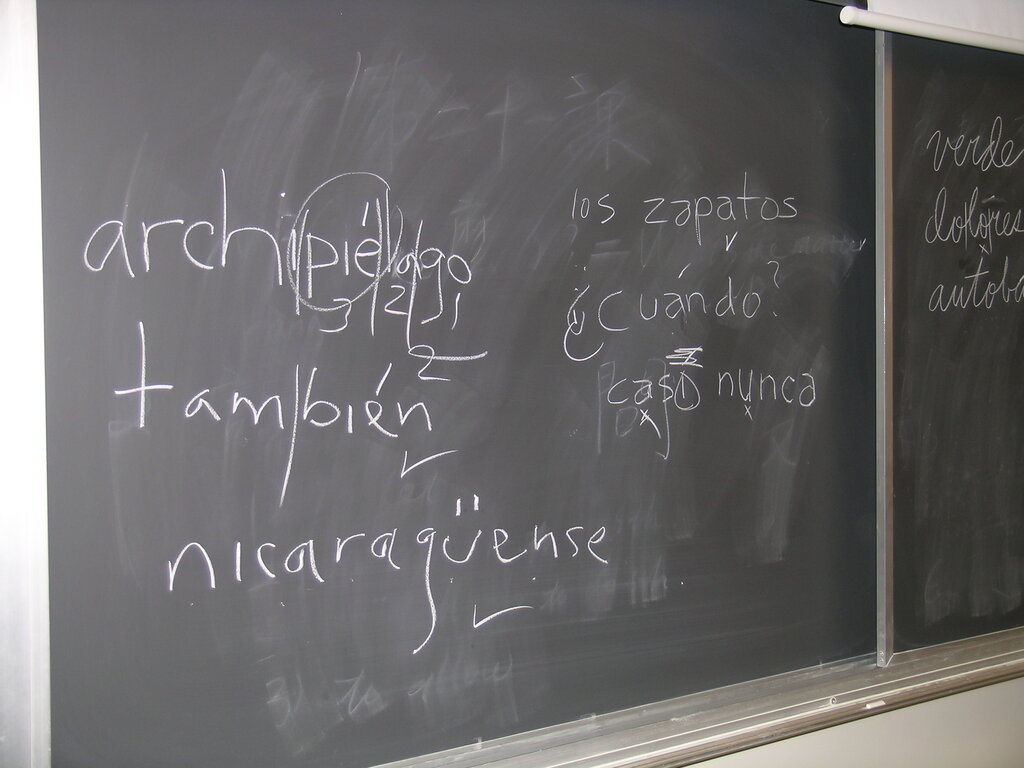
What about the exceptions? That's where accent marks (tildes) come in. An accent mark tells you to ignore the rules and stress that specific syllable. For example, café ends in a vowel, so the stress would normally be on 'ca'. The accent on the 'e' tells you to stress the final syllable instead: ca-FÉ. Similarly, árbol (tree) ends in 'l', but the accent places the stress on the first syllable: ÁR-bol.
Accent marks are extremely important to Spanish pronunciation.
As for intonation, Spanish questions often have a rising pitch at the end, similar to English. For statements, the pitch tends to fall at the end of the sentence. Listening to native speakers is the best way to get a feel for the natural rhythm and flow of the language.
Ready to test your knowledge?
True or False: Spanish vowels have multiple possible sounds depending on the letters around them, similar to English vowels.
The Spanish letter 'J' is typically pronounced like which English sound?
Consistent practice is the key to mastering these sounds. Try reading Spanish text aloud, even if you don't know all the words. Focus on applying the rules of vowels, consonants, and stress you've just learned. The more you speak, the more natural it will become.