Spanish for Family Chats
Basic Greetings
Greetings for Any Time
The first word you need is the simplest. It works anytime, anywhere, with anyone.
Hello
Think of it as your all-purpose greeting. But if you want to be more specific, you can greet someone based on the time of day, just like in English. These phrases are very common.
| Spanish Phrase | Pronunciation | English Meaning |
|---|---|---|
| Buenos días | BWE-nos DEE-as | Good morning |
| Buenas tardes | BWE-nas TAR-des | Good afternoon |
| Buenas noches | BWE-nas NO-ches | Good evening / Good night |
Notice that Buenos días uses "buenos" (masculine) while the other two use "buenas" (feminine). This is because días is a masculine noun, and tardes and noches are feminine nouns. Don't worry about the grammar for now; just memorize the phrases as they are.
After greeting someone, the natural next step is to ask how they are.
How are you?
And here’s the standard, cheerful reply:
I'm well, thank you.
Keeping it Polite
Politeness is key in any conversation. A few simple words can make a big difference. You already saw gracias in the phrase above.
Thank you
The standard reply to "gracias" is "de nada."
You're welcome
When you need to ask for something, use por favor.
Please
What if you need to apologize or get someone's attention? There are two common ways to say sorry.
Use perdón to say "excuse me" or for minor mistakes, like bumping into someone.
Excuse me / Pardon me
For a more sincere apology, use lo siento. It literally means "I feel it" and is closer to "I'm sorry."
I'm sorry
Formal vs. Informal
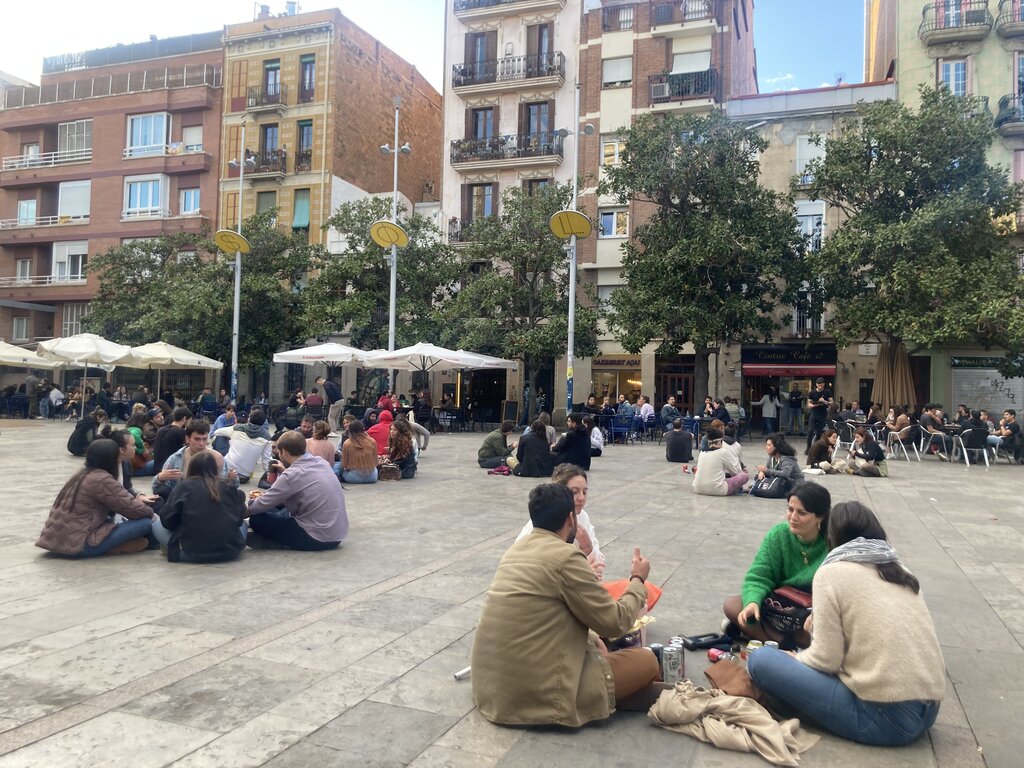
Spanish has two ways to say "you." The one you choose depends on your relationship with the person you're speaking to. This is a concept called formal and informal address.
Tú is the informal "you." You use it with people you know well, like family, friends, and children. It shows familiarity and closeness. The question we learned earlier, ¿Cómo estás?, uses the tú form.
Usted (often abbreviated as Ud.) is the formal "you." Use it to show respect to older people, people in positions of authority (like a boss or a professor), and people you've just met. It creates a polite distance.
When you use usted, the verb changes slightly. ¿Cómo estás? becomes:
How are you? (formal)
A good rule of thumb: When in doubt, use the formal usted. It's always better to be too polite than not polite enough. If the other person wants you to use the informal tú, they'll let you know.
Now let's practice what you've learned.
Ready to check your understanding?
It's 2 PM. Which is the most appropriate greeting to use?
How do you respond to "Gracias"?
With these key phrases, you're ready to start and end simple, polite conversations in Spanish.