Spanish for Beginners
Spanish Alphabet and Pronunciation
The Spanish Alphabet
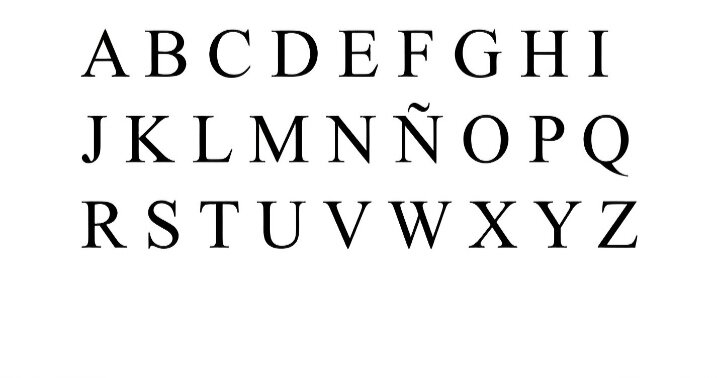
Good news: the Spanish alphabet is almost identical to the English one. Most letters look and sound familiar, which gives you a great head start. The official Spanish alphabet has 27 letters. The main difference is the addition of one special character: the 'ñ'.
Spanish pronunciation is consistent: once you learn the sounds, you’ll understand and be understood more easily.
Let's look at the full alphabet. Notice how each letter is pronounced. In Spanish, the name of the letter consistently tells you its sound.
| Letter | Name of Letter (in Spanish) |
|---|---|
| A, a | a |
| B, b | be |
| C, c | ce |
| D, d | de |
| E, e | e |
| F, f | efe |
| G, g | ge |
| H, h | hache |
| I, i | i |
| J, j | jota |
| K, k | ka |
| L, l | ele |
| M, m | eme |
| N, n | ene |
| Ñ, ñ | eñe |
| O, o | o |
| P, p | pe |
| Q, q | cu |
| R, r | ere |
| S, s | ese |
| T, t | te |
| U, u | u |
| V, v | uve |
| W, w | uve doble |
| X, x | equis |
| Y, y | i griega |
| Z, z | zeta |
The Five Simple Vowels
Unlike English, which has many vowel sounds for each letter, Spanish keeps it simple. There are only five vowel sounds, and they never change. Once you learn them, you can pronounce any Spanish word you see.
Each vowel has one, and only one, pure sound.
| Vowel | Sounds Like... | Example |
|---|---|---|
| A | the 'a' in "father" | amigo (friend) |
| E | the 'e' in "they" | elefante (elephant) |
| I | the 'ee' in "see" | si (yes) |
| O | the 'o' in "go" | hola (hello) |
| U | the 'oo' in "food" | uno (one) |
Practice saying them clearly: ah, eh, ee, oh, oo. Don't blend them together into diphthongs like in English. Keep them short and crisp.
Key Consonant Sounds
Now for the consonants. Many are just like English, but a few have specific rules or sounds you'll need to learn. Mastering these will make a huge difference in how natural you sound.
Let's break down the tricky ones.
H is always silent. Think of the 'h' in "hour." So, the word hola is pronounced "o-la."
J sounds like the English 'h'. The word jardín (garden) is pronounced "har-deen."
Ñ has a 'ny' sound, like the middle of the word "canyon." This sound is distinct and important in Spanish.
year
The letters C and G have two sounds each, depending on the vowel that follows:
- C sounds like a 'k' before 'a', 'o', and 'u' (casa, color). Before 'e' and 'i', it makes an 's' sound (cero, cine).
- G sounds like a hard 'g' (like in "go") before 'a', 'o', and 'u' (gato, gusto). Before 'e' and 'i', it makes a soft, throaty 'h' sound, similar to the Spanish J (gente, gigante).
LL and Y are pronounced like the 'y' in "yes" in most of Latin America. So calle (street) sounds like "CAH-yay."
Z sounds like an 's'. The word zapato (shoe) is pronounced "sa-PA-to."
The Rolled R
This is the sound that often gives learners the most trouble, but it's manageable with practice. Spanish has two 'r' sounds: a soft tap and a strong trill.
-
The Single R (soft tap): This sound is made when a single 'r' appears in the middle of a word, like in pero (but). It's a quick tap of the tongue against the roof of your mouth, just behind your front teeth. It sounds a lot like the 'dd' in the American English pronunciation of "ladder."
-
The Double RR (strong trill): This is the famous rolled 'r'. You hear it when you see 'rr' in a word, like perro (dog), or when a single 'r' starts a word, like rojo (red). To make this sound, you lightly press your tongue against the roof of your mouth and push air through, causing your tongue to vibrate or 'trill'.
Don't worry if you can't roll your 'r's perfectly at first. It takes time for your tongue muscles to learn the movement. The key is to relax and practice.
You've now covered the core sounds of the Spanish language. With these rules, you can look at almost any word and have a good idea of how to say it. This phonetic consistency is one of the best things about learning Spanish.
How many letters are in the official Spanish alphabet?
In the word 'gigante', how is the first 'g' pronounced?