Spanish for Beginners
Spanish Pronunciation
The Sounds of Spanish
Spanish pronunciation is refreshingly consistent. Unlike English, where letters can have many different sounds, Spanish letters almost always sound the same. Once you learn the basic sounds, you can pronounce almost any word you see. Let's start with the five simple vowels.
| Vowel | Sounds Like... | Spanish Example |
|---|---|---|
| A | the 'a' in 'father' | agua (water) |
| E | the 'e' in 'bed' | elefante (elephant) |
| I | the 'ee' in 'see' | si (yes) |
| O | the 'o' in 'go' | hola (hello) |
| U | the 'oo' in 'moon' | único (unique) |
That’s it. There are no tricky vowel combinations or silent letters to worry about. The letter u is silent after a q (like in queso, cheese) or after a g and before an e or i (like in guerra, war), unless it has two dots over it, called a diaeresis or crema, like in pingüino (penguin). In that case, you do pronounce the u.
The letter y can also act as a vowel, especially when it's by itself or at the end of a word. When it does, it sounds just like the Spanish i (ee). For example, y (and) and rey (king).
Tricky Consonants
Most Spanish consonants sound similar to their English counterparts, but a few have unique pronunciations you'll need to learn. Mastering these will make a big difference in how easily you're understood.
The letter
His always silent in Spanish. Always. Think of the wordhola(hello). You don't pronounce thehat all; it sounds likeola.
Here are the other key consonants to watch out for:
ñ
noun
A distinct letter in the Spanish alphabet that makes a 'ny' sound, similar to the sound in the English word "canyon".
j
noun
This letter produces a sound similar to the English 'h' but often a bit stronger, made from the back of the throat.
The double rr is famous for being tricky. It's a rolled 'r' sound that requires vibrating your tongue against the roof of your mouth. Think of how a cat purrs. The single r is much softer, just a quick tap of the tongue. Listen to the difference between pero (but) and perro (dog).
Finally, B and V sound exactly the same in most Spanish-speaking regions. They both make a soft 'b' sound. The word vaca (cow) and the non-existent word baca would be pronounced identically.
Where's the Stress?
One of the best things about Spanish pronunciation is that the rules for word stress are very clear. There are just two main rules to remember, plus an exception.
Rule 1: If a word ends in a vowel (a, e, i, o, u), or the consonants n or s, the stress falls on the second-to-last syllable.
- ca-sa (house)
- ha-blan (they speak)
- za-pa-tos (shoes)
Rule 2: If a word ends in any other consonant (not n or s), the stress falls on the last syllable.
- ciu-dad (city)
- co-mer (to eat)
- re-loj (clock)
What about words that don't follow these rules? Spanish uses a written accent mark, or tilde, to show you exactly where to put the stress. If you see an accent mark, that syllable gets the emphasis, no matter what letter the word ends in. For example:
música,árbol,teléfono.
The Music of Spanish
Intonation refers to the rise and fall of your voice when you speak. It's the melody of a language. Spanish intonation patterns are different from English.
In a simple declarative sentence, the pitch usually stays fairly level and then drops at the very end.
- Voy al mercado. (I'm going to the market.)
For most questions, especially simple yes/no questions, the pitch rises at the end. This signals to the listener that you're asking something.
- ¿Vas al mercado? (Are you going to the market?)
For questions that start with a question word like ¿Qué?, ¿Dónde?, or ¿Cuándo?, the pitch often starts high on the question word and then falls toward the end, similar to English.
- ¿Dónde está el mercado? (Where is the market?)
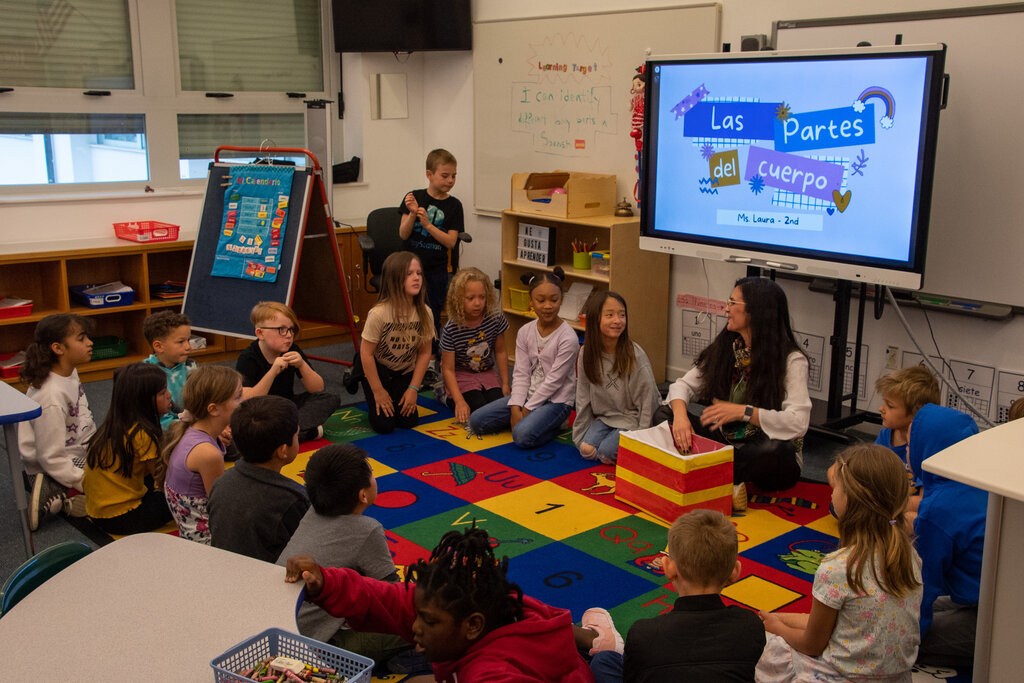
Listening to native speakers is the best way to get a feel for the natural rhythm and flow of Spanish. Pay attention to how their pitch changes in statements versus questions. Try to mimic what you hear. This is often called shadowing, and it's a great way to improve your accent.
Spanish pronunciation is straightforward thanks to consistent letter sounds and only five pure vowels; mastering the rolled r, distinguishing b and v, and mimicking native intonation helps you sound authentic.
Ready to check your understanding of these core concepts?
According to Spanish stress rules, which syllable is stressed in the word "comida" (food)?
In the Spanish word "guerra" (war), the letter 'u' is silent.
Practicing these rules will help you speak more clearly and understand others more easily. With its consistent sounds and predictable stress patterns, Spanish pronunciation is a skill you can master with a little attention and practice.